

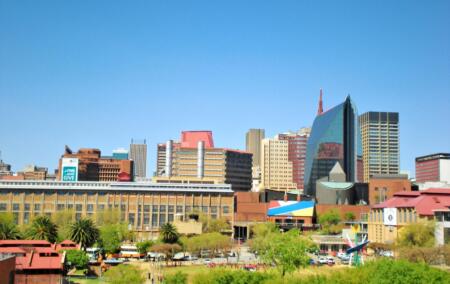
One of the things that really excites me about the potential of Helen Zille winning the Johannesburg metro mayoral race is that she is far more open to working with the private sector and not particularly tied to patronage concerns and all her incentives are directed towards making a success of JHB especially the inner city because, for the Democratic Alliance, making a success of JHB is a recipe for potential wins or at least massive voter gains.
When Joburg sneezes the rest of the country catches a cold.
This is why I think a POPS(privately owned public spaces) approach to the CBD would be an absolute gamechanger and here it is useful to explain what these are. Privately Owned Public Spaces are outdoor or indoor areas—such as plazas, parks, and atriums—that are privately owned but legally required to remain accessible to the public. In places like New York and London this allows developers to build taller and denser buildings in exchange for maintaining these public spaces, in South Africa this could be for very advantageous tax abatements.
Why is the JHB CBD well suited to this?
It might seem counter-intuitive but the city has already effectively abdicated the CBD in that streets are not reliably cleaned, lighting is inconsistent, law enforcement is stretched and informal private control by Taxi’s, gangs, rogue building owners already exists. There was a vacuum and the vacuum got filled informally and most often by some very unsavoury elements. The logic of Privately owned, public spaces already exists in the CBD, just informally. Ask anyone who has to navigate Park Station and the surrounds. A formalized POPS style arrangement between the city and private sector is actually less radical than the status quo despite what potential detractors might say. It also opens up the potential for integrating private security and police resources to make the CBD a much safer place for everyone who lives there or has to visit there. The upside in safety, amenities and housing quality and choice for especially lower middle class and working class residents(most of whom are black- it goes to the major criticisms of Zille) is astronomical.
The upside for developers is just the sheer density of the CBD and the extremely low acquisition costs(by South African and global standards). Density has built in residential demand which comes with foot traffic and demand for goods and services(retail, food, education, healthcare etc).
There are already proof of concept examples like the Maboneng, Jewel City, 44 Stanley and parts of Newtown that show the CBD works on semi-private control just informally and unevenly which cries out for the opportunity to formalize, scale and professionalize the whole thing.
How it could work
Firstly the city must see itself as an enabler and support to private led development rather than seeking to dominate the process for short term political gains. This is a long game. You don’t fix the CBD, you methodically and incrementally carve out islands of 1-3 city blocks with clear sightlines, limited entry points and residential and retail mix. These blocks should have affordable and workforce housing(Jewel City for example starts at R3 000 per month), 24/7 security and people who live there and not just pass through. Unlike a place like London, in JHB rules must be ultra visible and legitimate(where they are subtler there) ie trading zones, behaviour codes and clear boundaries but this must negotiated rather than imposed because it will meet heavy resistance and roadblocks if it does not bake the informal economy into it through allocated trader bays, proper licensing and integration of existing informal systems. JHB is not Cape Town. Trying to drive out informality is a recipe for failure.
The City must work together with the private sector so that there is formal control of infrastructure that enables 24/7 visible security(foot and static), lighting that overpowers the street(lighting is a crime deterrent when done right), cleaning crews on a visible schedule, signage that clearly defines “managed precinct” and most importantly a control room tied to cameras ala Vumacam which is accessed by both the city’s security infrastructure and private sector security.
What the City must absolutely offer the private sector for this to work is zoning flexibility, informal trader regulation support, service prioritization(Lighting, waste), political spine(cover for enforcement) and these are the things that Zille absolutely shines in and wants to do as she has already said herself.
A final truth
JHB CBD cannot be “fixed” but it can be partitioned, stabilized, monetised methodically and incrementally block by block because in all honesty that is the only viable(financially and otherwise) and scalable urban regeneration mechanism left in the CBD. Entrenched patronage, rogue building owners(like those who murdered DJ Warras), criminal networks tied to local politicians will not like it and will probably use every racial mongering weapon to obfuscate
and derail this but again, Zille has spine and FAFO( F around and find out) energy as the kids would say and is the ideal person to take them on.
Over to you Joburgers: Get out, vote and give her the mandate to lead.
[Image: https://www.flickr.com/photos/120420083@N05/13920264454]
The views of the writer are not necessarily the views of the Daily Friend or the IRR.
If you like what you have just read, supportthe Daily Friend