

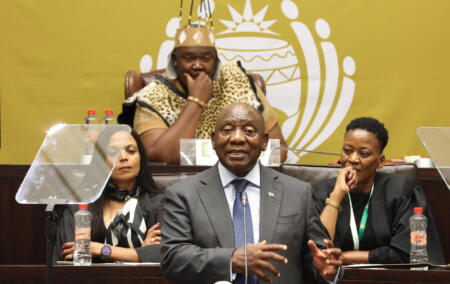
In his 2026 State of the Nation address (SONA) this evening, President Cyril Ramaphosa is expected to set out the government’s key policy objectives and deliverables for the year ahead, flag challenges and outline interventions to unlock South Africa’s potential. The President will also highlight what has been achieved since his last address in 2025.
However, his address will likely repeat the same promises made in previous SONAs and strongly contradict the reality on the ground. In his 2019 SONA, the President asserted that “…we must accelerate inclusive economic growth and create jobs”.
He further went on to say that the government “…introduced a range of measures to ignite economic activity, restore investor confidence, support employment and address the urgent challenges that affect the lives of vulnerable members of our society.”
In the 2022 SONA, he said “The key task of government is to create the conditions that will enable the private sector – both big and small – to emerge, to grow, to access new markets, to create new products, and to hire more employees. With a view to addressing these challenges we are accelerating the implementation of far-reaching structural reforms to modernise and transform these industries, unlock investment, reduce costs and increase competitiveness and growth.” 2025’s SONA added “Our most urgent task is to grow our economy so that we can create jobs, reduce poverty and improve the lives of all South Africans. To create this virtuous cycle of investment, growth and jobs, we must lift economic growth to above three percent.”
In reality, GDP growth between 2021 and 2024 amounted to just 2.1%. This is far below the emerging market levels of 5%, and even lower than the 3.5% South Africa achieved between 2001 and 2010.
In the last decade, investment as a proportion of GDP has remained around the 15% mark – half of what it should be when compared to the government’s target envisaged in the National Development Plan. Unemployment based on the expanded definition has crept up from 36.4% in 2016 to 42.9% in 2025. Excluding the pandemic years in which economic lockdowns were implemented (2020, 2021 and 2022), this is the highest level of unemployment in South Africa’s democratic history.
In terms of education outcomes, the 2019 SONA reads “… our history demands that we should improve the education system and develop the skills that we need now and into the future.” The President promised in the 2022 SONA that “…we will work harder to ensure that all learners and students get the quality education they need and deserve.” In his 2025 SONA the president said that “Central to our efforts to end poverty and to develop our economy is to provide decent, quality education to every young South African.”
Remains poor
However, the latest matric results demonstrate that the quality of education remains poor and continues to produce a workforce that is ill equipped to be absorbed into a modern economy. Only 62.8% of grade 10s become matric exam candidates in the minimum time. And only 8.6% of those candidates pass maths with 50% or more – a decline from 10.8% in 2024.
Regarding crime the 2019 SONA indicated that “Violence against women and children has reached epidemic proportions. Every day, South African women are faced with discrimination, abuse, violence and even death, often by those they are closest to. Over the last year, we have started to address this scourge in a more serious and coordinated way.” The 2022 SONA mentions the “…implementation of the National Strategic Plan on Gender-Based Violence and Femicide, and other measures to promote the empowerment of women.”
In the 2025 SONA it is stated that “We have promulgated the National Council on Gender-Based Violence and Femicide Act, establishing a national structure to oversee a coordinated response to this crisis.”
But the ‘G20 Women’s Shutdown’ suggests that the government is failing to deal with this crisis. The murder rate for women has also risen from a low of 8 incidents per 100 000 in 2015, to 11 incidents in 2025. This reflects a broader trend in rising levels of violence over the last decade and according to the latest CRA polling results, crime now features as one of the top 3 issues that voters want government to address.
The only way to address the wide range of socio-economic issues facing the country is to promote growth-inducing policies. As Makone Maja, the IRR’s Strategic Engagements Manager, writes: “Jobs flow from growth, and growth flows from investment.”
Chase capital away
SONAs year after year emphasise the necessity of investment and economic growth, yet the government continues to push for policies that chase capital away. President Ramaphosa has signed a raft of laws which will further undermine South Africa’s investment and growth potential, prominently amongst these the National Health Insurance Act, the Expropriation Act, and the Employment Equity Amendment Act, which if fully implemented, will severely damage market participation in key sectors, property rights, and labour absorption, further complicating doing business in South Africa.
As long as these harmful policies remain in place, the country is unable to improve its growth and investment performance. And unless South Africa can get growth going, the promises made in the 2026 SONA will continue to ring hollow.
[Image: https://www.flickr.com/photos/governmentza/54350425640/in/photolist-2qNL919-2qNK6sj-2qLnSKF-2qLmUE8-2qLnQAk-2qLkH3p-2qLmT4w-2qLnQwT-2qLnQxu-2qLg9E7-2qLkH1W-2qLnQwx-2qLkH1R-2qLk1iZ-2qLk1id-2qLk1gV-2qLn9bH-2qLn9aW-2qLn9b2-2qLk1gu-2qLmcGM-2qLfrNn-2qLmbvn-2qLn993-2qLn98X-2qLk1e5-2qLmbuA-2qLfrLZ-2qLmbuF-2qLiQb9-2qLiNMX-2qLhCux-2qLhCjx-2qLd4GC-2qLiNAV-2qLiPXd-2qLiPWM-2qLhCho-2qLd4FL-2qLjL8Z-2qLhCh3-2qLhCgr-2qLiNya-2qLjL8t-2qLd4Db-2qLhCeN-2qLiPUn-2qLiPU7-2qLd4Cj-2qLiNwm]
If you like what you have just read, support the Daily Friend