

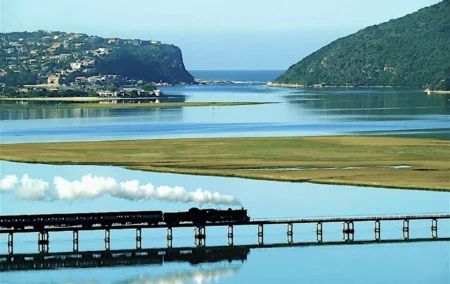
The project to return the famous steam train between George and Knysna to service has begun, but one lot are trying to put a stick in the spokes.
When what was then South African Railways (now Transnet) put an end to the steam era in 1992, only a few steam train services survived the chop. Perhaps the most famous of these was the Outeniqua Choo Tjoe, which ran the extraordinarily scenic route between George and Knysna.
From George, it meandered along the Meul river, rolled past the beach at Victoria Bay, across the bridge over the Kaaiman’s river gorge (which is now a heritage landmark), burrowed through the rock at Kaaiman’s Grotto, stopping at a railside café hidden below Dolphin’s Point, dropped down to the station in Wilderness, wound its way along the banks of Island Lake, Bo-Langvlei and Rondevlei with old-growth forest on the other side, crossed over the blackwater expanse of the Swartvlei, going on to Sedgefield station, strained its way up and back down the ridge north of Buffalo Bay, to emerge at quaint old Belvidere, and most memorably, running across a long bridge slung low over the wide river estuary, to the station in Knysna.
For years, the Choo Tjoe operated as a tourist attraction, with passenger numbers peaking at 115,000 per year (over 300 per day) in the early 2000s. It was a great tourist attraction, and featured in many of the most iconic photographs of Knysna.
The photo accompanying this article was taken by legendary Knysna photographer Ian Fleming (not to be confused with the James Bond author). Below is a photo from the Railway World Annual 1981, featuring a triple-locomotive train crossing the lagoon.
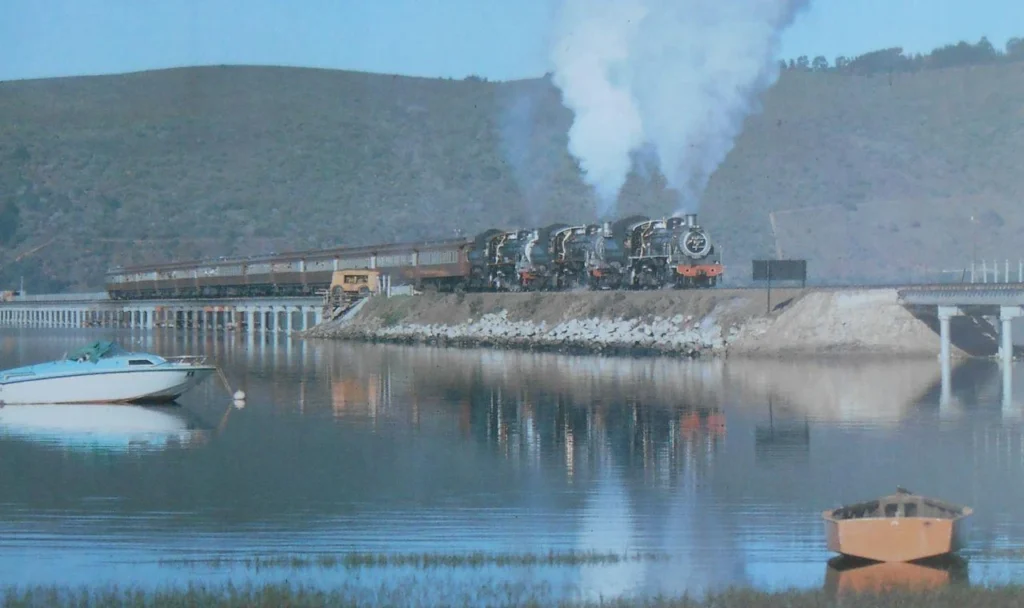
The railway line was also used to haul solid waste on a 125km trip to the Gourikwa landfill outside Mossel Bay. That trip now has to be made daily by road using Knysna’s fleet of refuse collection trucks, lest a huge pile of refuse collects in the centre of town (which happens frequently).
Rock-slide
In 2006, torrential rain caused a rockslide at Dolphin’s Point, in the Kaaiman’s River Pass (see photo below by Henry Lazenby, ca. 2015).
The damage to the line, and the relative inaccessibility of the location where it occurred, sounded the death knell for the steam train that first ran in 1928. It limped along for a few years on a route between George and Mossel Bay, but in 2010, Transnet called it quits.

The closure hit the towns along the route hard. So central was it to Garden Route’s tourism identity that many a conversation around braais, in pubs, and at local events inevitably turned to nostalgia for the steam train, and the fervent hope that someone, somehow will be able to raise the capital – and secure the necessary authorisations – to resurrect the beloved Choo Tjoe.
For years, this hope seemed vain. The damage to the line was extensive, and in the intervening years, many of the valuable yellowwood railway sleepers were stolen. Looking along the bridge over the Swartvlei, one could see the tracks simply hanging unsupported from pier to pier. The likely cost of repairing the line seemed to mount with each passing year of neglect.
Tender awarded
After many false starts, and almost 20 years of negotiations with Transnet, a private consortium, Classic Rail and Outeniqua Choo Tjoe, secured capital commitments and was awarded a 25-year concession to return the train to service on 27 October 2025.
Classic Rail has appointed specialist subcontractors for a variety of jobs, including repairing the line, surveying and if necessary repairing bridges, constructing a new turntable and workshops at Sedgefield station, restoring a number of passenger carriages, and refurbishing several Class 19D steam locomotives, of which two will be converted to burning oil for use when fire risk is high, as well as two Class 32 diesel locomotives as backup.
The consortium has started clearing encroaching vegetation and repairing the line between Sedgefield and Knysna, with the aim of resuming a train service by May this year. The second, and more challenging, phase of the project, will tackle the repairs on the Sedgefield to George stretch, where the most extensive damage occurred.
Everyone is excited, and delighted, with these developments, and can’t wait to welcome the old steam train (and perhaps a new refuse train) back to town.
Cyclists
Except some entitled cyclists. (Not all cyclists; some of my best friends are cyclists.)
There was a second bidder for the tender to claim the railway line, called the Garden Route Cycleway Association (GRCA). Unlike Classic Rail, which emerged from Friends of the Choo Tjoe, and has been negotiating to bring the steam train back for almost two decades, the GRCA was a latecomer to the party, having surfaced in 2024.
As the name implies, it had no intention whatsoever of restoring the railway or operating a steam train tourism business along the line.
Calling the abandoned line “arguably South Africa’s most precious public asset”, it proposed to convert (or rather, to have Transnet convert) the 70km corridor to into a “non-motorised transport” route for cyclists, joggers and walkers, with free, public access.
Who wants a 70km jogging or walking route? That’s just a diversion. The GRCA has mooted extending the route to Plettenberg Bay, or even to Gqeberha. That would make it a 300km route. For walkers.
Let’s be clear: the GRCA plan will benefit cyclists only, and then only some cyclists.
“Precious public asset”
How “precious public asset” squares with “free, public access” was left for the tender adjudicators to figure out. An “asset” that generates no income is not an asset at all. It is a liability.
Presumably the adjudicators figured that the cost of removing the railway tracks and paving the route, with no prospect of ever generating revenue, was rather less attractive than restoring an iconic tourist attraction with the added benefit of accommodating a refuse removal service.
The group argues that “steam trains are polluting, inefficient, slow and costly”. That is true, but entirely irrelevant, because people love steam trains.
Have you ever seen the crowds that come out to wave at steam trains? Have you seen the children jumping up and down, and clapping as the train blows its whistle?
The GRCA wants to keep the steam trains in a museum, and says if the demand for a commuter rail service in the region warrants it, “a new high-speed rail alignment will be required”.
There’s no demand for a “commuter rail service”. There’s demand for a “tourist steam train service”. That the GRCA can’t tell the difference is, well… ah, I shouldn’t be rude.
Where this proposed new high-speed railway will be located if not along the existing rail line is left as an exercise for the reader. I’m no surveyor, but carving a new railway route between George and Knysna strikes me as technically challenging, and environmentally destructive.
As for the refuse problem, the GRCA proposes that Knysna and Sedgefield use “that capital” (meaning the private capital raised to restore the steam train, to which neither it nor Transnet have any claim) to construct plastic recycling and waste-to-energy facilities.
“Permanent Public Way”
The GRCA argues that when the rail line was decommissioned, it was converted into a Permanent Public Way (which is legalese for a public road under the National Road Traffic Act). This seems absurd, as a railway line is not really all that suitable for road traffic.
According to the GRCA, because the line is now a Permanent Public Way (i.e. a road), Transnet had no right to concession the corridor, and that it should legally be considered public property in perpetuity.
If that is true, one wonders why the GRCA applied to Transnet with a proposal to construct a paved cycleway. If Transnet didn’t have the authority to make that decision, why not challenge its authority in the first place?
You can get an idea of how flimsy the GRCA proposal is by reading its meandering petition on change.org (because unlike Classic Rail, which has been keeping the public updated on its website for eight years, GRCA couldn’t even get its own website off the ground).
The GRCA is appealing to Parliament to review the tender.
Nice things
Whenever there’s some positive development that people can get excited about, there’s always some selfish lot who demand that government put a stop to it. There’s always someone demanding that government give them stuff for free. There’s always someone who is prepared to tie up promising commercial projects in legal red tape, just to delay, obstruct and frustrate development.
I’m going to go out on a limb here and guess that the cyclists don’t actually have any capital to invest in clearing the track and constructing the cycleway they claim to want. They will demand that taxpayers foot the bill for their pipe dream.
And instead of recognising that their proposal was inadequate and accepting defeat graciously, all they can do is put a stick in the spokes of the winning bidder.
This is why we can’t have nice things.
[Image: Outeniqua Choo Tjoe Fleming.webp]
Caption: The iconic stream train crosses the Knysna river tidal estuary in this photograph by legendary Knysna photographer Ian Fleming. (Source: Outeniqua Choo Tjoe.)
The views of the writer are not necessarily the views of the Daily Friend or the IRR.
If you like what you have just read, support the Daily Friend