

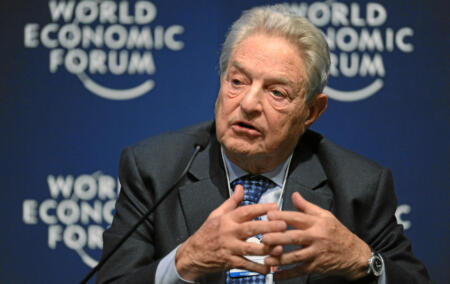
I have long been confused by the extent of rage and hatred directed at George Soros (which has flared again in both Israel/Gaza and Russia/Ukraine twitterspiracy space).
I have met a few people who have worked for one or other of his foundations, all of which seemingly do yeoman’s service for local communities. They all spoke highly of Soros and his work. But when I have asked haters what it is that he has done to attract this astonishing level of opprobrium, I never get a clear answer. More often than not, they don’t know.
A recent Facebook post attacked a local politician vying for the mayorship of a large city for having sat on the board of a Soros Foundation company. “That tells me exactly where you stand!”, said the poster with contempt. So, I set off down a few rabbit holes to trace the source of all of this hate.
Soros occupies a peculiar throne in the ugly land of conspiracy theories. He is, depending on who you ask, the puppet master behind Black Lives Matter, the financier of open-border chaos, the architect of COVID-19, the antichrist’s banker. At the peak of the 2020 protests following the murder of George Floyd, the Anti-Defamation League recorded more than 500,000 negative tweets about him in a single day. A pipe bomb was placed in his mailbox. The Hungarian government spent millions plastering his face on derisive billboards that reminded many observers of Nazi-era propaganda.
But here’s the problem – when you look at what Soros has actually done – the full record, not the social media toxin – the portrait that emerges is so far removed from the mythology that the hate itself becomes its own story.
Soros was born in Budapest in 1930. He survived the Nazi occupation that killed more than 500,000 Hungarian Jews, fled Communist Hungary in 1947, studied under philosopher Karl Popper in London, and made his fortune in finance. In 1979, having decided he had enough money, he began giving it away.
His first act of philanthropy was funding scholarships for Black students at the University of Cape Town, in apartheid South Africa.
In the 1980s he turned to Communist Eastern Europe, funding dissident movements, academic exchanges, and independent cultural institutions. By the time the Berlin Wall fell, his Open Society network had offices across the former Soviet bloc. Historians tend to underweight his role in the peaceful dissolution of Soviet communism. They probably shouldn’t.
Today the Open Society Foundations hold $23 billion in assets, operate in over 120 countries, and are the largest private funder of democracy, justice, and human rights work on earth. Soros has personally transferred more than $32 billion into the work – 64 per cent of his fortune. In 2020, Forbes named him “the most generous” giver in terms of percentage of net worth – he had given away nearly three times his current net worth. His causes have included drug policy reform, criminal justice, independent media, and higher education in countries where such things can get you killed.
The critics have two things. First, Black Wednesday, 1992, when Soros shorted sterling and made over £1 billion as the pound collapsed out of the European Exchange Rate Mechanism. The trade was legal. Soros was not alone – many institutions had identified the same problem: Britain had entered the ERM at an unsustainable rate. The British Treasury’s own papers, released later under freedom of information requests, confirmed officials had privately known the pound was mispriced. Soros did not manufacture the crisis. He identified it and bet on it. Most economists now argue the forced exit was, in the medium term, good for the British economy.
Second, a French insider trading conviction in 2002, relating to a 1988 share purchase in Société Générale. Soros had been approached about a takeover bid, declined to participate, but bought shares in several recently privatised French companies including the target bank. The law that made this illegal did not exist when he made the trade – France revised its insider trading statutes in 1990. He fought the conviction for twenty-three years, to the European Court of Human Rights. The fine was roughly €2.2 million – what he made on the transaction. That is the entirety of the legal record.
The conspiracy theories began in Russian intelligence circles in the 1980s, when the KGB correctly identified his foundation work as a direct threat to Soviet power in Eastern Europe. The response was a classic disinformation technique: invert his strengths. The man funding democratic transitions became a sinister manipulator. The Holocaust survivor became, grotesquely, a Nazi collaborator.
The conspiracy migrated westward via far-right American media, arrived in the mainstream around 2004 when Soros donated to the John Kerry campaign, and was institutionalised by Viktor Orbán in Hungary, who found it useful to have a Jewish billionaire villain to blame for the civil society institutions that were complicating his authoritarian consolidation. QAnon absorbed it wholesale. Giuliani called Soros the antichrist.
The imagery – puppet master, string-puller, destroyer of nations – is not a politically neutral criticism of a wealthy donor. It is the specific idiom of centuries of antisemitic conspiracy theory, updated with a contemporary face.
Strip away the mythology and what remains is a policy disagreement. Soros funds some so-called “progressive” causes. Conservatives disagree with many of them. That is a legitimate argument. What is not legitimate is the claim that he is actively malevolent or corrupt – that he engineers crises and seeks the destruction of Western civilisation. That claim was manufactured by hostile intelligence services, amplified by bad-faith media, and laundered into mainstream discourse so thoroughly that tens of millions of people are unknowingly repeating logic first assembled by the KGB.
George Soros is ninety-four. He has handed over the foundations to his son. The mythology no longer needs him. It is self-sustaining infrastructure now, but will no doubt still attract insult and spittle.
The story is not really about George Soros, the man. But a global PR machine cynically and successfully exploiting an age-old antisemitic libel.
[Image: https://www.flickr.com/photos/worldeconomicforum/5393262055]
The views of the writer are not necessarily the views of the Daily Friend or the IRR.
If you like what you have just read, support the Daily Friend