

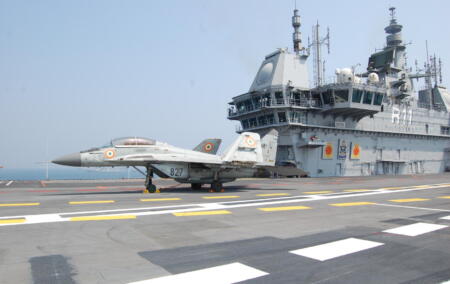
If the International Fleet Review off Visakhapatnam illustrated the reach of India’s naval diplomacy, stepping aboard INS Vikrant revealed something deeper: the strategic thinking shaping India’s maritime policy.
On the sidelines of Exercise Milan 2026, a small group of foreign defence journalists was invited aboard the carrier while it was berthed in Visakhapatnam, home of the Indian Navy’s Eastern Naval Command. At first glance the ship impresses simply by scale. Yet the real significance of Vikrant lies less in its dimensions than in what it represents.
Vikrant is the first aircraft carrier designed and built in India, and marks an important milestone in the country’s defence policy.
India has operated aircraft carriers for decades. Its other operational carrier, INS Vikramaditya, began life as the Soviet vessel Admiral Gorshkov before undergoing a major refit for Indian service. Vikrant, by contrast, was constructed domestically at the Cochin Shipyard in Kerala. It reflects a deliberate effort to build complex military platforms at home rather than depend entirely on foreign suppliers.
The programme took two decades to complete. Aircraft carriers are among the most complex platforms any navy can attempt to build, and delays were inevitable. Yet the extended timeline also allowed India’s shipbuilding industry to absorb the technical knowledge required to design and integrate such a vessel.
In that sense Vikrant is more than a warship, it is the result of a long industrial learning process.
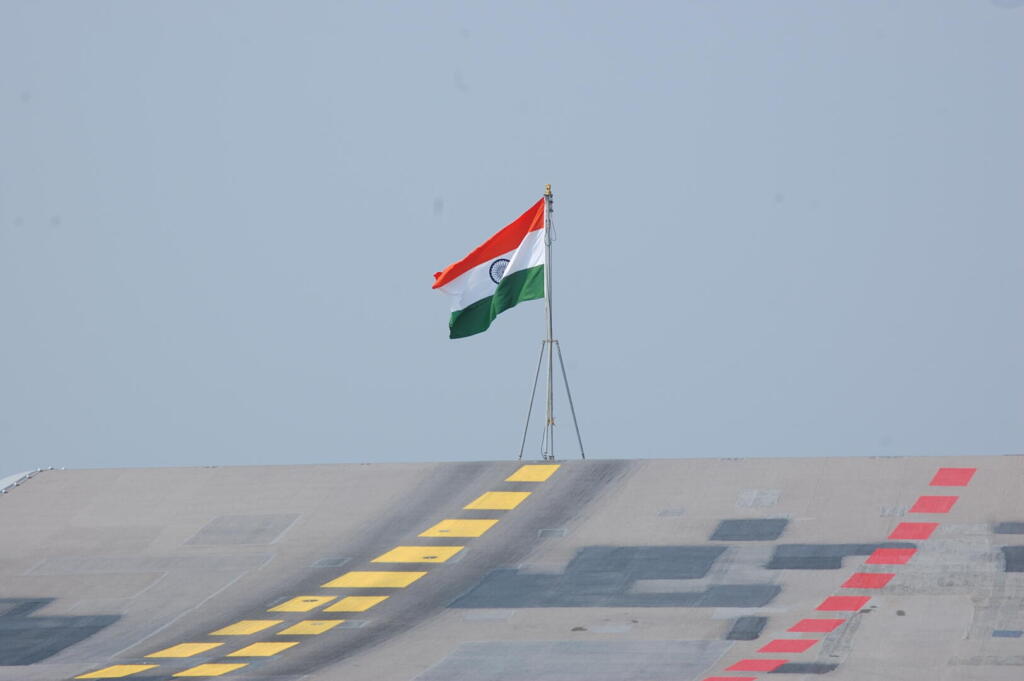
Aatmanirbharta and defence policy
The carrier sits squarely within India’s broader strategy of defence self-reliance, often described by the Hindi term Aatmanirbharta, which translates to “self-reliance”
In policy terms, Aatmanirbharta aims to reduce India’s long-term dependence on imported military equipment by strengthening domestic defence production. For decades India relied heavily on foreign suppliers, particularly the Soviet Union and later Russia, for much of its military hardware. While that ensured access to advanced systems, it also created vulnerabilities in supply chains and technology access.
The push for self-reliance seeks to address this imbalance.
Crucially, Aatmanirbharta does not imply technological isolation. Instead, it reflects a pragmatic effort to develop domestic industrial capacity while continuing to cooperate with foreign partners where necessary.
The Vikrant programme illustrates this hybrid approach clearly. Although the ship was built in India, its development relied on cooperation with several international suppliers. Italian and Israeli companies, among others, contributed key technologies and expertise.
Such partnerships allow Indian industry to absorb technical knowledge while gradually expanding indigenous capability.
This strategy has now been formalised in long-term defence planning. India’s “Defence Forces Vision 2047” roadmap places Aatmanirbharta at the centre of military transformation. By the centenary of independence in 2047, New Delhi intends to field a technologically advanced military supported by a strong domestic defence industrial base.
Maritime strategy in the Indian Ocean
India’s emphasis on naval capability is also driven by geography.
The country sits at the centre of the Indian Ocean, a maritime region through which a large share of global trade passes. Energy shipments from the Middle East to Asia move across these waters, as do major shipping routes linking Europe with the Indo-Pacific.
For India, whose economic growth depends heavily on maritime trade, protecting these sea lanes is a strategic priority.
Over the past two decades New Delhi has increasingly framed its naval policy around the idea of becoming a “net security provider” in the Indian Ocean region. This concept reflects India’s ambition to contribute actively to maritime stability while safeguarding its own economic interests.
Multinational exercises such as Milan and diplomatic gatherings such as the International Fleet Review form part of this strategy. They strengthen relationships between navies, improve interoperability and reinforce India’s position as a central actor in regional maritime cooperation.
Aircraft carriers support that broader approach. They allow naval forces to project air power far from the mainland while supporting operations across vast maritime spaces.
India’s pursuit of Aatmanirbharta is accompanied by a degree of strategic realism. Developing advanced military systems domestically is an inherently complex process.
The country’s indigenous Tejas fighter programme, for example, experienced significant delays before reaching operational maturity. Naval aviation faces similar challenges.
India is currently developing a new carrier-based fighter under the Twin Engine Deck Based Fighter programme. The aircraft is intended eventually to replace the MiG-29K fighters currently operating from Indian carriers.
At the same time New Delhi has ensured near-term capability through foreign procurement. In 2025 India signed a government-to-government agreement with France for the acquisition of 26 Rafale M carrier-based fighters for the navy.
The decision reflects a pragmatic balance. Indigenous development remains the long-term objective, but operational capability cannot be postponed indefinitely.

Lessons for South Africa
For South African observers, the visit to Vikrant raises an obvious question: what lessons, if any, can Pretoria draw from India’s approach?
The two countries differ greatly in scale. India’s defence budget and industrial base dwarf those of South Africa. Yet the principles underlying India’s strategy offer several insights.
The first is the importance of long-term policy consistency. India’s pursuit of defence self-reliance did not begin with the Vikrant programme. It has evolved gradually over decades through sustained political commitment, industrial investment and international partnerships.
South Africa once possessed a similar approach. During earlier decades the country developed a significant domestic defence industry capable of producing armoured vehicles, artillery systems and naval equipment. In recent years, however, inconsistent funding and policy uncertainty have weakened that industrial base.
India’s example suggests that rebuilding such capacity requires patience and sustained political will.
The second lesson concerns the role of industrial cooperation. India’s pursuit of Aatmanirbharta has not excluded foreign partners. Instead, it has relied heavily on partnerships that combine domestic production with international expertise.
For a country such as South Africa, whose defence industry remains technologically capable but financially constrained, similar partnerships could help sustain key capabilities while reducing reliance on imports.
India’s maritime outlook offers a reminder of the strategic importance of the oceans. South Africa occupies a critical position along the Cape Sea route, one of the world’s most important maritime corridors. Yet the country’s naval capacity has steadily declined over the past decade due to funding constraints and maintenance challenges.
The broader message
Maintaining maritime awareness and presence along these sea lanes is essential not only for national security but also for economic stability. India’s growing naval presence in the Indian Ocean underscores how seriously other states treat the strategic importance of maritime trade.
Seen against the wider backdrop of Exercise Milan and the International Fleet Review, Vikrant stands as a powerful symbol of India’s evolving maritime ambitions.
The ship demonstrates that India is not only expanding its naval capabilities but also strengthening the industrial foundations required to sustain them. Building a carrier domestically sends a clear signal about the direction of the country’s defence sector.
Modern military power depends as much on industrial capacity as it does on operational platforms. Nations able to design, build and maintain their own systems enjoy greater strategic autonomy.
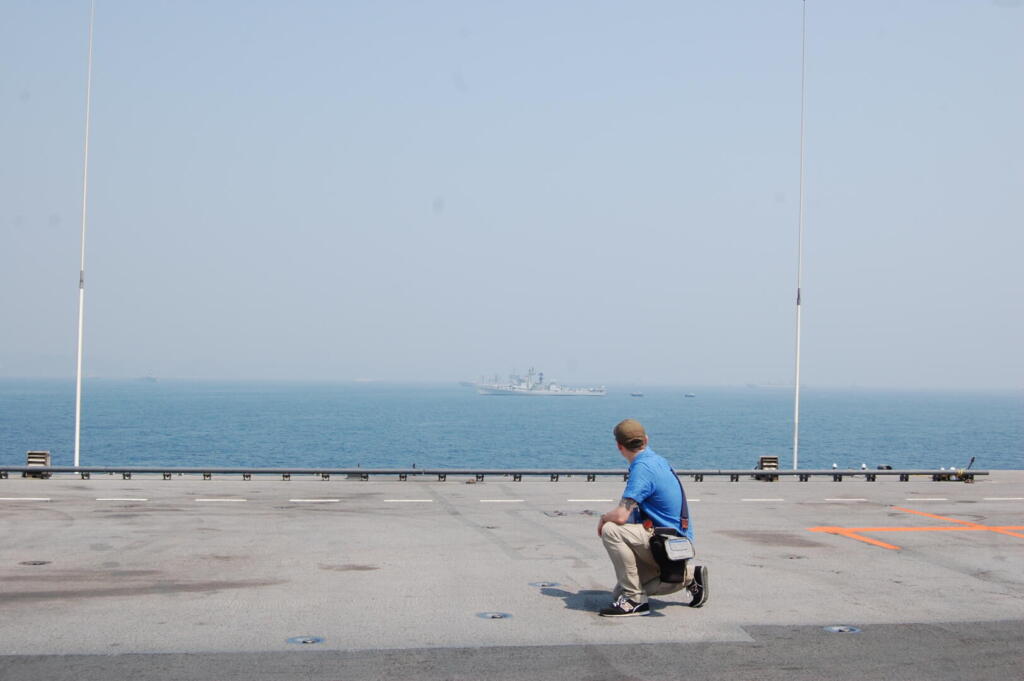
Walking across Vikrant’s flight deck, with the Bay of Bengal stretching beyond the harbour, the broader logic becomes clear.
India did not merely add another ship to its fleet; it invested in the technological and industrial base required to sustain maritime power for decades to come. Aircraft carriers alone do not define naval strength; they reveal a nation’s strategic direction.
In the case of INS Vikrant, that direction is unmistakable: India intends to combine maritime capability with Aatmanirbharta, building both the operational capacity and the industrial foundation needed to shape the future security architecture of the Indian Ocean.
[Image: Ricardo Teixeira]
If you like what you have just read, support the Daily Friend