
- Communication and Visible Progress
This could just as easily be seen as the Chris Pappas model where local government builds trust and goodwill with residents by communicating small wins via multi social media strategy(tiktok, instagram and facebook) in the form of fixed streetlights, cleaned parks and fixed roads in communities across the metro and it is important to stress that it be across the metro because there is still a depressingly thick fog of racialism that permeates how even good things are seen in South Africa. This is especially pertinent to a metro like Nelson Mandela Bay which is spatially defined in very racial terms. Updates on improvements especially to industrial areas that will facilitate business confidence and job growth with the Mayor front and central. The City of Cape Town has been incredibly effective at doing this with its mayor Geordin Hill-Lewis. This sort of high touch governance is far more impactful than any plans or projects or policies for residents who have had to endure chronically poor and uncaring governance for a quarter of a century. It will make them feel like the mayor and city leadership is working for them and to improve their lives.
- Service Delivery and Governance Fixes
This is a rather obvious point but the foundational key to unlocking Nelson Mandela Bay is making sure to do basic repairs quickly(streetlights, potholes etc), reducing service delivery backlogs and ensuring fair ward allocations in order to effectively deal with each communities issues at a granular level. I would add that prioritizing 2 to 3 critical wards(high crime + high economic potential) would help demonstrate tangible improvements more clearly and signal that city leadership intends to work for all residents. This is a key point in sidestepping shallow and baseless accusations of only catering to the “privileged” that has dogged the City of Cape Town.
- Safety and Public Order
This is another obvious and critical point but one which forms the foundation of a metro that can eventually become a regional hub for tourists who can both enjoy the metro and use it as a launchpad to explore Addo Elephant Park, Jeffrey’s Bay, St Francis, Port Alfred and other amazing cultural, nature and beach experiences the Eastern Cape has to offer. For any of this to become a reality and be an engine of job growth, people who visit Nelson Mandela Bay have to feel safer, have to see clean streets, fixed streetlights and roads without potholes. Visible police in key beach and nightlife nodes and a focus on safe business corridors around shops and light industry. I would even argue that a renewed focus on the CBD as part of the triangle around the CBD, Richmond Hill and into the St Georges Park area would yield incredible results. Nelson Mandela Bay has a unique opportunity to showcase itself during the 2027 Cricket World Cup and visitors will want not just a clean city with functioning streetlights and well paved roads but one which can be broadcast to the world with beautiful beaches and boardwalks, dense and safe nightlife and restaurants around Richmond HIll and a matchday experience around St George’s that can make this metro if it shows up well on camera with influencers and other fans and visible policing will form part of making this tapestry work.
- Rooting out Organized Crime and Political Capture
An add on to safety and public order would be to root out the extortion gangs and organized crime syndicates that are terrorizing residents in the metro. Organized crime in the metro often infiltrates tender processes(construction service contracts, waste collection), Licensing permits and municipal supply chains(procurement fraud). I believe there are 4 interconnected ways to deal with organized crime and political capture:
- Establish an independent anti-corruption unit that audits tenders, procurement and high risk municipal contracts and reports directly to council oversight committees. Ancillary to this is a public procurement portal that has online disclosure of all tenders, awarded contracts and contractors and real time and real time updates to prevent backroom deals. As part of the metro’s procurement policy, there must be a mandatory rotation of tender committees to prevent entrenched influence and patronage networks. This is just a standard anti-corruption safeguard.
- Audits must focus on high risk contracts or areas first(waste management, construction and electricity maintenance) so that crime and tender irregularities can be mapped and patterns can be used to identify “ capture hotspots” in wards, service departments and industrial zones. As far as possible a dashboard of this with clear visualizations should be developed.
- The independent anti-corruption unit should then partner with the National Prosecuting Authority(NPA), specialized units in SAPS and Asset Forfeiture Units to seize gains from corrupt networks. This is a way to coordinate and enforce and bring to book corrupt patronage networks and ensure that as much of their loot is returned to the public purse as possible.
- Procurement, payroll and service contracts must be digitized so that human discretion is minimized and as a part of that all high value contracts must require multi-level verification and high risk departments(finance, planning and infrastructure) must be subjected to regular third party audits. This is how capture resistant systems and processes can start to be built.
Conclusion:
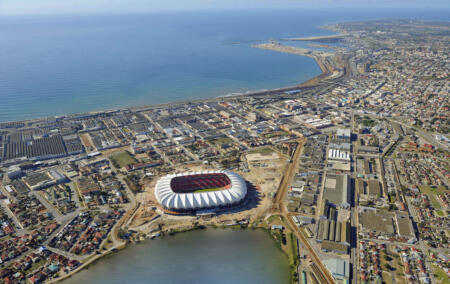
Nelson Mandela Bay has immense potential and upside. A beautiful coastline and boardwalk, an industrial base ready to fill the “missing middle” layer of South African businesses with mid sized and export oriented industrial firms that can integrate into global supply chains via the Coega SEZ and the Port of Ngqura and a metro that is primed to be a regional hub for tourism if it can show up well during the 2027 Cricket World Cup and beyond. The main difference between Nelson Mandela Bay and the Eastern Cape as a whole from the Western Cape is governance quality.
[Image: https://upload.wikimedia.org/wikipedia/commons/thumb/b/b4/Nelson_Mandela_Stadium_in_Port_Elizabeth.jpg/1920px-Nelson_Mandela_Stadium_in_Port_Elizabeth.jpg]
The views of the writer are not necessarily the views of the Daily Friend or the IRR.
If you like what you have just read, support the Daily Friend