

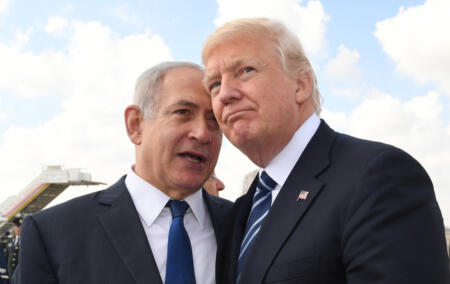
Whatever Donald Trump and Benjamin Netanyahu decide to do next in their rightful war against the Islamic regime, the West has a responsibility to the people of Iran that cannot easily be sidestepped with clever “realist” slogans.
This column was prompted by Konstantin Kisin’s recent remarks on the Free Press lamenting the apparent lack of strategy behind the present wave of US-Israeli strikes. To Kisin, the timing is odd because, in his (terribly cynical) view, the people who were meant to topple the regime were “all” killed in January 2026. He says: “they’re all dead”.
Foreign misadventures
I usually agree with Kisin on almost everything. He is a principled Western civilisationalist who champions a muscular liberalism against genuine threats. He has been scathingly critical of the “libertarian” anti-war crowd, exemplified by figures like Dave Smith, and of the broader conservative isolationist faction that reflexively opposes any American or Israeli assertiveness abroad. Kisin is by no means one of them.
Yet, on this specific question of interventionism in Iran, he shares their sincere though uncritical reservations.
The ghosts of Iraq, Afghanistan, and Libya loom large for Kisin, and he is right to have those concerns. Recent American “nation-building” adventures have ended in deprivations of liberty, debt, and often strategic blowback. This should be conceded, though understood that it is problematic to pretend that only the failures of Iraq, Afghanistan, and Libya happened, whereas the relative successes of Germany, Japan, Korea, Panama, Grenada, Kuwait, and Bosnia somehow did not.
Kisin’s caution is intellectually serious, but submitted to be overstated. His pivot from the January uprising to today’s “no plan” scepticism reveals a deeper inconsistency in the thinking of geopolitical “realists” (quite a presumptuous self-labelling).
The West bears a measure of responsibility in Iran for failing to support a popular revolt at its peak, and more particularly and historically: for exporting ideas that left ordinary Iranians disarmed and helpless.
Can’t have your cake and eat it, too
Let us be clear about the timeline, because the sequence reveals the opportunism.
The countrywide uprising erupted in late December 2025, fuelled primarily by economic collapse. By early January 2026 it had become the most serious threat to the Islamic regime since 1979. Protesters – generally secular, middle-class, educated, overwhelmingly young and urban – chanted for an end to the regime.
The mullahs responded with overwhelming violence: tens of thousands killed, hospitals raided, internet blackouts, and the Revolutionary Guard and Basij militias given free rein.
Many of those who would have formed the backbone of support for a transitional government, as Kisin rightly notes, were eliminated.
But at that moment, the dominant realist posture was hands-off: This is an Iranian problem – the people must rise up themselves, and the West should not risk “entanglement”.
No calls for arming dissidents, providing intelligence, targeted strikes to degrade the enforcers, or even diplomatic amplification of the revolt. Both Trump and Netanyahu called on Iranians to take to the streets and promised help, only for no help to be forthcoming as thousands were massacred.
Sympathy, sure. Action, none.
Now, after the US and Israel finally and rightly launched their strikes from late February onwards – thoroughly decapitating the Islamic regime’s top leadership – the realists decide to have their cake and eat it, too. There is no viable plan, they say, because the opposition figures are “all” dead.
The realists want it both ways.
They can avoid the upfront costs and risks of supporting a genuine popular revolt when it mattered most, and then retroactively declare the inevitable mess “unplanned” once events have escalated. It is akin to criticising a fire department for poor strategy after having prohibited it from sending trucks when the blaze was still more easily containable.
Supposedly principled non-interventionism, but only in theory. Blame-shifting in reality once the immense and intolerable human cost of restraint becomes obvious.
This is not intellectually honest geopolitics. It is a rhetorical sleight of hand that allows the realists to be right twice, first by staying out, and then by saying “I told you so” while Iranians pay in blood.
The realists oppose support for uprisings before they fail (which itself then guarantees failure), and then lament the failure as solid proof against action.
The “no plan” complaint only holds if we pretend the alternative – doing nothing in January – was cost-free. It was not.
The regime had already demonstrated its willingness to slaughter its way to survival. By refusing even limited support then, the West ensured the very (overstated) “vacuum” it now decries. Ethically, the bloc now has to make the best of a bad situation rather than pretend its hands are clean.
Disarmed citizenry
The deeper problem, however, is not just rhetorical inconsistency.
It is with the very Western-realist mindset that insists the people of Iran must “sort this out themselves”.
This sounds noble and democratic, by respecting the wishes of local populations, but it collapses under scrutiny when we examine the preceding realities the slogan conveniently ignores.
An armed citizenry changes the calculus of revolution. The possibility that even a single rifle might be hidden behind every window alters any regime’s willingness to send in its thugs.
It is the English Civil War, the American Revolution, the French Revolution, and the Boer Wars that Western realists have in mind when they say, “Others must sort out their own oppression”.
But the Iranian civilian population – like many around the world today in reality, not the idealistic version of reality the “realists” presume – is a disarmed one. Gun ownership in Iran is highly regulated with only some 3-7% of permit applications being approved.
This phenomenon, of a disarmed population, was not some organic outgrowth of Islamic teaching or ancient Persian thought.
It is a modern tool that tyrants from Venezuela to Iran to Zimbabwe to North Korea got from the West.
Various non-Western polities had engaged in disarmament throughout history prior to colonialism, but it is Western absolutism, the notion of the total territorial state under a romantic, supreme “general will” or nowadays “rule of law”, that distinguishes what we understand by gun control today from its ancient precursors. Arms control, like taxes, have existed as raw manifestations of power throughout history that depended fully on the state’s ability to enforce.
The West, uniquely, in a commendable attempt to regulate the exercise of raw power, turned these into avowedly legal phenomena. No longer was it merely a matter of ability – allowing civilians to scoff at the empty commands of faraway political elites – but it became a matter of public, personal, religious, and communal morality to obey these dictates.
This coincided with the Western age of the statutes, which displaced the ius commune (common law) of society with the codified, textual edicts of the elite. The statutory model was exported, directly and indirectly, all around the world through Western colonialism, and arguably its worst manifestation – the French mould of so-called “civil law” codifications – was adopted throughout the Middle East, no less in Iran.
From the West itself, the Islamic regime in Iran learned the value of a disarmed populace from 20th century experiments in totalitarian, centralised control. Neither the mullahs or the Pahlavi dynasty before them procured these sentiments from the Quran or Persian tradition – they imported and adapted it from the West’s own experience with tyranny, via the “best practice” of supposed international norms and Soviet influence on revolutionary factions.
By exporting (or at least failing to counter) the ideological toolkit of civilian disarmament, the West inadvertently helped rig the game against the very Iranians the realists say must now sort things out themselves.
If Western ideas and policies contributed to stripping Iranians of the practical means for self-liberation, then a pure “hands-off, it’s their fight” stance becomes not principled restraint, but active complicity.
You cannot sell someone a fundamentally unsound boat, watch it sink and its passengers drown, and declare with a shrug: “Swim harder”.
The West’s anti-war crowd often wants the moral high ground of non-intervention without acknowledging how its own ideological exports (good and bad) shaped the battlefield.
Wisdom of the American Founding
This brings us to the American Founding Fathers, those armed revolutionaries who shrugged off the yoke of British colonialism, whose wisdom is constantly invoked by a subset of libertarians, classical liberals, and Western conservatives in these debates.
“Avoid foreign entanglements”, they quote from George Washington’s Farewell Address and Thomas Jefferson’s First Inaugural.
Washington warned against “interweaving our destiny with that of any part of Europe” and permanent alliances. Jefferson meanwhile spoke of “peace, commerce, and honest friendship with all nations – entangling alliances with none”.
The sentiment is treated as timeless gospel. How dare we ignore these intellectual giants amidst Western civilisational collapse and the cautionary tales of Iraq and Libya?
But this thinking is profoundly discontextual.
Firstly, as a matter of principle: the Founders were warning against entanglement that could undermine America’s independent national destiny – essentially, alliances and activities that would subordinate the self-determination of the United States to the dictates of foreign conflicts. What they were not warning against – which modern realists and anti-war types implicitly attribute to them – was “American taxpayers should not have to fund foreign adventures” or “our volunteer-warriors should not have to die abroad”.
The Founders sought to preserve a new, relatively weak country’s republican soul from being remade in the fires of European wars. They were not seeking to declare “taxation is theft”.
Secondly, and perhaps more importantly: the Founders lived in a world where Western civilisation essentially filled the terms of reference of geopolitics.
The United States, a fragile republic on the edge of a vast continent, could only realistically become entangled with Britain, France, Spain, and other European great powers. These were, for all their monarchical flaws and rivalries, civilisational kin: Judeo-Christian, Enlightenment-influenced, operating (however imperfectly) from a shared rulebook of sovereignty, decorum, and honour.
In that context, “avoid foreign entanglements” made sense.
It was akin to a family saying we trust our brothers and sisters to generally behave themselves according to the standards of our civilisation, and we will not second-guess them. The British will govern Britain, the French will govern France, the Spanish will govern Spain, and we will trade and stay out of their quarrels.
The Founders were not dogmatic pacifists. They proved it with the Barbary Wars.
When North African Muslim states – Tripoli, Algiers – demanded tribute and justified piracy and enslavement on religious grounds far away from American waters, Jefferson did not counsel restraint or “it’s their corner of the world”.
He sent the US Navy.
The pirates were not Western kin. They were barbarians operating outside the civilised rulebook. The Founders acted in defence of commerce, honour, and freedom.
Apply that logic to Iran today.
The people of Iran – largely secular, middle-class, educated, westernised in culture and aspiration – have been oppressed by a non-democratic Islamic regime that they did not choose. This “government” is not an organic Persian evolution, but theocratic totalitarianism that treats Iranians as infidels to be subdued.
This terrorist regime has also inflicted direct and proxy damage on the United States and its allies for decades. To name but a few: the 1979 embassy hostage crisis, support for Hezbollah in the 1983 Beirut bombing, IEDs that killed hundreds of American troops in Iraq, attacks on shipping, the recent proxy wars against Israel, and the constant “Death to America” threat of nuclear escalation.
These are not family quarrels among Western states. This is a clash of civilisations, against a power that rejects the notion of a shared rulebook per se, no matter their rhetorical reliance on “international law”.
Uncritically transplanting the American Founders’ “no foreign entanglements” wisdom into this radically changed world is not reverence but opportunistic historical malpractice.
We no longer live in a reality of Western geopolitical omnipresence as the Founders did. To them, “foreign states” meant the great powers of Europe, which is no longer an applicable assumption.
The modern lie that all states are equal – and therefore each is interchangeable as a matter of geopolitical morality – has been institutionalised in the United Nations and other international forums. The Western bloc is now functionally a minority.
In the UN General Assembly, the Middle East, Africa, and the broader Third World bloc (which now includes various European states) outnumber the West overwhelmingly. The only reason the West can assert itself at all is the US veto in the Security Council, and its military and economic power.
Everywhere else, numbers favour the non-Western world.
The American Founding Fathers, had they confronted this reality, would not have applied their principles in a civilisational yet suicidal manner. They would have recognised that avoiding “entanglement” with barbarism is not prudence, but akin to surrender.
Their principles of liberty, responsibility, self-determination, of course remain intact. But their specific policy prescription for 1796 does not.
A responsibility
The West therefore bears a responsibility in Iran.
Not for another decade-long occupation or democracy-by-bombing fantasy. But for intelligent intervention: arming credible opposition networks, flooding the country with uncensorable means of communication, targeted degradation of the regime’s enforcers, formal recognition of alternative governments, and preparation of effective leadership in exile.
The West should do this openly and unashamedly and not hide behind silly pretexts like “weapons of mass destruction”.
As realists attempt to dominate the conversation again, it is important to remember that the West helped create the conditions – through the ideological exportation of disarmament and lawful state monopoly on force – that made self-liberation by the Iranian people nearly impossible. So the West cannot now wash its hands of the situation.
The realists’ “no plan” broadside is only coherent if we ignore how restraint in December, January, and earlier, guaranteed the mess we face now; just like nuclear North Korea today is downstream from the realists restraining General Douglas MacArthur in 1951.
The people of Iran are not abstract “others”.
We should see them as civilisational kin in aspiration, crushed by a group of terrorists that operates on a fundamentally different moral and strategic plane to what is tolerable. The American Founders confronted similar threats and acted. So should the West today – prudently, decisively, and without the self-serving “realist” retrospective that lets them be right twice while others bleed.
In Iran, the alternative to action is not “realism”. It is complicity in injustice.
[Image: https://www.flickr.com/photos/israel-mfa/34466451480]
The views of the writer are not necessarily the views of the Daily Friend or the IRR.
If you like what you have just read, support the Daily Friend