

The loss of a United States fighter over Iran has earned close attention for what it might mean about the war and the claims made by the belligerents.
Earlier yesterday, Iran claimed it had shot down a US fighter. Images of a tail fin and other debris were released by Iranian state media, accompanied by an initial claim that an advanced US F-35 and been hit by a new air defence system over central Iran and the pilot probably killed.
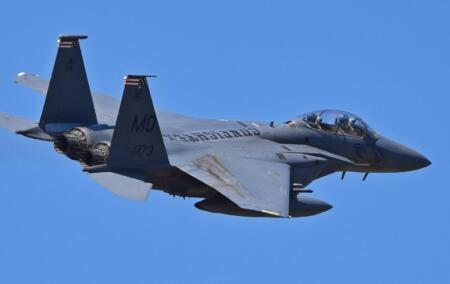
Over the next few hours, aviation experts said the wreckage pictured was in fact from a F-15E from the US Air F3orce’s 494th squadron, based at RAF Lakenheath in the UK, though it could not at first be confirmed when and where the pictures were taken.
The loss of the fighter – which prompted a frantic US search and rescue effort in the southern Kohgiluyeh and Boyer-Ahmad province for its two-strong crew, in the first such incident since the start of the war – was confirmed.
In the United States, White House Press Secretary Karoline Leavitt said economically: “The President has been briefed.”
Media were quick to seize on the import of the event, in particular that a confirmed shoot-down of a fighter jet immediately raised questions about Iran’s ability and willingness to continue the fight, and the threat it might pose to US personnel and aircraft over the country.
Equally, attention focused on repeated claims by senior US figures, including President Donald Trump and his Secretary of Defence, Pete Hegseth, that Iran’s air defence capabilities had been destroyed in the conflict.
As the BBC put it: “Hegseth and military commanders have spoken of ‘air superiority’ and how degraded Iran’s air defences are. Trump had claimed that Iran ‘can’t do a thing’ about US planes flying over its country. That rhetoric now seems over-confident. This shows that Iran still retains – albeit likely a limited and very reduced – capacity to defend its skies.”
The BBC also noted that “this comes as the US has been threatening further escalation while also talking up hopes for a deal. This could be used as fuel to accelerate that US escalation in retaliation”, and that the shooting down of the plane “may increase nerves among the American public that more US service people are being impacted by this war, at a time when the Trump administration has reportedly been mulling a potential ground invasion – which would increase the risk to US personnel significantly”.
Within hours, in a turn of events that will have heartened Washington, US officials were able to confirm that one crew member from the downed fighter had been rescued.
CBS News, which reported the rescue, said it was “not known how many crew members were on board”.
In Iran, a quite different narrative was playing out.
Yadollah Rahmani, the governor of the southern Kohgiluyeh and Boyer-Ahmad province, where the fighter came down, was reported as saying that the priority was “capturing” any downed US crew “alive”.
“Those who succeed in capturing or killing hostile enemy forces will be specially commended by the Governor’s office,” Rahmani added, according to a report by the ISNA news agency.
Iranian outlets said a reward of 10 billion tomans (around £50,000) had been set by traders of the province for anyone who found the American “intruder”.
And – evidently before it was confirmed that the US had rescued at least one crew member – Iranian parliament speaker Mohammad Bagher Ghalibaf mocked the US on X.
A post on his account read: “After defeating Iran 37 times in a row, this brilliant no-strategy war they started has now been downgraded from ‘regime change’ to ‘Hey! Can anyone find our pilots? Please?’.”
Ghalibaf also sarcastically posted, “Wow. What incredible progress. Absolute geniuses.”
Some unconfirmed reports suggested that the Trump administration had been considering Ghalibaf as a potential partner and possibly even a future leader.
Sources: The Guardian, BBC
[Image: https://www.flickr.com/photos/ajw1970/49992907296]