

There is a disconnect between the meaning of “peace through strength” and how US President Donald Trump appears to interpret it.
“Peace through strength” is one of Trump’s campaign promises.
Critics have denounced this slogan, and its justification of high levels of spending on military power, as akin to George Orwell’s “doublethink” slogans in 1984: “War is Peace. Freedom is Slavery. Ignorance is Strength.”
They quote Martin Luther King: “A nation that continues year after year to spend more money on military defense than on programs of social uplift is approaching spiritual doom.”
The White House frequently refers to “peace through strength”, such as in this statement from February 2026: “Through bold actions rooted in Peace Through Strength, President Trump has ended conflicts, dismantled threats, and rebuilt U.S. military dominance, making the world safer for Americans and restoring respect for the United States on the global stage.”
It continues: “President Trump’s America First approach has not only deterred adversaries, but also forged new partnerships — making the world safer and America more secure.”
The website of the US Department of War (formerly the Department of Defense), reads: “From defending America’s borders and fighting drug trafficking to changes in culture and business operations to better build the nation’s arsenal of freedom, President Donald J. Trump and Secretary of War Pete Hegseth are ushering in a new era characterized by peace through strength.”
New era?
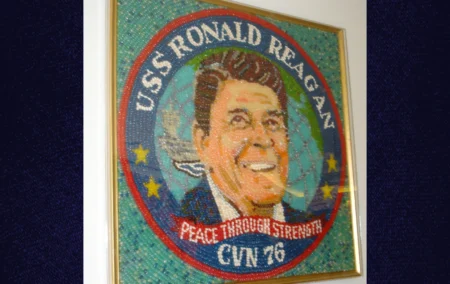
Yet this doesn’t usher in a new era at all. “Peace through strength” has been part of the Republican Party’s platform in every election since 1980, when Ronald Reagan ran on this slogan.
Here’s the Gipper himself, explaining it: “Since the dawn of the atomic age, we’ve sought to reduce the risk of war by maintaining a strong deterrent and by seeking genuine arms control. Deterrence means simply this: making sure any adversary who thinks about attacking the United States or our allies or our vital interests concludes that the risks to him outweigh any potential gains. Once he understands that, he won’t attack. We maintain the peace through our strength. Weakness only invites aggression.”
Its origin in modern American politics can be traced back to Barry Goldwater in 1964, and before him, to Bernard Baruch, an advisor to US presidents on industrial mobilisation during both World Wars.
Morris V. Rosenbloom’s 1952 book about Baruch was entitled Peace through Strength. Baruch argued for strengthening military-industrial capacity, saying, “If we spend a little too much money we can recover; if we lose our freedom we can never recover it.”
Ultimately, it goes back to the ancients. “Let him who desires peace prepare for war,” wrote Vegetius in the 4th century. Other writers attribute a similar policy to the Emperor Hadrian.
Distrust government
As a libertarian-leaning classical liberal, I distrust the exercise of government power as a matter of principle.
If I don’t trust governments to be competent or efficient at producing deliverables that the market ought to provide instead, why would I trust them to be any better at national defence, or worse, at making war?
Military spending is notoriously wasteful. Military campaigns are ruinously expensive. Governments are infamously quick to manufacture conflict in order to bolster their power, enrich their military-industrial cronies, and keep the masses cowed.
As H.L. Mencken wrote: “The whole aim of practical politics is to keep the populace alarmed (and hence clamorous to be led to safety) by menacing it with an endless series of hobgoblins, all of them imaginary.”
And that’s to say nothing of the moral qualms any sane human being should have about the devastation in lives and livelihoods caused by wars.
Yet despite this instinct, which is deeply rooted in the belief in individual liberty, and despite my hippie sympathies in my distant youth, I’m inclined to agree more with Ronald Ray-Gun, than with peaceniks like MLK.
Military power, and the industrial strength and economic prosperity that pays for it, does deter aggression. Investing in deterrence seems to me preferable to the alternative: being vulnerable to, and unable to prevent, the breakout of war.
Even if war doesn’t cost a people their freedom, which is what Baruch feared, it surely costs them a lot in treasure, and more importantly, in blood.
So, consider me a fan of “peace through strength”.
Discomfort
Why, then, my discomfort with the use of this phrase by the Trump administration?
When Trump promised to be the “Peace President”, who unlike his rivals would not get the US embroiled in more wars in the Middle East, I thought that was a pretty good policy.
The US has a poor record in the region. It has paid a great price over the years for campaigns that have had dubious, if any, long-term benefits.
Sure, the tyrannical Saddam Hussein is dead, but his overthrow spawned the Islamic State. Sure, the Taliban was overthrown, but 20 years later, when Trump announced the withdrawal from Afghanistan, the Taliban was back in power.
Trump did very well to mediate the Abraham Accords, which normalised diplomatic relations between Israel and a growing number of Arab states, starting with the UAE and Bahrain, but drawing in former enemies from across the entire Middle East and North Africa.
Yet his approach to Iran has been anything but diplomatic, anything but measured, and anything but strategically shrewd. After tossing out the deal with Iran made by his predecessor, Barack Obama, on the grounds that it unfroze seized Iranian funds, the president who claimed to end wars, not start them, and claimed to be the great negotiator, failed to make a deal with Iran.
Instead, he was drawn into a war, reportedly influenced both by Israeli prime minister Benjamin Netanyahu (according to New York Times reporting that suggests major leaks at the highest levels in Trump’s administration), and by his heavily conflicted envoy son-in-law, Jared Kushner.
Unhinged
As the war escalated, the messaging from the Trump administration became increasingly shrill and inconsistent.
In what may be a first for a sitting US president, Trump decided that swearing might earn him some respect, posting on Easter Sunday: “Tuesday will be Power Plant Day, and Bridge Day, all wrapped up in one, in Iran. There will be nothing like it!!! Open the Fuckin’ Strait, you crazy bastards, or you’ll be living in Hell – JUST WATCH! Praise be to Allah. President DONALD J. TRUMP.”
(Imagine if Obama had ever tweeted “Praise be to Allah”!)
To blunt the impact of the closure of the Strait of Hormuz, Trump ordered that certain Russian and Iranian oil stocks were to be exempted from sanctions (so much for not letting Iran have any money; it is earning more from oil today than it was before the war started).
He keeps telling the world that re-opening the Strait of Hormuz is easy, yet for weeks he has refused to send the strongest navy in the world into the “kill box” to do so. (Or his military commanders refused to obey his orders to do it.)
Weakness
These are not the actions of a strong power. These are the actions of a weak power, at its wits’ end.
If the US had been perceived as strong, Iran would surely have capitulated long ago, as Trump expected it to do within days of the start of the war.
Two weeks ago, the US submitted a “15-point ceasefire plan” to Iran, which fell on deaf ears. That plan reportedly “contains terms including the dismantling of all existing Iranian nuclear capabilities, a commitment that Iran will discontinue efforts to obtain nuclear weapons, and a requirement that any already enriched uranium be moved out of Iran.”
In response to Trump’s expletive-laden outburst on Sunday, Iran, through Pakistani intermediaries, submitted a “10-point ceasefire plan” on Monday.
That plan reportedly contradicts several points in the US 15-point plan, notably demanding that the US recognise Iran’s right to enrich uranium, lifts all sanctions, permits Iran to levy tolls on ships passing through Hormuz, and undertakes to cease all hostilities.
It is a great deal more favourable to Iran than its pre-war conditions were.
On Tuesday, Trump went postal: “A whole civilization will die tonight, never to be brought back again.”
Proposing genocide cannot be written off as mere bluster. This is unhinged brinkmanship taken to its most dangerous extremes. (For the record, and in case it needs spelling out, I support regime change in Iran, not the destruction of Iranian civilisation.)
In response to Trump’s deranged threat, Iran severed all channels of communication with the US.
About-turn
Ninety minutes before the Tuesday night deadline Trump had set, he caved. He did an about-turn and accepted that the 10-point plan from Iran that had already been on the table on Monday as offering “a workable basis on which to negotiate”.
He announced a two-week ceasefire. Why the plan wasn’t acceptable on Monday, but was good enough for a ceasefire by Tuesday evening, is left as an exercise for the ardent Trump supporter.
Trump keeps setting deadlines and making ultimatums. Iran keeps refusing to make a deal. Trump keeps chickening out, as the Wall Street phrase goes, giving Iran more time because, supposedly, negotiations are progressing well. Iran keeps denying that they’re in negotiations at all, and if they were, they wouldn’t accept any of Trump’s terms.
Strength
A man who threatens to destroy civilisations is not a strong man.
Strength is when you walk into a room, put a deal on the table, and convince the other party by your mere presence to agree. Iran did not do that.
Iran ignored the proposal for two weeks, and eventually made a counter-proposal that directly conflicted with the US terms on several major points. Then it held out in the face of Trump’s apocalyptic threats until he was forced to admit that he was bluffing, and accepted the counter-proposal as “a workable basis on which to negotiate”.
If you have to hold a gun to someone’s head in order to “make a deal”, that displays not strength, but weakness. If you have to take innocent civilians hostage to “make a deal”, that displays not strength, but evil. If you do all that, and then surrender to further negotiations anyway, you’re not just weak and evil, but pathetic.
One of the Kardashians (surprisingly, perhaps) wrote an excellent psychological profile of Donald Trump. You can read it here.
Pattern
Trump seems to think of “strength” as the power to make threats, and to use those threats to extort concessions.
His entire tariff war has been one long series of threats and pull-backs, to force other countries – including America’s closest allies – to bow to his will (not to mention manipulating markets so his family and friends can make millions).
The tariff war didn’t earn Trump respect for America’s strength. It is where the insult Trump Always Chickens Out (TACO) originated.
In Venezuela, the Trump administration sent in special forces to take out Nicolás Maduro, only to install his equally socialist, equally authoritarian deputy, Delcy Rodriguez, in his place, forcing her to ship oil to the US lest the same fate befall her.
That is not an intervention in the interest of freedom and democracy. It is the action of a gangster extorting a rival gang.
Buoyed by that success, perhaps, he thought a little “shock and awe” would be enough to topple the Iranian regime. It wasn’t.
Resisting the Great Satan (and the Little Satan, Israel) is a war of destiny for Iran. The legitimacy of the Islamic Revolution depends upon resisting America, to the death if need be. No amount of sabre-rattling, or bombing, is likely to change that.
Using vs having
Trump is trying to demonstrate America’s power by using its strength, against adversaries and allies alike.
He claims that this is earning the US greatness, respect, and even admiration.
Nothing could be further from the truth. America’s readiness to threaten anyone – even its allies, and even civilians – is making it look reckless, untrustworthy and violent. Its habit of making empty threats is eroding respect for the US.
To maintain the appearance of having “destroyed 100% of Iran’s Military capability” (which he announced more than three weeks ago), the US has been burning through its stock of missiles at an alarming rate.
China and Russia are watching closely. An America that not only acts weak, but is also low on critical weaponry, really is weak.
If Xi Jinping decided now would be a good time to reunify China, would you back America to be able to defend Taiwan?
If Vladimir Putin decided now would be a good time to reconquer the Baltic states, would you think the US ready to repel Russia from NATO territory?
Deterring aggression
There’s a difference between deterring aggression by having strength, and imposing one’s will by using strength. The latter depletes both actual and perceived strength.
Acting as an aggressor, whether in trade or in war, undermines the claim to value strong alliances and a secure peace.
Peace through strength comes from having strength. Trump’s policy is to use America’s strength; to squander it. They are not the same thing.
[Image: A patch made from Ronald Reagan’s favourite sweets, jelly bellies, features the motto of the aircraft carrier USS Ronald Reagan, “peace through strength”, Mike Renlund, licensed under CC BY 2.0. Background designed by Asmaarzqused under free licence]
The views of the writer are not necessarily the views of the Daily Friend or the IRR.
If you like what you have just read, support the Daily Friend