

Does the fall of Viktor Orbán after 16 years of authoritarian rule signal the end of illiberal nationalism? Probably not.
The landslide victory of Peter Magyar’s Tisza party over the ruling Fidesz party of Hungarian strongman Viktor Orbán is being celebrated around the world as if right-wing populism itself has been toppled.
Hungary’s voters came out in record numbers to deliver a humiliating thrashing to Orbán, and by implication to his closest allies, Vladimir Putin and Donald Trump. But Péter Magyar should not be seen as some liberal reformer. He is not.
US election interference
Both America and Russia played prominent parts in the build-up to last Sunday’s national election in Hungary.
The MAGA movement has long viewed Hungary as a model of post-liberal conservative nationalism, and Orbán has been a strong supporter of Donald Trump. He has also been a strong ally of the US in its campaign against what it sees as the weakness and wokeness that supposedly threatens European civilisation.
Trump repeatedly expressed wholehearted support for Orbán. Last week, Trump dispatched his vice president, JD Vance, to Budapest, to campaign for Orbán.
Speaking on the same podium immediately after Orbán himself, Vance started his speech by dialling up Trump. In the obseqious fashion we’ve come to expect from the Don’s minions, he said: “Mr. President, you are on with about 5,000 Hungarian patriots and I think they love you even more than they love Viktor Orbán.”
Trump repeated his endorsement of Orbán, and lauded him because “he didn’t allow people to storm … and invade [Hungary] like other people have and ruined their countries, frankly.”
Vance painted progressive bureaucrats in Brussels as Hungary’s biggest enemy, and without a trace of irony, accused the EU of “one of the worst examples of election interference I have ever seen or ever even read about” and of “trying to destroy the economy of Hungary”.
A day later, Vance said that he did “find it darkly ironic that people are accusing me of engaging in some kind of foreign influence”… and added that the United States would never threaten its friends in the same way the EU has threatened Hungary, because the US, he said, respects their “democratic will”.
(One wonders what America’s one-time allies make of that claim, in light of the tariffs the US routinely levies as “leverage”.)
Russian election interference
The prize for “worst examples of election interference”, however, should probably go to Vladimir Putin (who else?)
Hungary has long acted as an agent for Russia inside the EU and NATO. Its foreign minister allegedly maintained back-channel contacts with Moscow during confidential European meetings – a practice which Magyar described as “treason”. (In true Orbán fashion, the investigative reporter who broke the story has been charged with espionage.)
Hungary has also held a strong line within NATO against its expansion to new members, and especially against permitting Ukraine to join. It blocked Sweden’s accession for years.
Within the EU, it blocked a €90 billion aid package to Ukraine among other attempts to frustrate European support for the beleaguered country in its defence against its illegal invasion by Russia. It maintained a pro-Russian position on several other European issues.
Concerned about their Hungarian ally’s slide in the polls, Russia’s intelligence services proposed what they called “the Gamechanger”: staging an assassination attempt on Orbán. (What could have given them that idea?)
After the exposure of this plot, Orbán tried to regain the initiative by reporting that explosives had been found near a major pipeline carrying Russian gas into Hungary via Serbia. It was widely believed to be a “false flag” operation.
To be fair to Russia, it used more traditional methods to influence the Hungarian election, too.
It reportedly sent election fixers to Budapest, to run vote-buying programmes, troll farms and influence campaigns. It leaked a phone call in which Orbán offered to be a “mouse”, assisting the “lion” of Russia “in any way I can”. It spread disinformation attacking Magyar with the false claim that he would reinstitute mandatory military conscription.
Putin also publicly endorsed Orbán, echoing Trump and Vance’s anti-immigration reasons: that Hungary represented “political forces based on national interest and orientation” and that “the majority of Hungarians want to remain Hungarian”.
Rejecting populism?
That Orbán’s defeat is an embarrassing blow to both Trump and Putin is clear. The question is whether it is more than that.
Parts of the media, along with Democrats in the US, are portraying this as a sign that MAGA-influenced right-wing populism is being rejected by voters.
“Orban’s fate is a warning not to get too close to Trump,” wrote European expert David Broder for the New York Times, from Hungary.
“In blow to MAGA, Europe’s ‘Trump before Trump’ loses in Hungary,” headlined Newsweek, referring to a description of Orbán coined by early MAGA architect, Steve Bannon.
The magazine’s senior defence reporter, Ellie Cook, wrote: “Orbán’s self-declared ‘illiberal democracy,’ a term that has become shorthand for a democratic state with fragile liberal principles like weakened independent media and courts, has long been a model for Trump’s own Make America Great Again (MAGA) program.”
The election delivered “an important victory for democracy and accountability,” wrote Matthew Sussex, an adjunct associate professor at Australian National University in The Conversation.
“Pay attention, Donald Trump. Wannabe dictators wear out their welcome,” Senate Minority Leader Chuck Schumer said, according to Reuters.
The same report quotes the Congressional Minority Leader, Hakeem Jeffries, saying “Far-right authoritarian Viktor Orbán has lost the election. Trump sycophants and MAGA extremists in Congress are up next in November.”
Why Orbán lost
Contrary to what Trump claimed, Orbán does not have “a proven track record of delivering phenomenal results”.
On the contrary. Hungary’s economy shrank by 0.9% in 2023, grew only 0.5% in 2024, and 2025 figures are projected to come in at a mere 0.4%. Its budget deficit is 4.6% and rising. By some metrics, such as household consumption, which stands at only 72% of the EU average, Hungary has become the poorest country on the continent.
Low fertility combined with a staunch anti-immigration stance has produced a shrinking population. The rate at which the population declined accelerated after Orbán took power, decreasing from 10 million in 2010 to 9.56 million in 2024.
Consequently, the country grappled with labour shortages in many industries, and notably in the health sector, as thousands of doctors emigrated in search of better pay elsewhere in Europe.
The problem of a shrinking labour force is one common to most developed countries, and poses a major threat to future economic growth and the ability of the fiscus to sustain social services and public pensions.
Under Orbán, Hungary was also consistently ranked the most corrupt nation in Europe. The elite affiliated with his party, Fidesz, were shielded by his authoritarian power-grab.
He constructed what he called an “illiberal democracy”. In 2020, the Hungarian parliament voted 137 to 53 in favour of legislation creating a state of emergency without a time limit, granting Orbán the ability to rule by decree, and suspending by-elections. Orbán rewrote the constitution, packed the courts, and subordinated the press. He transformed Hungary’s public media into a mouthpiece for his party.
Biggest mistake
The Fidesz government’s biggest mistake came in 2024, when the country’s president, Katalin Novák, secretly pardoned a man convicted of helping cover up systematic child sexual abuse at a state-run orphanage. This made a mockery of the Orbán government’s public defence of Christian family values. Although the president and Judit Varga, the justice minister who certified the pardon, both resigned, the stink clung to the Orbán regime.
This was a turning point. Varga’s ex-husband was Péter Magyar. A member of Fidesz, he resigned and gave an explosive interview that reached millions of people. In it, he described the Orbán government as a “political facade” designed to protect the corrupt establishment. He founded Tisza, and rapidly amassed support.
Magyar called the Fidesz regime a “kleptocracy”, and mocked former gas fitter Lőrinc Mészáros, a childhood friend of Orbán’s who had become Hungary’s richest man, almost exclusively off public contracts, and who had built an entire zoo adjacent to his mansion.
He also ran on the inappropriateness (and even treason) of Orbán’s close relationship with Putin. He held that Hungary was better served as a member of the EU, receiving EU funding, than being cast out as a patsy of Russia.
Who is Magyar?
Amid the elation of the ouster of the man who built Hungary’s system of illiberal democracy, gerrymandered elections, co-opted media houses, rewritten constitution, and corrupt patronage funding, many observers forget where Magyar came from, and what he stands for.
He is a former member of the ruling party, whose main issues with Fidesz and Orbán were corruption, unwise hostility to Europe, and embarrassing subservience to Putin.
He is still a nationalist conservative, however, and is even more hostile to immigration than Orbán was. He is not in the right-wing populist mold, but he is not a liberal, either. It isn’t clear how he proposes to resolve the population collapse that faces Hungary.
On the plus side, he promised to restore the rule of law, rebuild democratic checks and balances including term limits for prime ministers, and implement strong anti-corruption measures. He is also firmly pro-Europe, and has promised that under his leadership, Hungary would join the eurozone (the currency union) by 2030.
Under Orbán, Hungary was too close to both Trump and Putin. (That this is even possible says a lot about the priorities of the US government.)
Under Magyar, Hungary will reassert itself as a European country that respects the democratic rules appropriate to EU, NATO, and eventually eurozone, membership. This is a blow to both the US and Russia, and Ukraine will likely benefit significantly from this election result.
Hungary’s vote was a vote against corruption, and against subservience to the US and Russia. It was a vote for accountability, and for Europe.
It was not a vote against right-wing politics, however. Magyar’s party will remain, at best, a nationalist centre-right party.
That this is a significant improvement is not in doubt, but it is not a wholesale repudiation of MAGA-style xenophobic nationalism and illiberalism. It is a victory for the rule of law and democratic accountability, but a victory for classical liberal principles more generally, it was not.
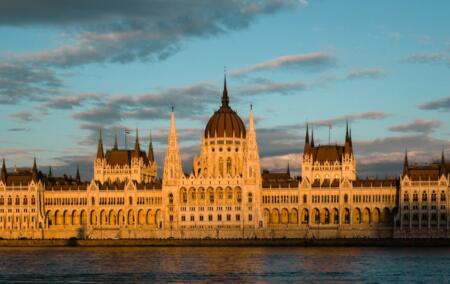
[Image: A setting sun illuminates Hungary’s Parliament building on the east bank of the Danube river in Budapest. Photo used under CC0 public domain licence]
The views of the writers are not necessarily the views of the Daily Friend or the IRR.
If you like what you have just read, support the Daily Friend