

The Brent crude oil price closed yesterday at $90 per barrel – down nearly 10% – at Iran’s announcement that it was opening the Strait of Hormuz, underscoring the route’s vital importance to world economic fortunes.
However, crude oil remains far above its pre-war level. Before the conflict, Brent crude was trading at just below $70 a barrel. It rose above $100 in early March and peaked at more than $119 later that month.
Shipping operators remain cautious about the conditions in the region. Furthermore, the damage to infrastructure in the region means energy production, such as that of liquid gas in Qatar, could take years to fully recover.
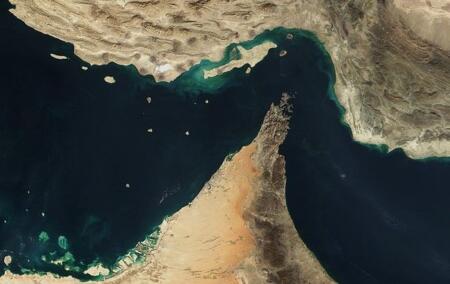
Roughly 20% of the world’s oil and natural liquefied gas passes through the strait. Bounded to the north by Iran and to the south by Oman and the United Arab Emirates (UAE), the corridor – only about 50km wide at its entrance and exit, and about 33km wide at its narrowest point – connects the Gulf with the Arabian Sea.
Iran’s foreign minister Abbas Araghchi announced in a post on X yesterday that “passage for all commercial vessels through strait of Hormuz is declared completely open for the remaining period of ceasefire”.
The passage through the strait would follow the coordinated route announced by Iran’s the Ports and Maritime Organisation.
The statement came as a new 10-day truce in Lebanon entered its first full day, partly pausing fighting between Israel and the Iran-backed Hezbollah Islamist militant movement.
The Guardian reports that Araghchi’s pledge “was given only qualified support by the Islamic Revolutionary Guard Corps, which has reinforced its already powerful authority in Tehran during the war”.
In post on Truth Social, written in capitals, US President Donald Trump said the Strait of Hormuz is “COMPLETELY OPEN AND READY FOR BUSINESS”. He went on: “BUT THE NAVAL BLOCKADE WILL REMAIN IN FULL FORCE AND EFFECT AS IT PERTAINS TO IRAN, ONLY, UNTIL SUCH TIME AS OUR TRANSACTION WITH IRAN IS 100% COMPLETE.
“THIS PROCESS SHOULD GO VERY QUICKLY IN THAT MOST OF THE POINTS ARE ALREADY NEGOTIATED. THANK YOU FOR YOUR ATTENTION TO THIS MATTER! PRESIDENT DONALD J. TRUMP”.
A related topic concerns Iran’s nuclear materials.
Trump gave a range of interviews yesterday in which he told CBS News that Iran had “agreed to everything”, including the removal of nuclear materials from the country; told Agence France-Presse that there were “no sticking points” left in the peace negotiations with Iran and that an agreement in writing was “very close”; told Bloomberg that Tehran had agreed to suspend its nuclear programme indefinitely without receiving any frozen funds from the US in exchange; is reported to have told NewsNation that Iran had agreed to stop enriching uranium; told Reuters that Iran had agreed to allow the US to enter its territory to collect enriched uranium, saying “[w]e’re going to go in with Iran, at a nice leisurely pace, and go down and start excavating with big machinery … [and] bring it back to the United States”; and told Axios that negotiators might meet again this weekend to finalise a deal to end the war (with the news outlet also citing unnamed US officials as saying that Iran was requesting the release of $20 billion of frozen funds in exchange for enriched uranium.
To this last point, the White House said: “Only announcements from President Trump or the White House — not anonymous sources — should be taken as fact. Productive conversations with Iran continue, but we will not negotiate via the press.”
Meanwhile, in Tehran, Foreign Ministry spokesperson Esmail Baghaei is quoted as saying on TV state media in Iran that “the transfer of uranium to the US has not been presented as an option. Iran’s enriched uranium is as sacred to us as the soil of Iran and will under no circumstances be transferred anywhere”.
Sources: BBC, Reuters, Bloomberg, The Guardian
[Image: https://www.flickr.com/photos/48722974@N07/5301246446]