

Modern politics has abandoned the basic civility of recognising the humanity of all people. We will come to regret this.
“Some of you have travelled far, and suffered much, pursuing freedom for your country. Some of you have ended up adopting strategies and supporting ideologies which some of us have difficulty in supporting or understanding, but which we want to find out more about. Despite that, and despite whatever differences there may be, we have come to talk to you because we realise your critical role in finding a resolution to our tragedy.”
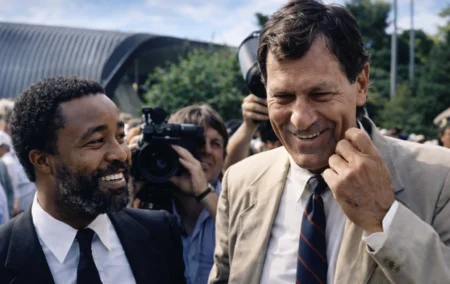
When the late, great Frederik van Zyl Slabbert spoke those words to members of the African National Congress in exile, in Dakar, Senegal in 1987, he was extending a hand across one of the deepest political chasms of the twentieth century.
(View a contemporary eight-minute news video about the Dakar meeting, courtesy of Johann van Loggerenberg, here.)
A year before, in 1986, Van Zyl Slabbert resigned as leader of the official opposition and leader of the Progressive Federal Party. He had lost faith that parliamentary politics could ever achieve a non-racial, democratic South Africa.
Alongside Alex Boraine, he founded the Institute for Democratic Alternatives in South Africa (IDASA), and led the now famous mission of 62 influential non-government Afrikaners to Dakar, in search of a negotiated settlement to South Africa’s bitter racial divide.
Mutual suspicion
Van Zyl Slabbert was himself an Afrikaner. He was addressing people engaged in an armed struggle against a racist Afrikaner regime, including Pallo Jordan, Thabo Mbeki and Mac Maharaj. His own government had letter-bombed them, imprisoned them, banned them and driven them into exile.
Many in his own delegation were uncomfortable. Rapport denounced Van Zyl Slabbert and Boraine as “Die dom doktore van Dakar” (“The stupid doctors of Dakar”).
Many on the other side were equally suspicious. The ideological distance between them was vast. Yet the hand was extended, and it was taken.
That outstretched hand – that willingness to listen before condemning, to acknowledge suffering before asserting disagreement – contributed to what the world would later call a miracle: the relatively peaceful transition to democracy in South Africa in 1994.
Slabbert’s words represent something that democratic politics once considered essential, but now treats as weakness: the basic civility of recognising your opponent’s humanity, even when you are mortal enemies, or believe they are profoundly wrong.
That norm of political civility is dying, and we will come to regret it.
The new incivility
The populist movements that now dominate politics across the democratic world – on the right and on the left – share a common feature that distinguishes them from the liberal democratic tradition they claim to have superseded.
They have abandoned even the pretence that political opponents deserve respectful engagement. The opponent is no longer merely mistaken. The opponent is unpatriotic, insane, sick, evil, treasonous, subhuman.
On the right, this manifests as open contempt for immigrants, minorities, and political dissenters. Donald Trump describes undocumented immigrants as “animals” who are “poisoning the blood of our country”. He calls political opponents “low-IQ”, “the enemy within”, “left-wing lunatics” or “domestic terrorists”. He calls the media “fake news” and “the enemy of the people”.
These are not aberrations; such hateful, divisive rhetoric is his standard register.
In Europe, parties from the French National Rally to the Alternative for Germany use words designed not to persuade, but to degrade. In Britain, Nigel Farage’s long career has been built upon the deliberate conflation of immigration with invasion, framing ordinary people seeking work or safety as a violent threat to the peace.
The left is not innocent of this sin, though it has different targets. The rhetoric of social justice movements frequently descends into the same dehumanising register it claims to oppose, dismissing entire categories of people as irredeemably hateful on the basis of their demographic identity or voting habits.
Not content to call out specific beliefs, words or actions, left-wing politicians and commentators often generalise about “basement dwellers”, “rednecks”, “gammon”, or “bitter small-town communities clinging to their guns and religion”.
Hillary Clinton’s “basket of deplorables” remark during her campaign for president in 2016 was revealing not because it was uniquely offensive, but because it expressed a contempt that millions of educated progressives genuinely felt (and still feel) towards their fellow citizens.
Purposeful hatred
This rhetoric is not without purpose. It doesn’t merely whip up the political support and donations necessary to win elections.
As H.L. Mencken wrote in 1918, “The whole aim of practical politics is to keep the populace alarmed (and hence clamorous to be led to safety) by menacing it with an endless series of hobgoblins, most of them imaginary.”
Casting political opponents, or foreigners, or out-group minorities, as dangerous enemies in the minds of the people has important political purposes.
It enables leaders to assume ever-greater powers, with ever-declining oversight. Any powers can be justified by their supposed necessity in fighting the enemies conjured up in the popular mind.
Surveillance of innocent civilians, militarised and brutal policing, side-stepping due process and circumventing constitutional constraints – all can be excused by claiming they serve the greater good of resisting, suppressing, or eradicating, the common enemy of the people.
Hateful rhetoric also distracts from closer public scrutiny to the nuances of policy choices. In the face of a great enemy, policies no longer need to be justified on their economic or sociological merits, but can pass muster simply because they are intended to combat whatever hobgoblin the political leadership has created.
Likewise, such rhetoric distracts from the personal failings of political leadership. Who cares if a strongman is morally bankrupt, or even criminal, as long as they have the balls to take bold action against hobgoblins?
From rhetoric to violence
Words have power. Language shapes the boundaries of what a society considers acceptable.
When someone describes immigrants as “vermin” or “invaders,” they are not engaging in harmless hyperbole. When they claim transsexuality is a “mental disorder”, or that gay people are “groomers”, they are not just “saying what everyone is thinking”. When they say “all white people are racist”, they’re not just expounding a theoretical sociological principle.
They are turning a general characteristic into individual moral failings. They are constructing a moral framework in which cruelty towards those people becomes not just permissible but righteous.
This is the direct and well-documented link between dehumanising rhetoric and state violence.
When political leaders frame certain groups as threats to the nation’s survival, they grant implicit permission for the instruments of the state – police, bureaucracies, border agencies – to treat those groups with brutality.
The logic is inexorable: if these people are truly poisoning our country, or threatening our children, then harsh treatment is not cruelty, but self-defence. And when innocents are caught in the cross-fire, they’ll say one can’t make an omelette without breaking a few eggs.
We see this in the normalisation of police violence; in the casual acceptance of inhumane conditions in immigration detention centres; in government agencies that treat people guilty of minor misdemeanours as dangerous criminals; in bureaucratic systems designed to exhaust, humiliate and marginalise the vulnerable.
Cruelty is the point
The cruelty, as the author Adam Serwer observed, is the point – but it begins long before any hand is raised. It begins in the speech that teaches a society to see certain people as less than fully human, as enemies of the people, as threats, as agitators, as impure, as class enemies, as reactionary, as animals, as cockroaches, as untermenschen.
History offers no shortage of evidence for where this leads. Fascism did not arrive fully formed in jackboots. It was built, gradually and publicly, upon the rhetoric of national victimhood, ethnic hatred, and the identification of internal enemies.
Every fascist movement in history, every communist revolution, and every genocide, has required, as its precondition, a politics of dehumanisation. Every such movement has found willing accomplices among ordinary citizens who had been taught, by years of escalating rhetoric, that their neighbours were their enemies.
The case for empathy
Against all this, I want to make an unfashionable argument: that empathy is not weakness, and that civility does not amount to surrender.
The populist right has, in recent years, waged an explicit war against empathy. “Excessive compassion” or “mercy” for migrants is recast as self-sabotaging naïveté. Concern for the rights of the accused is reframed as being “soft on crime.” Any attempt to understand the grievances of a political opponent is denounced as capitulation.
This is catastrophically wrong, and it is corrosive to the foundations of civilised society.
The basic norms of civilisation – norms that predate liberal democracy and underpin every functional society in human history – require that we treat people with a baseline of humanity and decency, regardless of who they are, what they believe, or what they have done.
This should not be a partisan position. It is the minimum requirement for a society that does not wish to descend into war and barbarism.
Elon Musk says the fundamental weakness of Western Civilisation is empathy. I think empathy is its fundamental strength. It is how Western Civilisation is able to resolve differences without resorting to violence, repression, and war.
One can condemn crime without tolerating police brutality. One can advocate for secure borders and reasonable immigration policy without being cruel towards migrants who are, overwhelmingly, ordinary people fleeing hardship or seeking a better life. One can disapprove of certain lifestyle choices without being hateful towards those who make them. One can disavow a political ideology without insulting every person who subscribes to it.
These distinctions are not difficult to draw. They require only the recognition that the people on the other side of any political question are, in fact, people.
The necessity of listening
Most people, most of the time, act from genuine concerns, even when their analysis is mistaken, or their proposed solutions are misguided.
The nationalist who fears immigration is often responding to real anxieties about employment or cultural friction. They may be wrong, but those anxieties do not evaporate simply because someone dismisses them as bigotry.
The socialist who demands radical redistribution is often responding to real suffering caused by poverty and inequality. That suffering does not become fictitious simply because free-market economics offers better remedies.
Dialogue – real dialogue, not the harangues that pass for political discourse today – requires not only speaking but listening. It especially requires listening.
It requires genuine interest to hear what actually troubles the person across the table, rather than the caricature one has constructed of them. It requires the humility to acknowledge that one’s opponents may have real grievances, even if you disagree with their solutions.
Political progress
Van Zyl Slabbert understood this. He did not travel to Dakar because he agreed with the ANC’s ideology or approved of its methods. He travelled because he understood that no resolution was possible without understanding what drove the people on the other side, and without finding whatever slender common ground might exist between them.
This is not naïvety. It is the precondition for political progress. One cannot change a person’s mind by first insulting them, or the groups of which they form part.
One cannot build a peaceful nation by first declaring half the population to be irredeemable.
One cannot sustain a democracy by treating every election as a war of annihilation.
The liberal democratic tradition, for all its imperfections, was built upon an important insight: that people who disagree profoundly can nonetheless govern themselves peacefully, provided they maintain certain norms of mutual respect and institutional restraint.
That insight was born of the blood of millions, brutally slain on the battlefields of Europe, Africa, and the Pacific. That insight flowed from the crucibles of genocide.
Reject the rhetoric
Populist politics, in its left and right variants alike, is systematically dismantling those norms. Fuelled by the polarising effects of internet clickonomics and content feed algorithms, and by the electoral payoff of whipping up angry mobs, we are replacing persuasion with denunciation, dialogue with demonisation, and civility with contempt.
The consequences are already visible: a coarsened public life, an increasingly brutal state apparatus, and a citizenry increasingly sorted into tribes that regard one another not as fellow citizens who disagree, but as enemies to be defeated and punished.
This same populist instinct has infected South African politics. Whereas Van Zyl Slabbert stretched out a hand across the divide, in order to build bridges, today’s politicians and influencers are burning those bridges and spewing hatred at their opposition.
We can choose differently. We can reject the rhetoric of dehumanisation, not because our opponents are always right, but because they are always human.
We can insist on empathy not as sentimentality, but as the foundation of every society worth living in.
We can remember that the most remarkable political achievements in modern history – from the fall of apartheid to the reunification of Europe – were accomplished not by those who shouted loudest, but by those who, like Van Zyl Slabbert, were brave enough to sit down and listen.
That is not weakness. That is civilisation.
[Image: Mbeki and Van Zyl Slabbert.webp]
CAPTION: Thabo Mbeki and Frederik van Zyl Slabbert in friendly conversation in Dakar, Senegal, in 1987. (Photo: Rashid Lombard, upscaled and colourised using ChatGPT.)
The views of the writer are not necessarily the views of the Daily Friend or the IRR.
If you like what you have just read, support the Daily Friend