
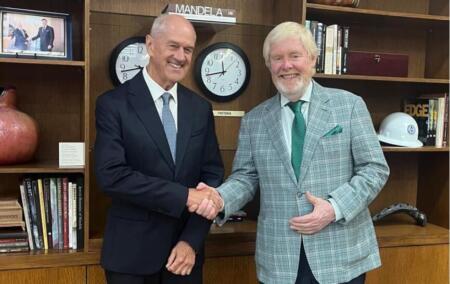
There is something deeply telling about a country’s diplomatic choices. They reveal not only where a nation wants to go, but what it is willing to sacrifice to get there. When President Cyril Ramaphosa announced Roelf Meyer as South Africa’s new ambassador to the United States this month, he did not simply fill a vacant post. He made a statement, and that statement is drenched in contradiction.
The ambassador’s post had been vacant since 14 March 2025, following the expulsion of former ambassador Ebrahim Rasool, who was declared persona non grata after criticising the Trump administration. Ramaphosa subsequently appointed former Deputy Minister of Finance Mcebisi Jonas as a special envoy, but the US government denied Jonas a diplomatic visa, citing past remarks in which he had reportedly called Trump a “racist” and “narcissistic.” The pattern was clear: Washington was dictating the terms. And Pretoria was listening.
Meyer, 78, is a member of the white Afrikaner community that led the apartheid government for decades. Trump has repeatedly accused the South African government of racial discrimination against Afrikaners. The logic of the appointment, then, is almost embarrassingly transparent. As one analyst put it, his being a white person of Afrikaner descent in Washington will push back against Trump’s continual accusation of South Africa engaging in a white genocide. Ramaphosa is not sending a diplomat. He is sending a symbol, a human shield against a narrative he has failed to dismantle through substance.
Meyer is a former member of the National Party, which introduced apartheid in 1948. He held several key positions within the white minority government, including deputy minister of law and order and later minister of defence. These were not ceremonial titles. The Department of Law and Order was directly responsible for the police machinery that enforced apartheid laws, crushed political opposition, and maintained a regime built on fear and violence. As Minister of Defence, Meyer was part of the political leadership overseeing the South African Defence Force, which was deeply implicated in cross-border destabilisation campaigns, regional wars, and internal repression.
Meyer’s responsibilities as Deputy Minister of Law and Order included coordinating law enforcement responses to township violence, consumer boycotts, and perceived revolutionary threats, aligning with the National Party’s “total strategy” doctrine that framed internal dissent as a coordinated communist insurgency. Meyer participated in State Security Council deliberations, a cabinet-level body that directed counter-subversion efforts, the same body critics allege approved political assassinations and cross-border raids on ANC bases. His defenders will point to his later role as a negotiator. But negotiating your way out of a system you helped enforce is not redemption. It is damage control.
Meyer became the government’s chief negotiator in the Multiparty Negotiating Forum in 1993 after the failure of CODESA, where he established a close working relationship with the ANC’s chief negotiator, Cyril Ramaphosa. That relationship has proven to be the axis upon which this entire appointment turns. A friend had invited both men on a fishing trip, and when Meyer embedded a trout hook in his hand, Ramaphosa was the only one present who could extract it, feeding Meyer a stiff whisky before doing so. According to Meyer, that fishing incident was indicative of the kind of relationship and friendship they ultimately built. Decades later, that whisky-soaked trust is now directing South Africa’s foreign policy.
Political analyst Professor Theo Neethling confirmed that the president would not appoint someone he does not trust, and that since the days of CODESA, Ramaphosa and Meyer have maintained a good personal relationship. This is precisely where the appointment becomes most troubling. South Africa’s most consequential diplomatic posting has been filled not through an open, merit-based process, but through the private loyalty networks of two men whose bond was forged over three decades ago across a negotiating table designed to manage, not dismantle, white economic power. The MK Party stated that the appointment cannot be divorced from the political relationship between Meyer and Ramaphosa, arguing that the decision reflects not national consensus, but the extension of favour and familiarity between negotiating partners from the past.
Meyer joined the African National Congress in 2006. That fact alone deserves serious scrutiny. A man who served as Deputy Minister of Law and Order under P.W. Botha, who participated in the State Security Council during some of the most violent years of the apartheid state, eventually joined the very liberation movement that his government tried to destroy. Whether that trajectory represents genuine transformation or sophisticated political repositioning is a question that South Africa’s commentariat has debated for years and has never satisfactorily resolved. Chris Hani consistently warned against romanticising members of the apartheid regime who suddenly rebranded themselves as democrats, cautioning that figures like Meyer had not fundamentally transformed their worldview but were instead adapting to preserve white economic power under new political conditions. Hani was assassinated in 1993. His warnings were buried with him.
Trump has targeted South Africa and cut all financial assistance, accusing the government of allowing a “white genocide” against the white Afrikaner minority group. He has also implemented a programme offering migration and asylum to white Afrikaners who feel persecuted. The appointment of an Afrikaner former apartheid minister as ambassador is Ramaphosa’s response to this pressure, and it tells you everything about who this move actually favours. It does not favour the black majority who remain landless. It does not advance the country’s BRICS commitments or its posture of non-alignment. It favours Washington. It favours the optics of appeasement. And it favours the private comfort of a president who trusts his old fishing partner more than he trusts his own diplomatic corps.
The Economic Freedom Fighters condemned the appointment as deeply offensive and politically tone-deaf, and stated that Meyer’s involvement in South Africa’s transition process in the 1990s could not be used to sanitise or erase his earlier role in upholding apartheid. The irony cuts deeper still when one considers the timing. This appointment was announced in the same period that South Africa commemorates the assassination of Chris Hani, a man who died warning his people about exactly this kind of compromise.
The two nations are also at odds over South Africa’s decision to pursue an International Court of Justice case accusing Israel of genocide, and Trump boycotted the G20 Leaders’ Summit hosted by South Africa in 2025. Meyer now walks into Washington carrying this weight, representing a country that has taken a moral stand on Palestine while simultaneously bending its knee to the administration that is against that stand. He will be expected to defend South Africa’s sovereignty with one hand while extending the other in conciliation to a government that has openly ridiculed it. The central contradiction of this appointment is this: South Africa has sent a man who spent the formative years of his political career upholding apartheid to represent a country still trying to recover from it. It has sent an Afrikaner to neutralise a white genocide narrative that should be neutralised with facts, not faces. And it has sent Ramaphosa’s old friend to do the work that Ramaphosa himself appears unwilling to do through conviction.
Meyer’s negotiating ability and affable personality are real assets. He has taken his skills global, engaging in peace initiatives across multiple countries. But competence is not the argument being made in Pretoria’s corridors. The argument is optics. And when optics become your foreign policy, you have already lost the argument. South Africa deserves an ambassador chosen by the nation, not by nostalgia.
[Image: https://www.facebook.com/photo/?fbid=1345851047577823&set=a.287837063379232]
The views of the writer are not necessarily the views of the Daily Friend or the IRR.
If you like what you have just read, support the Daily Friend