

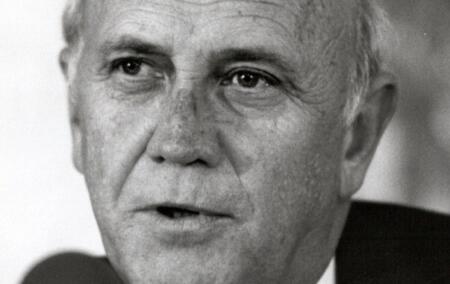
The reformer FW de Klerk left politics having secured for South Africa a constitutional federation and commitment to non-racialism, which the political elite began breaching before the ink on the Constitution was dry. Why, then, has his presidential foundation come out swinging in favour of unitarism and race law?
In a recent Rapport article, the Executive Director of the FW de Klerk Foundation, Christo van der Rheede, launched a broadside at the South African Institute of Race Relations (IRR) and its work on non-racialism broadly, and the IRR’s Index of Race Law in particular, of which I am the editor.
Punching allies
I generally have no wish to spend much effort on criticising the imperfections of those individuals and institutions who are in the trenches fighting for a free society.
This allows me to look past those aspects of AfriForum’s advocacy of closed borders, Solidarity’s occasional leftward lurches on labour, the IRR’s old habit of not calling for cutting the public sector workforce or their salaries, and the Free Market Foundation’s (FMF) old work on intellectual property.
We are all pulling in the same direction, and we need not agree on everything. South Africa’s current ideological and policy quagmire demands that we work eagerly together. Generally, I am afforded the same courtesy by those others.
But I now have my doubts about whether the FW de Klerk Foundation is pulling in the same direction.
To be clear, I have had a positive relationship with this organisation. Dave Steward has involved me and the FMF in many good initiatives and I know some of the people who work for the organisation to be conscientious defenders of the free society.
But since 2025, something seems to have gone awry, and while I thought for a moment that I had simply been mistaken, Van der Rheede’s Rapport article confirmed that I had not been. This organisation, which is meant to have our back just as we have its, has now publicly taken multiple stances against not only the principles of a free society, but the legacy of its own patron.
The FW de Klerk Foundation is an important South African institution, openly carrying the name of a very important figure whose legacy deserves to be presented in the best light possible: the FW de Klerk of his later, reformist years, was a federalist and a non-racialist.
Federalism
The Bloemfontein Congress of the (reformed) National Party in 1991, led by FW, adopted a very federalist programme for the upcoming negotiations of the transition.
And while Roelf Meyer decided to let go of much of the party’s federalism at Cyril Ramaphosa’s command, FW and his team ultimately managed to secure for South Africa a formally federal constitution which still holds much potential for decentralisation today. This is the legacy of De Klerk.
How is it, then, that in March 2025, Van der Rheede, then recently named as Executive Director of the FW de Klerk Foundation, rubbished this legacy by claiming on SABC that “we fought for a unitary state”.
Who was this “we”? Surely, as head of a presidential foundation, he means the president it is named for. Why would Van der Rheede misrepresent De Klerk’s legacy unprovoked and try to undermine the cause for political decentralisation? Why publicly proclaim that South Africa is a unitary state and deny the legacy of the foundation’s patron?
Around the same time and in the same context, Van der Rheede attacked AfriForum and Solidarity – mere months prior, fellow-travellers of the foundation – by insinuating that they were hiding something nefarious about their trip to the United States. It was also around this time that Van der Rheede began downplaying the completely observable fact, widely acknowledged by all arms of the South African political elite, that the white minority faces political hostility.
Non-racialism
But it is his Rapport article of 10 May 2026 that proves most egregious.
Van der Rheede expands his deviation from the legacy of FW de Klerk by placing himself squarely in the racialist formation of South African discourse, even though FW in the final era of his life criticised the prevalence of racial legislation.
De Klerk was the final Apartheid-era president who promised his constituency and the world that classifying people by their inborn melanin content was over as a matter of public policy. For this, he received the Nobel Peace Prize. By 2020, however, this elder statesman had to lament:
“Increasingly stringent BEE measures are progressively limiting the economic space within which minorities can operate; and, most seriously, South Africa can no longer be described as a non-racial society. The crucial protection that citizens enjoyed against unfair discrimination has, for all intents and purposes, been stripped away – sometimes by the very courts and institutions to which minorities looked for their protection. South Africa in 2020 is once again one of the most racially regulated societies in the world.”
It is this last line, that South Africa is “one of the most racially regulated societies in the world”, that Solidarity is using in its commendable and honourable campaign against race law. This campaign, implicitly, would have been endorsed by FW himself, and yet his presidential foundation is rallying against Solidarity?
A nee a!
Van der Rheede goes on to characterise the IRR’s Index of Race Law as “quasi-research”, joining a long list of critics of the vibes of the Index who are unable or unwilling to point out exactly where the supposed errors are.
They all fall back on the supposed underlying intentions behind the laws, and pretend that because the Index does not elevate mere intention to decisive status, they have somehow found real fault. As of June 2025, 145 laws that had been adopted as racial remain on the books in South Africa, and 136 of those are legally operative.
Most worrying is Van der Rheede’s implication that the Index somehow defends or equivocates on Apartheid. Yet the Index is the only comprehensive reference resource for the full spectrum of the legislation of white supremacy. Indeed, Van der Rheede himself relies on the Index to point out the many race laws adopted prior to 1994.
This is a common tactic among the modern-day supporters of race law. From years of experience, they think associating their opponents with Apartheid is still an effective way to win a debate.
It is not.
But Van der Rheede does so in a bizarre fashion, writing that South Africa’s post-1994 race law paradigm is (get this) premised on “non-racialism, which prioritises dignity, equality, and human rights”.
He characterises it as “teengif” (the antidote) to Apartheid! Real non-racialists, including the foundation’s patron, understand that free enterprise and property rights are the real antidote, and that the progress made by black South Africans since Apartheid ended has been due to their own merit, grit, and determination, not political rentseeking.
Van der Rheede’s criticisms in this regard are nothing but another instance of the “racists oppose race laws and non-racialists support race laws” circus in modern South African public discourse.
Further, Van der Rheede wants to have his cake and eat it, too.
At once, he criticises the Index for ostensibly not being cognizant of the fact that race law is allowed by the Constitution “because” the Constitutional Court said as much, and then warns the courts that they must be careful about allowing “too much” race law.
Well, Mr Van der Rheede, the courts did not heed your warning.
It is precisely the Van Heerden judgment, decided in clear and unambiguous error – among other judgments – that breathed racialism into the textually and formally non-racial instrument that is the Constitution. The “social engineering” you’re warning against is premised exactly on this judicial misconstruction of South Africa’s highest law.
Not content to stop there, Van der Rheede writes that the IRR (of all civil society!) must still provide credibility in its century-long fight for non-racialism.
The IRR had established this credibility long before Van der Rheede was born, and has not strayed.
After all, it would have been in large part based on IRR research and advocacy that the United Party, which by all the accounts of the time should have won the 1948 election, would have begun the process of de-racialising much of the economy.
Van der Rheede should have done some basic inquiry into the history and nature of this institution before launching a broadside against its credibility.
The illusion of access
I can speculate about why Van der Rheede has taken up this unjustifiable posture against the principles of the free society and the legacy of FW de Klerk, though I hope I am wrong. Unfortunately, if I am correct, it is a story that is all too common in South Africa.
There were and are various organisations that believe the African National Congress (ANC) is simply corrupt, and/or misinformed. Therefore, all that is necessary, is to excise the corruption, and/or provide better information. For this, one needs to work with the ANC, not against them.
It goes something like this: If the ANC could just understand that adopting better policies would lead to higher economic growth, they would get rid of many of the laws holding us back!
In pursuit of this goal, many individuals – in policy advocacy and commerce – have pursued the much-vaunted “access” to power.
For years, they have made sure that they can, perhaps through one or two or three steps, get hold of the President, Deputy President, or key ministers or regulators, take them out to lunch, or have a frank conversation over the phone.
With this access, they believe, they can weather the worst of the storms caused by the ANC’s corruption and/or incompetence.
To these people, ideology plays a small, if any, role. It is the occasional thing they chuckle and roll their eyes about, when they lament how ANC ministers call each other “comrade”.
But perhaps above all – and this reveals their complete detachment from reality – they live in a world where they can sincerely say: “The ANC is bad, but at least they’re not Donald Trump bad!”
Van der Rheede seems to believe, like so many others – in error – that if he just shows the ANC that the FW de Klerk Foundation members are “patriots”, and do not press too hard against the underlying Transformationist (ideological) logic of ANC policy, the ANC will invite them into the fold and let them help craft a better future for South Africa.
This is a nice idea and I certainly wish it were true. It is simply not.
Access has its benefits, to be sure. On the margins, it has allowed senior business leaders to help capacitate certain key state functions around fighting corruption, repairing rail infrastructure, and so on.
But at its most benign and advantageous, access is the mechanism through which one can help manage the decline of South Africa. It has never and can never make South Africa turn the proverbial corner and become a growing, prosperous, and free society – because the only way that can conceivably be done, is to address the core ideological reasons for the decline.
This means calling out (and fighting) the Transformationism, socialism, and authoritarianism that have a firm grip on the imaginations of the South African political elite.
One cannot do this, and have full access at the same time. To have access, you need to at least embrace Transformationism in principle – which is precisely what Van der Rheede and many others have done.
And FW de Klerk turns in his grave.
Thankfully, the fight for real reform in South Africa by the likes of the FMF, IRR, AfriForum, Solidarity, and many others will not abate, even if allies occasionally stray. This is not a hopeless phenomenon, as they, too, can come back to reality and rejoin the fight.
[Image: By Library Am Guisanplatz (de), Collection Rutishauser, CC BY-SA 4.0, https://commons.wikimedia.org/w/index.php?curid=74185686]
The views of the writer are not necessarily the views of the Daily Friend or the IRR.
If you like what you have just read, support the Daily Friend