


In 2025, the price of gold soared 63%, from roughly $2,600 per ounce to $4,300 by the end of the year. That return far exceeded the gains from almost all stock market indexes.
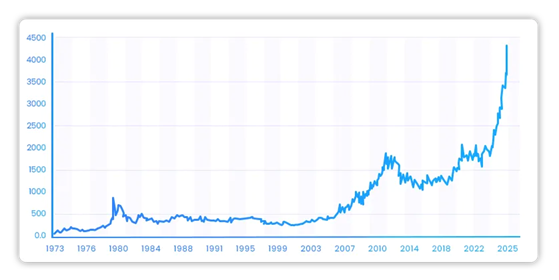
Canadian mining investor and philanthropist Pierre Lassonde believes we’re in the midst of gold’s greatest bull market in many decades. He makes the seemingly preposterous prediction that gold will reach $17,250 per ounce by 2030.
Lassonde and others say that after years of slumber the gold price has taken off because inflation is rising while government debt, particularly in the United States, has exploded. Other factors are a perceived breakdown of the dollar-based global order, geo-political uncertainty, unprecedented central bank purchases, a loss of confidence in the dollar and a corresponding move to diversify global reserves away from reliance on the dollar.
A 2026 Deutsche Bank report finds that the dollar’s share in global reserves shrank from 60% in 2000 to 41% in 2025. “This decline,” says the report, “jump started the record inflows into gold.” Central banks are stockpiling gold, it continues, because the dollar-based banking system has been weaponized and could be replaced by a new order with gold—not the dollar—as anchor.
There have been rallies into gold that were not sustained. From February to December 1979 gold soared 300% from $217 to $850 before pulling back. From February 2010 to September 2011 the precious metal went from $1,063 to $1,900, an 80% gain, before again falling back.
Terrible investment
Astute observers recall that for two decades, the 1980s and 90s, gold hardly moved. It was at that time a terrible investment, a dead asset that neither rose in price nor paid a dividend. However, if you bought a Krugerrand a decade ago you’re a winner as its price rose 300%, from $1,100 an ounce to $4,600.
Even today there are doubters. For example, if gold is a safe haven why has its price declined by 10% (from $5,000 to $4,500) in the three months since the US and Israel launched their war against Iran?
There are exogenous factors impacting gold. In 2022 in response to Russia’s invasion of Ukraine, the US and the European Union froze about $300 billion of Russian central bank reserves held in western Europe. While Russia’s gold was not seized the action sent shivers through financial markets and may have prompted central banks to boost gold purchases and diminish their holdings of dollars and euros.
China is the world’s biggest gold producer, followed by Russia and Australia. Those three countries account for one-third of global production. They are followed by Canada, the United States and Ghana. South Africa led in gold production as late as 1970 but since then its output has steadily fallen to about 98 tons per year.
The past two years have seen the biggest sustained central bank purchases of gold in decades.
The Peoples Bank of China has bought gold for 17 consecutive months. Last year Poland led the field adding 20 tons of gold to its central bank reserves. In terms of holdings, the US is far in the lead. It possesses over 8,000 tons of gold, followed by China (3,000 plus tons), Italy, Japan and Russia.
Speculative assets
Crypto currencies have similarly impacted the gold market. Bitcoin, the most commonly traded virtual currency, for two years traded in tandem with gold but its price rose at a much faster pace. That trend was broken in 2025 as gold gained dramatically while bitcoin fell. Both investor Warren Buffett and former Federal Reserve chairman Jerome Powell describe crypto currencies as mere speculative assets.
In 2025 the gold price recorded 50 all-time highs. Several analysts believe the gold market will continue to rally. Goldman Sachs has a year-end target of $5,400. JP Morgan Chase is predicting $5,000. And Deutsche Bank believes the market could reach $8,000 per ounce by 2031.
Legendary British economist John Maynard Keynes didn’t like gold. He called the metal “a barbarous relic.” Keynes died in 1946. Would he say the same thing were he alive today?
The views of the writer are not necessarily the views of the Daily Friend or the IRR.
If you like what you have just read, support the Daily Friend