

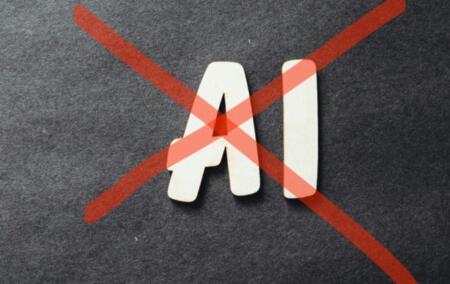
At the University of Arizona commencement this month, Eric Schmidt, the much-admired ex-CEO of Google, began telling graduates that artificial intelligence would reshape classrooms, hospitals and professions. The boos came back immediately, loud and clear. He was not alone.
Across the 2026 graduation season, several commencement speakers who tried to offer cheerful AI pep talks were jeered by students who heard something quite different: not progress, but redundancy. AP reported that about 70% of college students now see AI as a threat to their job prospects.
There has always been reasoned scepticism, concern about AI. But this was different. It was backlash, a broad, emotional repudiation of AI. And it is becoming increasingly organised. Data Center Watch reports that at least 142 activist groups across 24 US states are campaigning against new AI/data-centre developments, with tens of billions of dollars in projects delayed or blocked.
These are not isolated theatrics. They are the human face of a backlash that has been building – in town halls, courtrooms, state legislatures, and polling data – into something that now warrants the word ‘revolt’. A Gallup poll from early 2026 delivered the industry a startling piece of news: 71% of Americans would oppose a data centre being built in their neighbourhood. That is eighteen percentage points higher than opposition to nuclear power plants. AI, it turns out, has a bigger PR problem than fissile material down the road from your house.
How much of this backlash is well-founded?
Start with jobs, about which much has been written. The most exposed include people who hold special knowledge and who rent that out for a fee – lawyers, doctors, accountants, consultants, programmers. AI is certainly metastasising in these industries, but the long-term damage to careers is still difficult to quantify, because it is not clear yet whether the AI is additive or destructive. But there is no question about both the anxiety and the facts behind it.
Then comes the infrastructure. AI is not weightless. It needs concrete, land, transformers, substations, cooling towers, transmission lines and water permits. The International Energy Agency projects that global datacentre electricity consumption will more than double to about 945 TWh by 2030, roughly more than Japan’s current electricity use; in the United States, data centres may account for nearly half of electricity-demand growth through 2030. What is this going to do to our monthly electricity bills? If electricity becomes scarce and contested, well, we all know about scarcity and price.
More visceral issue
Water is the more visceral issue. Communities can live with abstract carbon accounting. They are less charmed by the idea of a machine-learning campus drinking from the same aquifers as their farms and homes. Sadly, the facts here are a little more nuanced – all the datacentres in the US consume less than 3% of US golf course consumption. The political problem for AI is not national consumption totals so much as intense local concentration in water-stressed regions.
The objection is not only “not in my backyard”. It is “why in my civilisation?” Why should scarce power, land, water, engineering talent and capital be diverted into machines that may enrich a few companies at the expense of everyone else? Global Finance recently framed the surge as a possible “crowding-out” effect, with an estimated $830 billion AI infrastructure boom competing for capital that might otherwise fund housing, clean energy, factories, transport or ordinary business expansion.
There is also the plutocracy problem. AI is sold as a democratising force (“intelligence for all”), but its commanding heights are anything but democratic. The stack is controlled by a tiny club: Nvidia for chips, hyperscalers for datacentres, frontier labs for models, and a small archipelago of billionaires and venture funds for ownership. Recent deals reinforce the sense of a closed circuit; massive circular deals being signed between OpenAI, Nvidia, Anthropic, Google AWS, Microsoft Azure, Oracle and the other usual suspects.
The industry knows the mood has turned. Its response is no longer just “look at this magic chatbot”. The new pitch is moral utility. AI will tutor children, discover drugs, detect and even cure cancer, predict floods. Microsoft’s AI for Good Lab, for example, foregrounds projects in public health, climate risk and cultural preservation; OpenAI has been pushing education partnerships with countries and school systems. Google’s DeepMind is doing astonishing work across multiple science-related axes. But sadly, that is not the message that is getting through, and that is AI’s messaging problem.
The industry has heard and reacted (as evidenced by the race to move data centres off land – either into space or underwater). Their reaction has not been to slow down, but to find a way to insulate themselves from friction, so deep is their belief in their product and its promise. The richest industry on Earth is now searching for a jurisdiction with the fewest voters and regulators.
Which brings us to China, no doubt watching the blowback with increasing glee.
Strategic
The Western AI debate is noisy, moralised and adversarial. China’s is strategic. That does not mean there are no Chinese concerns about job losses or other nasty consequences. But there is nothing like public pushback. Stanford’s 2025 AI Index found that 83% of people in China believe AI products and services offer more benefits than drawbacks, compared with only 39% in the United States.
Beijing is not treating AI as an optional consumer technology. It is treating it as an industrial and national operating system. In August 2025, China’s State Council issued its “AI Plus” policy (which I have written about previously), aimed at accelerating adoption across industry, education, public services and society. And when China sets down national policy of this magnitude, it is long-term, disciplined, deeply embedded, and state-financed. The country falls in line.
This is the geopolitical sting. The West is arguing about whether AI is theft, bubble, nuisance, water hog, job killer or billionaire vanity project. China is building its future around it and has already caught up to the West in most areas of the IP-stack (and has exceeded it in others).
The backlash has real moral force. Citizens are right to demand cleaner power, water transparency, labour protections, antitrust enforcement, copyright rules, safety standards and democratic accountability. But there is a tension between governing a technology and losing perhaps what is the single most important geopolitical battle in history. Regulators need to be clear-eyed about this.
No second place
Because of the exponential and self-recursive improvements in leading-edge AI, the winner of this race takes it all. There is no second place.
Western alarmism about the technology (or even just run-of-the-mill democratic resistance) may end up being the own goal to end all own goals. It would leave humanity’s future to the state most determined to let AI run without throttle or brake.
[Image: Featuring Markus Spiske on Unsplash]
The views of the writer are not necessarily the views of the Daily Friend or the IRR.
If you like what you have just read, support the Daily Friend