

“Well, gentlemen, which one of you wants this company to be remembered as the I G Farben of apartheid?”
Thus spoke JCI executive director Gordon Waddell at a board meeting in the mid-1980s.
After returning to his native Britain, Waddell complained in 1987: “What I felt very depressing was that really fundamental change was required to avoid bloodshed. But these views were held by a very small minority in the corporate hierarchy. Business has been a force for change in South Africa, but has it done all that it should have done? My answer is ‘no’”.
I raise this in the context of proposed changes to the history curriculum, and the teaching of our recent history.
Waddell’s two statements may at first glance seem to be of the same sort, but they are of very different orders. The second one is something anyone can sympathise with: SA’s private sector didn’t do as much as it could have done to oppose apartheid and to alleviate some of its deleterious consequences.
But the first statement could place a business in a different dock – that of an accused collaborator in a crime against humanity.
That would be despite a view that it is not a fundamental duty of business to busy itself with broader issues of citizenship. Such a purist take was, for example, given by Centre for Development and Enterprise CEO Ann Bernstein at the business hearings of the Truth and Reconciliation Commission in 1997:
“Corporations are not institutions established for moral purposes. They are functional institutions created to perform an economic task…They are not institutions designed to promote some or other form of morality in the world…This does not of course absolve individuals within companies from moral choices, but this is a different matter.”
Perhaps.
South Africa’s politics is fraught at the best of times, some of it a holdover from the propaganda wars that were part and parcel of the enforcement of minority rule until 1994, and of opposition to that. As in all wars, truth is often a casualty. In the Struggle vs Apartheid conflict (to put it simply), a major play was always to portray one’s opponents as beyond the moral pale, thus rendering unnecessary a full accounting of human rights abuses committed by one’s own side.
So, positioning apartheid as a crime against humanity allows tarring with that brush anyone or anything that operated in SA when that system was being imposed. Anyone, from a company to civil servants and beyond, can be accused of “collaboration” with a crime against humanity, more or less on a par with the Nazism that gave rise to such crimes being codified and used in the post-war Nuremberg Trials.
This is to simplify a reputational danger that all SA companies could face on an issue we can expect to rear its head again and again.
It may be useful to note some of the basic facts that come with the origination of the concept of apartheid being a crime against humanity.
Upfront, it should be noted that the term “apartheid” is itself woolly, and is used differently and interchangeably by different people at different times.
For some it refers to segregationist policies of the type once found in the American South. For others it’s the “baaskap” doctrine of SA Premiers DF Malan and JG Strydom, or Grand Apartheid’s “separate development” of especially Premiers Hendrik Verwoerd and John Vorster.
For yet others it refers to attempts by particularly Presidents P W Botha and F W De Klerk to entrench group-based minority political provisions in a final constitutional settlement.
For all, it encompasses human rights degradations that come from a system of economic exclusion, racially discriminatory policies, and the often brutal enforcement of these.
Most claims that this system constituted a crime against humanity rest on the United Nations Convention on the Suppression and Punishment of the Crime of Apartheid of 1973.
A useful source on this is a seminal paper written by Professor John Dugard, when he was Professor of International Law at Leiden University.
Dugard notes:
“The Apartheid Convention was adopted by the General Assembly on 30 November 1973, by 91 votes in favour, four against (Portugal, South Africa, the United Kingdom and the United States) and 26 abstentions. It came into force on 18 July 1976. As of August 2008, it has been ratified by 107 States.”
In other words, only around half the world’s countries and territories have adopted this convention. Why is that? It might be because to declare an entire political philosophy, or approach, as a crime against all of humankind, is always going to be difficult for some to accept. Few can afford the potential future risk to their own interests of allowing a global criminalisation of an entire governmental approach or doctrine, so they mostly don’t allow it.
Thus, in 1962, for example, Liberia and Ethiopia accused South Africa at the International Court of Justice in the Hague of committing “crimes of apartheid” in SA-ruled South West Africa (SWA, now Namibia). Indeed, Bantustan-isation was in full flow at that time in SWA, and whites there had even been given five seats in the SA parliament – an effective annexation. But “crimes of apartheid” was felt by the court too broad a petition[1].
To go back to the point about the declaration of apartheid as a crime against humanity being part and parcel of a wider “hearts and minds” war at the time, it’s worth noting that the relevant resolution was introduced to the UN General Assembly by the USSR and Guinea, backed almost exclusively by fellow undemocratic states.
That’s probably why what should have been a resolution of the General Assembly and then become one in the Security Council was reduced to a convention that countries could sign or ignore. Today, there are 107 parties to the convention, but only 31 countries have signed it as such.
Even in 2020, the following democracies, among others, still hadn’t signed: Australia, Canada, France, Germany, Israel, Italy, New Zealand, The Netherlands, United Kingdom, and United States.
US Ambassador Clarence Clyde Ferguson Jr made America’s position clear enough when voting against the 1973 resolution:
“[W]e cannot…accept that apartheid can in this manner be made a crime against humanity. Crimes against humanity are so grave in nature that they must be meticulously elaborated and strictly construed under existing international law”.
Discomfort with the convention may also be about its reach. It was named for apartheid, but has long since shape-shifted into a tool used to combat racism/ethnic social engineering as defined by UN bureaucrats and allied activists.
Thus, apartheid’s abolition in SA didn’t mean the convention’s end, nor that of work done in its name. Indeed, no South Africans have ever been charged or prosecuted in terms of the convention. That seems a rather strange approach to a crime against humanity.
Says Dugard (2011):
“Although consideration was given in 1980 to the establishment of a special international criminal court to try persons for the crime of apartheid (E/CN.4/1426 (1981)), no such court was established. Instead it was left to States to enact legislation to enable them to prosecute apartheid criminals on the basis of a form of universal jurisdiction. The Apartheid Convention allows State parties to prosecute non-nationals for a crime committed in the territory of a non-State party where the accused is physically within the jurisdiction of a State party (arts. 4 and 5).
“No one was prosecuted for the crime of apartheid while apartheid lasted in South Africa. And no one has since been prosecuted for the crime”.
As mentioned, the convention isn’t strictly apartheid-related today. As Dugard has written:
“That the Apartheid Convention is intended to apply to situations other than South Africa is confirmed by its endorsement in a wider context in instruments adopted before and after the fall of apartheid. In 1977, Additional Protocol I of the Geneva Conventions of 1949 recognised apartheid as a “grave breach” of the Protocol (art. 85, paragraph 4 (c)) without any geographical limitation.
“Apartheid features as a crime in the Draft Code of Crimes against the Peace and Security of Mankind adopted by the International Law Commission on first reading in 1991 without any reference to South Africa and in 1996 the Draft Code adopted on second reading recognised institutionalised racial discrimination as species of crime against humanity in article 18 (f) and explained in its commentary that this “is in fact the crime of apartheid under a more general denomination”(Report of the International Law Commission on the work of its forty-eighth session (A/51/10), p. 49). In 1998, the Rome Statute of the International Criminal Court included the “crime of apartheid” as a form of crime against humanity (art. 7).
“It may be concluded that the Apartheid Convention is dead as far as the original cause for its creation – apartheid in South Africa – is concerned, but that it lives on as a species of the crime against humanity, under both customary international law and the Rome Statute of the International Criminal Court”
References
Dugard, J., Convention on the Suppression and Punishment of the Crime of Apartheid. Leiden University. New York. 30 November. https://legal.un.org/avl/ha/cspca/cspca.html [accessed February 2020] 2011.
Jamieson, B., Goldstrike! The Oppenheimer Empire in Crisis. Bergvlei. Century Hutchinson SA. 1990.
Rajak, D., In Good Company: An Anatomy of Social Responsibility. Stanford. Stanford University Press. 2011.
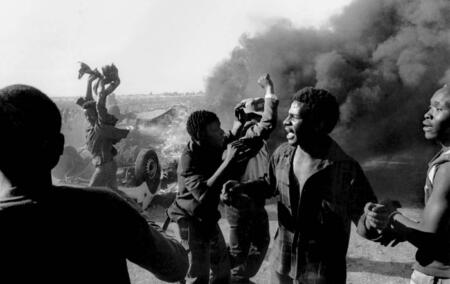
[Image: By Paul Weinberg – direct donation from Author, CC BY-SA 3.0, https://commons.wikimedia.org/w/index.php?curid=26754890]
The views of the writer are not necessarily the views of the Daily Friend or the IRR.
If you like what you have just read, support the Daily Friend
[1] International Court of Justice judgements/documents about relevant SWA cases can be found at: https://www.icjcij.org/en/quicksearch?utf8=%E2%9C%93&keywords=1962+ethiopia+liberia+south+africa+south+west+africa+apartheid+judgement.