

Last week, the DA took a leap in winning, for the first time, a township ward that has almost only black voters.
At the least, that shows that an increasing number of black voters are listening to what the DA has to say and are prepared to give it a chance. The big question is whether this signals the start of a nationwide political shift that could see many more black voters move to the DA.
Such political shifts tend to be sudden and very large.
The DA needs far greater black support to break through a 20 percent support ceiling and have a chance at replacing the ANC as the leading party in a national government coalition. And solid support from black voters will greatly increase the chance of the DA’s mayoral candidate in Johannesburg, Helen Zille, winning an outright majority.
In the 2024 national elections, 14 percent of black voters supported the DA, up from 9 percent at the 2019 elections. So black support has been growing for the DA, but not on the sort of scale as to make a sea change in our politics.
The DA win on Tuesday last week was in a municipal by-election in Ward 28 in Emfuleni, which even by the low standards of ANC service delivery has an atrocious record. From the limited sample that Ward 28 provides, there is certainly a serious question to be asked as to whether this win heralds an upcoming leap in support for the DA in townships across the country.
In Ward 28, the DA received 32.08 percent of the vote compared to the ANC’s 31.83 percent. That represents a win by just eight votes. A win is a win, and if nearly one in three voters are voting for the DA, that is significant. The South African Communist Party took 2.85 percent of the vote, 89 votes, which might have gone to the ANC. That definitely helped the DA, but so did the strong swing to the party.
In the 2021 municipal elections in the same ward, the ANC received 53 percent of the vote, and has now slipped by more than 21 percentage points. By contrast, the DA support has risen by 16 percentage points in the ward since 2021.
For years, the trend has been for voters who have abandoned the ANC to stay away from the polls. At the last national elections in 2024, many ANC voters in KZN and Mpumalanga abandoned the party and voted for uMkhonto we Sizwe. The DA has hardly benefited from the decline in ANC support.
But could the Ward 28 result point to a far larger jump of disillusioned ANC voters to the DA on November 4th and at the national elections in 2029?
There might well be a great deal of wishful thinking by the DA as they look at the Emfuleni result. A degree of caution is advisable. The DA only won by eight votes, and voter turnout in the ward was below 36 percent.
However, the total vote was 3,720, which exceeds the 2,000 interviewed in most of our political polls, yields a margin of error of three percent on either side. So, the Ward 28 result is a reasonable indicator of the way things might go in November, at least in Emfuleni.
It is not a bad indicator, but it is by no means a decisive one.
On the same day as the by-election in Emfuleni, the ANC saw its vote share rise from 58 percent in 2021 to nearly 73 percent in a Mahikeng ward poll. There was no DA candidate, which tells us that the DA still has to make inroads in certain townships.
But why did the DA do well in Emfuleni?
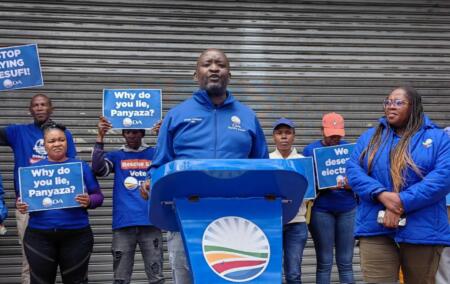
The DA’s campaign manager in the ward, Kingsol Chabalala, who is also the party’s mayoral candidate for the upcoming elections in Emfuleni, puts the win down to ten years of hard work to build the trust of the community.
He says most residents come to the party if they need a municipal problem resolved. Poor service delivery in Emfuleni was not the major factor in the DA win, says Chabalala. He insists the key factors were building community trust and countering the misinformation that the DA is a white party.
Midvaal, the DA-controlled municipality, which is next door to Emfuleni, is widely viewed as the best run in Gauteng and one of the best in the country.
“The political landscape is shifting, just wait for November 4th,” says Chabalala.
The DA’s strategist, Ryan Coetzee, declared on X that the DA win in Emfuleni “makes history.”
“What is striking about the Emfuleni by-election last week is that it makes the DA the only party in the history of SA that has managed to win in wards that are almost entirely black, white, coloured, or Indian, and of course, many wards that are diverse.”
“There is a long way to go,” he admitted, “but there is progress against all the odds.”
Poor service delivery might be forcing many ANC loyalists to place identity politics on the back seat and, at least, hear what the DA has to say.
The DA and its predecessor, the Progressive Party, seem to experience once-in-a-generation large and game-changing wins. Coetzee compared the Emfuleni win to that of the DA on the East Rand in the late 1990s, which showed that the party could gain traction in predominantly Afrikaans areas. In 1974, the Progressive Party went from one MP to six, showing that it could substantially grow among the white electorate.
Since 1994, the perpetual question has been whether the DA can grow among black voters.
Jack Bloom, the DA Shadow Minister for Health in Gauteng, who has been in politics for more than 40 years and is a long-time election observer, says it takes a long time for these game-changing shifts to happen. “But when the shift happens, it is a large shift,” he says.
“These sorts of changes are quantum leaps,” he says.
At the least, Emfuleni shows there has been a psychological shift among some black voters in their attitudes towards the DA. As Bloom points out, up until about twenty years ago, one could not walk around the Johannesburg CBD with a DA T-shirt without attracting some verbal abuse. Then about fifteen years ago, a DA T-shirt would attract neither abuse nor praise. And from about five years ago, many people ask, “where can I get a DA T-shirt?” if they see someone wearing one.
A quantum shift to the DA would fundamentally change our politics. It could reduce the ANC to a minor player threatened by multiple splits within its ranks. That would mean the question of whether or not Deputy President Paul Mashatile, who is close to the EFF and MK, takes over from President Cyril Ramaphosa, loses a great deal of its importance.
With the decline of the ANC, the odds are that at some stage there will be a sudden quantum shift to the DA. We just don’t know when this will occur.
[Image: https://press-admin.voteda.org/wp-content/uploads/2024/10/Kingsol-Chabalala-MPL-addresses-the-picket-scaled.jpg]
The views of the writer are not necessarily the views of the Daily Friend or the IRR.
If you like what you have just read, support the Daily Friend