

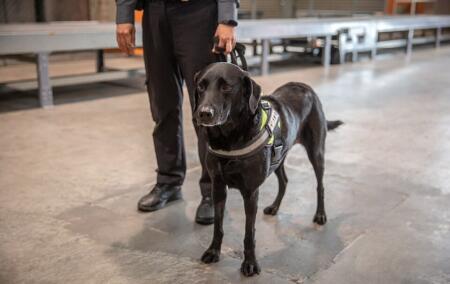
Working dogs shepherding sheep or cattle, K9 dogs in war zones working alongside their soldier handlers, or in the bush with anti-poaching rangers, sniffer dogs patrolling Woolworths for explosives, dogs rescuing people, helping them recover from trauma or injury … all of them amass droves of fans across social media.
But you probably haven’t heard much about the role of the SA Revenue Services’ Customs Detector Dog Unit in the seizure of cocaine and heroin worth over R900 million last month.
That’s partly because the government doesn’t talk enough about the people and dogs quietly defending our borders, and partly because it does not appear to value them enough to fund them sufficiently to do their job at full capacity.
Over recent weeks, I have been putting questions to Finance Minister Enoch Godongwana about the Customs Detector Dog Unit (DDU). The answers are both impressive and deeply troubling.
For example, over the past three years, the DDU team has seized no less than R10.4 billion in smuggled goods.
That’s not just customs revenue. That’s contraband seized at our borders, drugs, illegal weapons, counterfeit medicines, endangered species parts, and currency destined for criminal networks.
In the last financial year alone, the DDU contributed R1.59 billion to customs enforcement. For an annual budget of R3.9 million, that’s a return on investment of R31.8 million per dog. Let me spell that out, every dog working at our borders with SARS’s DDU generates a roughly 8,000% return on what we invest in it.
Most government programmes would kill for a 100% return on investment. Yet the illicit-trade-detecting heroes of the DDU are operating on a shoestring.
This isn’t just about customs revenue. This is about crime.
The DDU seized over R923 million in narcotics alone in the past three years. That’s narcotics that didn’t reach dealers on our streets and drugs that won’t destroy our families. The unit is integral to the fight against the trafficking networks that fuel violence, gang warfare, and organised crime in South Africa.
The DDU is preventing goods from entering the parallel economy and avoiding duty, and it’s protecting legitimate trade from competition with untaxed smuggled alternatives. Yet it is working at only half of its capacity because it is massively underfunded.
The finance ministry has acknowledged that “resource constraints collectively reduce our ability to prevent revenue leakage”.
Translation: We know we’re losing significant revenue at the border because we haven’t resourced our detection capability adequately.
Only 25% of our ports of entry have dedicated DDU teams. And the finance ministry has calculated that we’re short of 17 dogs.
This is where corruption and service delivery failures intersect. Weak border security doesn’t just mean missed tax revenue. It means corruption flourishes in the gaps, and criminals exploit our weakness.
Illicit trade doesn’t just cost the government revenue; it destabilises legitimate commerce.
Why are we investing less than R4 million annually in a programme that generates R31.8 million return per dog?
Why do we have capacity plans for ports but refuse to allocate the resources to meet the plan?
Why do we talk endlessly about corruption and crime, but fail to adequately fund the very units that actually identify the contraband and criminals at our borders?
The finance ministry further states that deploying more dogs requires “in-depth sourcing and testing.” Fair enough. But sourcing and testing take time and money, things we’re clearly not prioritising.
This is a jobs issue, too. Properly resourced, the DDU should be expanding. More dogs mean more handlers, more kennelling staff, more training positions. Instead, we’re running a lean operation that barely holds the line.
The DDU doesn’t get the headlines. There is no drama in a dog at a Durban container terminal, nose to a cargo manifest. But that dog is carrying the weight of our border integrity and the prosecution of criminals who wouldn’t have been caught otherwise. The DDU is integral to sending a clear message that we’re watching our borders to protect our economy and our people.
It’s time we treated the DDU as the effective, high-return investment it is, and enable it to double its capacity to perform this important task.
[Image: https://commons.wikimedia.org/wiki/File:A_detection_dog_of_Bureau_of_Animal_and_Plant_Health_Inspection_and_Quarantine_at_the_Port_of_Taipei_20210209.jpg]
The views of the writer are not necessarily the views of the Daily Friend or the IRR.
If you like what you have just read, support the Daily Friend