

This is the second of a three-part series looking at the philosophy behind the concept of liberalism and the history that gave rise to it. The series is based on a section of my recently completed MPhil project. The first part appeared on 1 June.*
As a driver of political action, liberalism manifested itself initially in demands for expanding liberties and constitutional governance, although not necessarily (indeed, not generally among liberals of the early 19th century) for comprehensive democratisation.[1]
In pressing their demands, liberals and liberalism were inevitably drawn into other ideological currents of the time, notably the rising tide of nationalism. This was, of course, dependent on the prevailing concerns of their host societies.
Liberals in the German and Italian states, for instance, linked the creation of their envisaged, unified nation-states to the triumph of liberal principles, which new entities would sideline the parochially minded regional nobility who were often particularly opposed to the political empowerment of their subjects.
Liberal principles of individual freedom and constitutional governance would provide ideas for the envisaged organisation of the countries that would be created. Thus, the 1848 uprisings across Europe and on a more restricted scale in Latin America were motivated in part by conjoined liberal and nationalist demands. They also demonstrated the severe fissures in the forces opposing the existing regimes, such as between liberals and radicals over questions of a universal (male) franchise.
Liberals might also be seduced by the lure of nationalistic impulses, as occurred to many in Germany as the 19th century progressed. Following Prussia’s victory over Austria in 1866, an event which made the beginnings of a united Germany possible – under the hegemony of an illiberal Prussia – one liberal commentator remarked: “I am no devotee of Mars… but the trophies of war exercise a magic charm upon the child of peace. One’s view is involuntarily chained and one’s spirit goes along with the boundless rows of men who acclaim the god of the moment – success.”
On the other hand, self-identifying liberal political organisations did in places succeed in taking power, and piloting political programmes.
Arguably the most prominent example was the case of liberally inclined groups in Britain, culminating in the formation of the Liberal Party in 1859. The legacy of this political tradition included extensive reforms to the structure of governance (continuing its professionalisation and control of expenditure) as well as to the manner of its political representation, creating a more equitable system of constituencies and extending the franchise to encompass wider segments of the population, although not conceding a universal franchise, even among men.
Socio-economic changes, chiefly industrialisation, presented another key challenge for all political actors in the 19th century.
Shuffling off the restraints to commerce imposed by regimes had been a concern for businesspeople, articulated notably by the political economist Adam Smith[2].
Although these sentiments emerged independently of political liberalism,[3] the mutual concern with freedom tended to associate the two streams of thought together.
In addition, the appeal of liberalism to businesspeople and the middle classes – often those deeply invested in commerce and industry – created a natural affinity between its political and economic expressions.
Social stresses and moral qualms caused by industrialisation and urbanisation prompted significant thinking among liberals about an appropriate response. Part of this response was to support policy initiatives that would ameliorate the conditions of the poor and labouring classes, and to enhance their ability to function productively in society, an example of which was the expansion of education provision by the British government in the early 1870s.
It was in this milieu that John Stuart Mill expounded a litany of ideas on the nature of society, politics and economics and on the theme of liberty.
“We find in Mill,” one treatment comments, “more clearly and consistently than in any other writer, all the central themes of modern liberalism.”
Mill was concerned not only by the restraints imposed on individuals by the state, but also by those imposed by society at large, and by those that might come through democratic or socialist systems. His views on the “tyranny of the majority” deserve special attention, as this extract from his work, On Liberty, demonstrates:
Like other tyrannies, the tyranny of the majority was at first, and is still vulgarly, held in dread, chiefly as operating through the acts of the public authorities. But reflecting persons perceived that when society is itself the tyrant—society collectively, over the separate individuals who compose it—its means of tyrannizing are not restricted to the acts which it may do by the hands of its political functionaries. Society can and does execute its own mandates: and if it issues wrong mandates instead of right, or any mandates at all in things with which it ought not to meddle, it practises a social tyranny more formidable than many kinds of political oppression, since, though not usually upheld by such extreme penalties, it leaves fewer means of escape, penetrating much more deeply into the details of life, and enslaving the soul itself. Protection, therefore, against the tyranny of the magistrate is not enough: there needs protection also against the tyranny of the prevailing opinion and feeling; against the tendency of society to impose, by other means than civil penalties, its own ideas and practices as rules of conduct on those who dissent from them; to fetter the development, and, if possible, prevent the formation, of any individuality not in harmony with its ways, and compel all characters to fashion themselves upon the model of its own. There is a limit to the legitimate interference of collective opinion with individual independence: and to find that limit, and maintain it against encroachment, is as indispensable to a good condition of human affairs, as protection against political despotism.
In On Liberty, Mill presented a succinct and eloquent argument for the value of individual freedom, for debate and deliberation, and for the right of expression of perspectives no matter how limited or marginal they might appear.
“If all mankind minus one,” he wrote, “were of one opinion, and only one person were of the contrary opinion, mankind would be no more justified in silencing that one person, than he, if he had the power, would be justified in silencing mankind.”
He went on to write that suppression of an opinion was akin to an act of robbery. “Should the view be correct, the benefits of knowing it would be lost; should it be wrong, the opportunity to disprove its falsehood would likewise be squandered.” [4]
Mill achieved a formidable reputation as an economist and social thinker, evincing a particular concern about the operation of the 19th century economy as it related to the working population. He argued for better working conditions, the redistribution of wealth and the provision of measures such as education to improve the lives of the less affluent. He was sympathetic to the development of collectively owned enterprises, and the creation of a form of socialism, which he believed would be more economically efficient for individual participants and for society at large – his thinking rested heavily and explicitly on utilitarianism – and ultimately more just.
Liberal thinking on societal welfare was given impetus by the example of Prussia, not a liberal state but one which had taken the conditions of poorer classes seriously.
The Franco-Prussian War of 1870/71 demonstrated not just the formidable strength of the Prussian military, but the value of investment in the population: for example, while the French army suffered catastrophic losses to disease, inoculated Prussian troops were far less susceptible. Prussian (and subsequently German) social policy was studied for its lessons on polities where liberalism had gained greater political influence. Commenting on the British experience, where a strong liberal party had emerged, Helen Rosenblatt states:
A growing number of British liberals began to favour a new type of liberalism that advocated more government intervention on behalf of the poor. They called for the state to take action to eliminate poverty, ignorance and disease, and the excessive inequality in the distribution of wealth. They began to say that people should be accorded not just freedom, but the conditions of freedom. They began to call this ‘new’ liberalism.
In addition to the social and political changes described above, the 19th century witnessed other profound emancipatory shifts. Slavery as a legal institution was abolished across the Western world, while the movement for the rights of women – most significantly, enfranchisement – gathered momentum.
The relationship of liberalism to these trends was not straightforward. Slavery had become a part of the economic systems that the European empires had created and was widely (though not universally) accepted as uncontroversial; the subordinate position of women was largely assumed to be the natural order of things. Early thinkers in the liberal tradition held contending views on these questions.
And despite the influence of proto-liberal thinking in the founding of the United States, slavery was accepted as a legal institution; many of its founders were themselves slaveholders – although a strong movement for abolition had developed in some parts, with Pennsylvania having decided on “gradual” emancipation of its slave population as early as 1780.
Liberalism in the 19th century, particularly in Europe, tended to be supportive of the abolitionist movement. In retrospect, it seems entirely natural, since slavery represented the abrogation of human liberty and the subjection of one human to the ownership of another.
Abraham Lincoln in his opposition to slavery[5] was supported by and corresponded with liberals from abroad on the question of slavery. For Agénor de Gasparin, a French liberal, the latter’s stand against slavery was “the greatest liberal contest of our times”. Other liberals across Europe and the United States – including Mill – supported Lincoln and the abolitionist movement as well
This support was not universal among liberals. The late Domenico Losurdo, an Italian Marxist historian and political theorist, has argued that liberalism was deeply entwined with slavery and the slave trade. He poses the question of whether John C Calhoun, stalwart defender of slavery and the interest of the antebellum South in the United States, could be considered a liberal.
He notes that despite this position, he was regarded as a liberal by some of his contemporaries, including the noted English Liberal, Lord Acton. For Acton, Calhoun and the Southern cause was a case of defiance of tyranny, including “democratic absolutism”. Acton would remain sympathetic to the Confederacy on these grounds through the American Civil War and after, the issue of slavery notwithstanding.
The gradual emancipation and enfranchisement of women was arguably even more ambiguously dealt with by proto-liberal and liberal thinkers. Rousseau, for example, held the view that women should occupy particular roles and men others; there were suggestions that women were less suited to higher, rational functions than men.
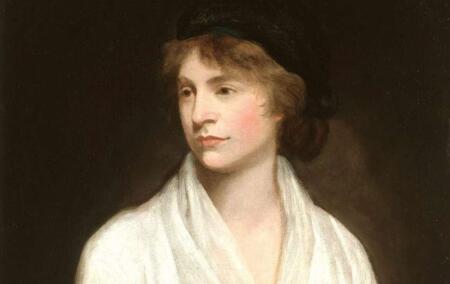
These were common assumptions at the time. But Mary Wollstonecroft, an early advocate for the rights of women based her seminal pamphlet, A Vindication of the Rights of Women, on Enlightenment arguments, calling for education to enable women to participate in society – her work is sometimes regarded as falling within the liberal paradigm.
Mill also wrote in favour of women’s rights, including suffrage: “Under whatever conditions, and within whatever limits, men are admitted to the suffrage, there is not a shadow of justification for not admitting women under the same.”
But even as liberalism grew in the West, and as women organised within established parties, their social and political rights lagged behind those of men; in Britain, several prominent members of the Liberal Party were noted for their opposition to women’s suffrage.
*The last of this three-part series will be published next Monday.
[Image: https://picryl.com/media/mary-wollstonecraft-by-john-opie-from-the-national-portrait-gallery-f6d7a3]
If you like what you have just read, support the Daily Friend
[1] Liberals tended to assert the notion of “capacity” for political participation. Alan Kahan describes it thus: “What did liberals mean by capacity? Where democrats talked about universal rights (and conservatives talked about historical or hereditary rights) liberals talked about capacity: who possessed it, who might acquire it, and by what means. It was liberals’ emphasis on capacity, and the varied ways in which they defined it, that distinguished liberals from other groups and from each other. The discourse of capacity expressed liberalism’s intermediate stance between the dead world of aristocracy and the world of democracy liberals wanted to see born, but not prematurely. Liberals defined themselves in opposition to both the old regime and to political democracy, and one of the functions of liberal political discourse was to enable liberals to reject the hereditary claims of absolutism and the aristocracy, as well as the democratic ‘rights’ claims of the numerical majority. The discourse of capacity enabled liberals to continue to pursue the progressive goals of the Enlightenment while avoiding the pitfalls of the Revolution and the dangerous language of ‘rights’. Through the discourse of capacity, liberals could establish and legitimize a rational and progressive hierarchy strong enough to withstand the threats they faced, both old and new. The discourse of capacity was the foundation of liberal political culture (Kahan: 2003).”
[2] Incidentally, Smith was concerned not just about the impact of unproductive government on society, but about the possibility of businesspeople suborning government to do their bidding.
[3] Russell Hardin writes: ‘In contrast to political liberalism, economic liberalism more or less grew, mostly out of conspicuous view. It was analysed and understood retrospectively rather than prospectively. It came into being without a party or an intellectual agenda. By the time Bernard Mandeville, Adam Smith, and others came to analyse it, they were analysing characteristics of their own society, some of which had been developing over many centuries.’ (Hardin, 1999)
[4] In this one sees an example not only of the normative argument, but a utilitarian one, a tradition with which Mill is also associated. Mill’s concern was not only with what was ethically correct, but with its impact on the wellbeing of society.
[5] Lincoln’s own position on slavery as a political matter was complex. He personally harboured strong views opposing it, though as presidential candidate in 1860, he pledged to respect the institution where it existed, but not to countenance its expansion. His initial priority was to save the American Union, even if this meant allowing slavery to continue. The American Civil War opened the possibility of making abolition a war aim – first through the limited Emancipation Proclamation, which did not apply to slaveholding regions that had remained in the Union, and later towards the end with the passage of the 13th Amendment. Lincoln was also at times sympathetic to the settlement of freed slaves outside the United States (Foner, 2010).