

The president condemns xenophobic violence while validating the very falsehoods that fuel it. The mob he warns against is the mob his own party helped create.
On the evening of 7 June, with the country still reeling from the murder of foreigners in Mossel Bay, just down the coast from where I live, President Cyril Ramaphosa addressed the nation on illegal migration and the anti-foreigner protests sweeping South Africa.
It was, in places, a fine speech. He said the responsibility for enforcing immigration laws rests with the state and the state alone. He said no person may confront someone in the street to demand proof of nationality. He warned against those who would exploit popular anger to incite lawlessness and violence. He even reached for genuine eloquence: “Migration is the way of the world and we must be prepared to embrace it. South Africa is a better country for migration. And we can become better still.”
He is exactly right about that. Our country is, as he said, a product of migration. With the exception of the Khoi-San, all South Africans have a heritage born of migration. It is the reason for our diversity and our vibrancy.
And yet the speech was a study in speaking with a forked tongue.
The lie inside the truth
Ramaphosa conceded that “illegal immigration is not the cause of all our economic challenges” (my emphasis).
Note the weasel word: all. Having granted that immigration is not the cause of all our woes, he spent the rest of the speech insisting it is the cause of a great many of them.
Illegal migration, he warned, “poses a risk to South Africa’s security, stability and economic progress”. It “affects service delivery and places additional burdens on essential services such as health care and education”. It “undermines our efforts to create decent work for our people”. Foreign-run spaza shops are “squeezing out South Africans”. And so on.
There is no good evidence that any of this is true, and a great deal of evidence that the opposite is true.
Immigration and prosperity
I have made this case before, more than once, and I will not rehash the entire argument here.
But the headline findings bear repeating, because politicians count on us forgetting them. Immigrants, including undocumented immigrants, contribute to economic growth. They create more jobs than they take. They commit crimes at lower rates than the native-born. Across the OECD, immigrants contribute more in taxes than they consume in public services.
Removing barriers to migration would do more to raise global prosperity than dropping every remaining restriction on trade and capital combined, according to a review in the Journal of Economic Perspectives.
Undocumented immigrants, who cannot easily claim public services and dare not approach the state, are, if anything, less of a burden on the fiscus than legal ones, not more.
When Ramaphosa says illegal immigration burdens our clinics and steals our jobs, he is not describing reality. He is flattering a prejudice.
Validating prejudice is dangerous
By validating the belief that illegal immigration is a burden on society, the president legitimises public anger against immigrants.
He may seek to direct that anger towards lawful process and constitutional values, but he feeds it all the same. He tells the frightened and the frustrated that their instinct is correct: yes, the foreigner is the problem; we, the government, simply need to be firmer in dealing with them.
The president surely knows that the mob does espouse Ubuntu, and does not check papers.
I wrote in 2022 that the mob doesn’t discriminate between legal and illegal immigrants. It doesn’t ask to see a visa or a residence permit.
The wrong complexion or the wrong accent is enough. We have just watched this play out in Mossel Bay, where more than 50 shacks were torched and at least two Mozambican men were beaten to death, while hundreds of people fled into the mountains and onto the beaches to escape.
Among the dead was a young South African, Nhlamulo Sambo, a Tsonga-speaker aged only 19. Elsewhere, the violence has swept up other South Africans, intimidated and assaulted for the crime of looking or sounding insufficiently native.
This is the predictable consequence of telling people that foreigners are the source of their misery. You cannot whip up a hatred and then primly insist it be expressed only through the proper channels. The president condemns the violence even as he ratifies its premise.
That is not leadership. That is arson.
Blaming out-groups
There is a reason politicians target foreigners whenever times are hard and elections loom. It is the quintessential populist play: when you cannot deliver, find an out-group to blame.
It creates a rally-round-the-flag effect, a xenophobic form of patriotism, fit only as a refuge for scoundrel politicians.
South Africa’s economic predicament can be reduced to a single phrase: stagnant economic growth.
There is no documented evidence that immigrants, legal or illegal, depress economic growth. There is abundant evidence that South Africa’s policies do.
The country is governed by statist politicians who smother private investment under taxes, racial carve-outs, licensing obligations and a blizzard of regulation; who imagine that old-fashioned socialism has somehow not failed every single place it has been tried; and who are, with dispiriting frequency, corrupt, incompetent, or both.
Whipping up protests against immigrants is a distraction, a way to deflect the mob’s fury away from its proper target. That target is the political class, the ANC chief among them but by no means alone, that has presided over collapsing municipalities, failing infrastructure, and an economy that cannot grow fast enough to employ its own people.
Whipping up the mob
And let us be clear about who is doing the whipping. The civil-society front of this campaign is led by Operation Dudula, now registered as a political party intending to contest Johannesburg, Ekurhuleni and Tshwane, and by March and March, whose founder, Jacinta Ngobese-Zuma, demands a state of emergency and the deportation of every undocumented migrant.
Both have set 30 June as a deadline for undocumented people to leave the country, a vigilante ultimatum no private group has any authority to issue, complete with a threatened “national shutdown”.
The political class has scented the votes. With local government elections set for 4 November, the timing of the latest unrest is no accident.
ActionSA’s Herman Mashaba has made a crackdown on undocumented immigrants one of his three red lines for any coalition in Johannesburg, and invites his critics to call him names.
The Patriotic Alliance, whose leader Gayton McKenzie once filmed himself chasing migrants along the Limpopo, holds its nationalist-conservative line.
The MK Party and the IFP have marched alongside the anti-foreigner groups in Durban and Gauteng.
The honourable exception (and it pains a classical liberal to say it) is the EFF, which distanced itself from the protests, sticking to its pan-Africanist, open-borders position even as the populist tide ran the other way. (That said, it has not always been consistent.)
The ANC, for its part, does not have clean hands, either. This is the party whose members have periodically led the charge against foreign traders, and Ramaphosa’s speech is best understood not as a break from that record but as an attempt to ride the same wave while looking statesmanlike doing it.
The façade called “legality”
The president leaned, as the other anti-immigrant political parties also do, on the supposedly unanswerable distinction between legal and illegal immigration.
Everyone, he intoned, agrees that every person in South Africa should be here legally.
Writing in these pages, Martin van Staden has demolished this sophistry thoroughly.
To say one favours legal immigration and opposes illegal immigration is to say precisely nothing, for everyone prefers lawful conduct to unlawful conduct.
The real argument is never about legality. It is about whether immigration should be easy or difficult. “Legal versus illegal” is a coded way of demanding that it be made harder, while preserving deniability.
Crossing a line on a map harms no one’s person or property; the common law never treated it as a wrong in itself. If illegality were truly the concern, the simplest fix would be to widen the lawful paths until the queues at the border were lawful queues.
What Ramaphosa should have said
The way to honour the president’s own fine words about embracing migration is not to call illegal immigration a “challenge that must be overcome”, as though human beings seeking a better life were a flood to be dammed.
It is to build an immigration regime that respects individual freedom by favouring the free movement of people.
Deport those who commit real crimes against person or property. Offer everyone else, the undocumented who are already here, working and raising families, a path to legal residency and, in time, to citizenship.
Replace an immigration policy that prohibits entry unless special circumstances permit it with one that permits entry unless special circumstances prohibit it.
Many of the people now hiding in the hills above Mossel Bay have built families and livelihoods in this country. That promotes social cohesion and economic activity; it is not a threat to either.
Tearing them from their homes and their work is not border management. It is a cruel violation of basic human rights.
A word to voters
So, to my neighbours in Mossel Bay and fellow South Africans, as November approaches I ask this: do not be played.
The Zimbabwean spaza owner and the Mozambican labourer next door are not the authors of your hardship.
The non-delivering mayor is. The councillor who cannot keep the roads paved or the water running is. The municipal manager who gives contracts to connected friends and family is.
The national politicians who shield them, and who now point at the foreigner to keep your eyes off their own failures, are.
Immigration, legal or otherwise, is a distraction. Don’t fall for it. Aim your anger, and your ballot, where they belong: at the incumbent politicians who stand between South Africa and implementing a blueprint for economic growth.
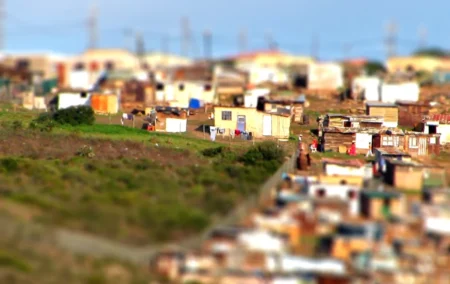
[Image: Mossel Bay, the scene of violent anti-immigrant protests in recent weeks. (Photo by Brendan Skinner, 20 June 2009, used under CC BY-NC-SA 2.0.)]
The views of the writer are not necessarily the views of the Daily Friend or the IRR.
If you like what you have just read, support the Daily Friend