

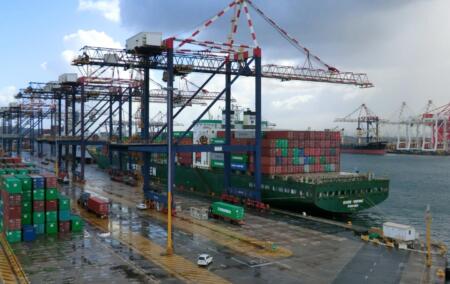
The 2025 Container Port Performance Index (CPPI) finds that Durban recorded the largest single-year efficiency gain of any port in the world between 2024 and 2025. Coega (Ngqura) was also among the top five most improved globally. Port Elizabeth leads all ports in long-run improvement since 2020. Despite the impressive improvements, South Africa’s main ports still rank near the bottom of the 400-port global index.
What the Index measures
Now in its sixth annual edition, the CPPI is produced jointly by the World Bank Group and S&P Global Market Intelligence. It evaluates 400 (ranked 1st to 400th) container ports worldwide using one metric: how long vessels spend in port from arrival at anchorage to departure from berth. Shorter turnaround times reduce shipping costs, lower supply chain risk, and improve a country’s competitiveness in global trade. The 2025 edition covers data from 2020 to 2025 and was released on 10 June 2026.
The global picture
Chinese ports dominate the rankings. Fuzhou holds first place, followed by Dalian, Oman’s Salalah, and two further Chinese ports – Mawan and Chiwan. Seven Chinese ports appear in the global top ten. The leading African port, Morocco’s Tanger Med, ranks sixth and is one of the few non-Asian facilities in the elite tier. East Asian ports account for the majority of the top 20 positions.
The report finds that efficient ports absorb and contain disruptions; congested ports amplify them. Given the Strait of Hormuz disruption, Red Sea rerouting, and ongoing geopolitical volatility in 2025, this context is analytically important. In a more transactional and volatile global trade, investment, and geopolitical environment, ports are active variables in supply chain risk.
Overall global port performance deteriorated slightly in 2025 relative to 2024, reflecting the cumulative effects of route disruptions and “burst congestion” episodes, where compressed vessel arrivals overwhelm terminal capacity in short, intense spikes.
South African ports rankings and scores
| Port | 2025 rank | 2025 score | 2024 score | YoY change | Trajectory |
| Cape Town | 400 / 400 | -302.6 | -281 | -21.6 | Deteriorating |
| Durban | 398 / 400 | -241.7 | -721 | +479.3 | Sharp recovery from 2024 low; still below 2020 baseline |
| Coega (Ngqura) | 380 / 400 | -119.0 | -284 | +165.0 | Sharp recovery from 2024 low; still below 2020 baseline |
| Port Elizabeth | 314 / 400 | -23.5 | -169 | +145.5 | #1 globally for improvement since 2020 |
Source: World Bank CPPI 2025 (Annex 2). Scores are relative to the annual median port performance. Zero equals median; negative scores indicate longer vessel turnaround times than the global median. The benchmark shifts each year as the global port mix changes; the more negative the score, the longer vessel turnaround times relative to global peers.
South Africa: the positives
Three South African developments merit attention.
- Durban recorded the largest year-on-year efficiency improvement of any port in the 400-port index between 2024 and 2025 – a swing of 479 CPPI points, from -721 in 2024 to -242 in 2025. The World Bank attributes this to reduced vessel waiting times, rising berth utilisation (from 52% to 76%), and the December 2025 awarding of a 25-year concession to ICTSI for Durban Container Terminal Pier 2.
- Coega (Ngqura) Port moved from -284 to -119, a gain of 165 points, placing it among the top five most improved ports globally year-on-year, alongside Freeport (Bahamas), Cristobal (Panama), and Manzanillo (Mexico).
- Port Elizabeth (ranked 314th) leads all ports worldwide in cumulative improvement since 2020, gaining 80 CPPI points from -103 to -23.5. It is the best-performing South African port in absolute terms and the only one approaching the global midfield.
South Africa features in global “most improved” rankings across both the short and long run – a first for the country in this index.
Why port efficiency matters: trade, growth, and jobs
Ports serve as a physical interface between a national economy and global trade. More than 80% of world merchandise trade moves by sea. For South Africa, a commodity-exporting, import-dependent middle-income economy with a structural tendency towards current account deficits, the cost of port inefficiency is a macroeconomic one
Every additional hour a vessel spends waiting at anchor or idle at berth is an hour of dead shipping capacity. Carriers price this into freight rates; freight rates feed into the cost of exported goods and the landed cost of imports.
For mining exporters, including iron ore, coal, manganese, chrome, platinum group metals, higher shipping costs erode already-thin margins and reduce the competitiveness of South African product against Australian, Brazilian, and Chilean alternatives with access to more efficient ports. For agricultural exporters, timing is existential: a delayed vessel at a congested terminal is citrus rotting in a container.
Port efficiency determines a country’s attractiveness as a manufacturing and export base. Foreign investors making location decisions for export-oriented facilities weigh logistics costs heavily. South Africa’s automotive sector, which exports vehicles and components through Durban and Port Elizabeth, competes directly with plants in Morocco, Egypt, and Eastern Europe, all of which benefit from materially better port infrastructure. The World Bank’s own research shows that a 10% reduction in port dwell time is associated with a measurable increase in export volumes and foreign direct investment in manufacturing.
Port delays also increase the cost of government procurement, drive up administered price pressures through import costs, and reduce the tax base generated by trade-exposed sectors. The National Treasury’s estimates have put the annual cost of South Africa’s port and logistics constraints in the range of 5% of GDP in lost economic potential; the CPPI data are consistent with that order of magnitude.
The strategic implication is that port reform is essential for macroeconomic growth and jobs policy. Durable improvement at Durban and Coega – sustained over multiple years, not just one – would lower the cost of doing business across every trade-exposed sector of the South African economy, attract logistics investment, and support the case for South Africa as a viable regional manufacturing hub. The ICTSI concession at Durban Pier 2 is the most significant policy signal in years. Its execution will determine whether 2025 marks a turning point or a statistical rebound.
South Africa: the negatives
Cape Town ranks 400th out of 400 ranked ports globally – last place – with a score of -302.6, worse than its 2024 score of -281. It moved in the wrong direction while Durban rebounded. Durban at 398th, despite its historic improvement, remains one of the most inefficient major ports on earth. Coega at 380th is still deep in the bottom tier.
The World Bank specifically notes that Sub-Saharan African ports are characterised by capacity constraints and import-dominated trade structures that produce longer turnaround times: ships arrive loaded but depart partially filled, extending vessel calls and reducing terminal throughput efficiency.
Every additional hour a vessel spends in port translates into thousands of dollars in carrier costs, costs that are ultimately priced into the landed cost of goods and the export competitiveness of South African producers. Mining exporters, agricultural exporters, and automotive manufacturers all carry this overhead.
Regionally, Walvis Bay in Namibia ranks 372nd globally with a score of -82.1, a modest improvement on its 2024 score of -91, but still well ahead of Durban and Cape Town. The Index ranked Maputo in Mozambique 273rd, with a score of -12.3; its score improved sharply from -40 in 2024. This means a port in one of the world’s poorest countries comfortably outperforms South Africa’s two largest container terminals. Beira (Mozambique) ranks 315th at -24.1, roughly on par with Port Elizabeth. South Africa’s ports continue to be outperformed by regional neighbours with far smaller economies and infrastructure budgets.
Shipping lines factor port reliability into routing decisions. Even as operational performance improves, the reputational lag in freight rate premiums and liner call frequencies takes time to reverse. A single year of improvement does not undo years of underperformance in the eyes of global logistics planners.
CRA assessment
While the short-term trajectory is positive, South Africa’s absolute port rankings remain dire. The country’s port improvement story is credible, and the World Bank data provide independent validation that reforms at Durban, Ngqura, and Port Elizabeth are producing measurable results.
However, the CRA cautions against reading directional improvement as structural resolution. Many of the impediments to better performance – Transnet’s labour constraints, electricity supply risk at port facilities, aging crane equipment, and road and rail bottlenecks feeding the ports – remain in place. The improvement reflects better management of a constrained system. The policies and legislation that drove the country’s ports into deep inefficiency remain largely unchanged.
For clients with supply chain, logistics, or export exposure, the key variable to monitor is whether Durban’s 2025 performance is sustained into 2026 or whether it reflects a one-year rebound from an unusually poor 2024 base.
[Image: https://commons.wikimedia.org/wiki/File:Durban_Container_Terminale_And_MV_Ever_Refine_-_panoramio.jpg]
If you like what you have just read, support the Daily Friend