

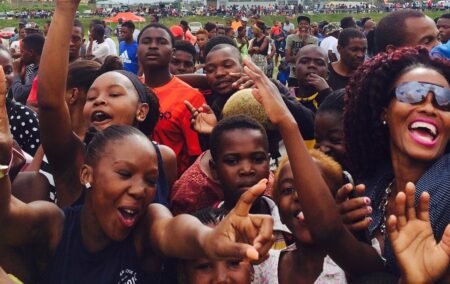
I began writing this last Tuesday, 16 June, nominally “Youth Day”, but in South Africa’s political lexicon, the commemoration of the 1976 Soweto students’ uprising.
We South Africans have an odd attachment to dates like these and the events they reference: our understanding of history is often shallow, our interpretations of it moralistic and refracted through the experiences of the present. Perhaps for that reason, days like this invariably become an “opportunity” to reflect on what they mean for the present.
So it has been today. The theme, of course, is youth. President Ramaphosa used his address at NASREC to highlight young people’s difficulties in entering the economy.
“The youth of 1976 fought exclusion,” he said, “ours must fight unemployment, poverty and inequality. Theirs was the struggle to enter the classroom. Ours is the struggle to ensure that what begins in the classroom does not end in the unemployment queue.”
In broad terms, he’s entirely correct. Of the 10.3 million South Africans between 15 and 24, about 2.7 million are in the labour force; working or otherwise wanting work and looking for it. Of these, a little over a million are employed, against 1.6 who are not – an unemployment rate of close to 61%.
The labour absorption rate for 15-to-24 year olds (that is, the ratio of the employed to the total population in that age range) is a dismal 10.1%.
If that is bad, there is another number that verges on the catastrophic. Another 3.9 million are classified as NEETs (not in employment, education or training). Representing around 38% of the total of this age group, these are essentially disengaged from the labour market. While a portion of these are definitionally unemployed a larger group are inactive, often completely discouraged from seeking work and taking no steps to improve their chances of finding it.
In other words, we may expect a lower proportion of the younger workforce to be outside the labour market while they pursue an education or qualification, but in South Africa, millions are not doing so.
By these indices, the economic mobility outlook for South Africa’s youth is among the worst in the world. The global average for youth unemployment sits at 13.4%. Higher rates tend to follow severe societal dysfunction or, to a degree, higher levels of development. In the former, the opportunities do not exist, in the latter, young people face hurdles of market demands for skills and experience (or their own expectations), or of regulatory barriers that make employers reluctant to take them on.
Yet, even such societies tend to do better than South Africa. According to the World Bank’s database, youth unemployment in Angola is at 27.2%, in Libya, 50.1%, and in Syria, 33.1%. In France it is at 18.9% and in Italy, 20.5%.
Not growing
For South Africa, there are two particular issues. One is simply that the economy is not growing. This is hardly a controversial assessment. Official economic strategies going back to the 1990s recognised the necessity of elevating growth to something above 5% a year as a precondition for sustained employment creation. But this level has only been attained in three years since 1994.
Behind this is the dismal rate of investment. At around 15% of GDP, it comes in at bang on half of what the National Development Plan aimed at, and below half of what comparable emerging markets are achieving. Until this is up, the economy will not grow, and job creation will remain anaemic.
By contrast, societies that have generated high growth over a protracted period can point to relatively low and declining levels of youth unemployment – even if the problem is not entirely absent. In India, youth unemployment stands at 16%, in Indonesia, 13%, and in Vietnam, 6.2%.
The second is that young people are entering a world of work that has been made inherently cautious about hiring. In a low-growth environment, taking on new staff is risky. Government policy has only aggravated this by onerous labour legislation and conditions of employment – bargaining council agreements, minimum wages, and a generally unsympathetic approach to business from the government.
And young people are entering the job market more often than not with substandard education – there has been plenty of coverage of this, with South African learners scoring among the lowest globally on assessments of reading and mathematics. This is despite quite respectable spending.
This is particularly troubling in view of the structural changes that have taken place. Fall-offs in the contribution of mining to the economy (a story on its own), and in the manufacturing sector has closed many of the entry level options for those without high-level skills. In practice, this has meant that many aspirant young people struggle to get onto a mobility ladder.
Bluntly put, the opportunities for business to make money are absent, and young people are ill-prepared for much of what is available.
Bespoke interventions
The state response to this has been a progression of bespoke interventions: investment conferences, wage subsidies, internships, public works, youth set asides and so on. Perhaps useful in the right context, but only as a multiplier when things are moving in the right direction. (And some measures, such as the demand for government-approved demographic representivity in a few years’ time, are positively deleterious.)
In reality, the state hasn’t the capacity or the resources to drive a real solution to this problem. To talk about 10,000 “opportunities” here, or even 100,000 there, barely scratches the surface. Only a transformed – a truly transformed, not one caught up in the official – economic environment that delivers high growth can do that.
In a resort to his personal form, the President appealed to employers: “I want to speak directly to the employers of South Africa – to every business owner, every manager, every person who holds in their hands the power to hire. The young person in front of you does not lack ability. They lack only the chance to prove it. I am asking you to open the door. Hire for potential, not only for experience.”
That’s high rhetoric from a podium on a commemorative day. Perhaps it’s also possible for a government with a steady flow of tax revenue and a lackadaisical regard for outcomes. For a business, things look rather different, and pursuing visionary social goals might come with an existential risk.
“Our problems are in the main our problems, and which we have a responsibility to fix ourselves,” President Ramaphosa said. He was referring specifically to the scapegoating of foreigners. But he touches on something. Much of what ails the youth today, the exclusion he decries, is because of what the country, or more accurately its government, has chosen.
It has opted for a policy mix that discourages hiring, and that disincentivises low-wage, unskilled employment. It has capitulated to union interests in the education sector, at the cost of the educational outcomes of the country’s young people. It has prioritised an extractive “empowerment” model that has escalated the costs and limited the rewards of doing business. It has pushed expropriation policies on a number of fronts, threatening property rights and placing future investments – local and foreign – in jeopardy.
Where the symmetry ends
Perhaps this is the real symmetry for South Africa’s youth between 1976 and 2026. Each confronts circumstances created and sustained in significant measure by official policy, and an official mindset resistant to change.
But that’s, fortunately, where the symmetry ends.
The youth of 1976 lacked democratic representation and the prospects of it. These exist today, should South Africa’s people choose to use them. With local elections taking place in less than five months’ time, that’s a choice they will have an opportunity to make.
[Image: By Holly Wasserfall – Own work, CC BY-SA 4.0, https://commons.wikimedia.org/w/index.php?curid=55550491]
If you like what you have just read, support the Daily Friend