

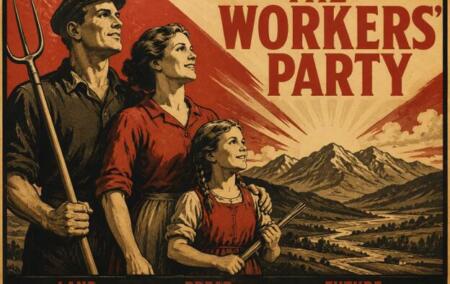
Every political party of the left, everywhere, has the same word around which much of its messaging emerges. Workers. The British Labour Party is named for them. The Democratic Party invokes “working families” with regularity. The Democratic Socialists of America (DSA), enjoying their moment in the American sun, promise to fight for the working class against the billionaire class. It is the left’s founding iconography – the calloused hand, the picket line, the lunch pail. The worker.
The AI-employment headlines today are often focused on which cognitive-heavy occupations are most vulnerable. Will software engineers survive? What about lawyers, accountants or graphic designers? Now the robotics headlines are beginning to surface, as the technology also starts its exponential trajectory. It is not only human cognitive employment that is under threat; physical AI has now moved into the realm of the senses — arms, hands, legs, feet, ambulation, grasp and lift. What then of those jobs?
The more profound question to ask is not whether work disappears altogether. It almost certainly will not. It is whether the “working class” (both blue and pale-collar) – the social and political constituency that has shaped politics for more than a century – will begin to dissolve as the central organising force of society.
If that happens, the consequences extend far beyond economics. They reach into the foundations of every political party, every election campaign and every ideological battle that has defined the industrial age.
For almost two hundred years, democratic (and some non-democratic) politics has revolved around a simple relationship. Capital owned the factories. Labour operated them. The inevitable tension between the two produced trade unions, socialist movements, labour parties and eventually much of the welfare state. The great political arguments of the twentieth century were arguments about how the rewards of production should be divided between those who owned capital and those who sold their labour.
This vocabulary reflects more than sentiment. It reflects an assumption that work remains the principal way in which citizens contribute to society, acquire dignity and meaning, and earn their sustenance.
But that assumption is beginning to look remarkably fragile, because the working class is disappearing.
Brutal
Consider the numbers, which are brutal even before AI entered the picture. US manufacturing employment peaked in June 1979 at 19.6 million people, about 22 per cent of all jobs. Today it is under 13 million – roughly 8 per cent – even though American industrial output has doubled since that peak. The factories did not go away. The people in them did.
China took some of those jobs after 2001; automation took the rest, about 1.7 million of them since 2000, and it never gave any back. Meanwhile private-sector union membership – the connective tissue between labour and left politics – has withered to 5.9 per cent, the lowest figure ever recorded. The mighty industrial proletariat of historical song and slogan is now, statistically, on its way to becoming a rounding error.
And that was the before picture. The after picture arrived in October 2025, courtesy of leaked Amazon strategy documents. The company – America’s second-largest private employer – plans to automate 75 per cent of its operations, avoiding the hiring of more than 600,000 workers by 2033, even as it doubles sales. Its template warehouse in Shreveport, Louisiana, swarming with a thousand robots, already runs on a quarter fewer humans. Amazon’s robot fleet has passed one million, closing in on its human headcount.
With brazen cynicism, executives were advised to avoid the words “automation” and “AI” in public, preferring “advanced technology” and (one cringes) “cobot”. Daron Acemoglu, the Nobel laureate who studies exactly this, warned that once Amazon cracks the economics, everyone follows, and one of America’s great job creators becomes a net job destroyer.
The queue behind the warehouse worker is long. Projections have US professional drivers falling from 3.8 million to around 2.3 million by 2030 as autonomous trucks scale. Some 80 per cent of customer service roles are considered automatable; Salesforce has already shed 4,000 support jobs to AI agents. Cashiers, janitorial work, mining, visual monitoring – all of it sits squarely in the AI and robotics blast radius.
By March 2026, AI was the single largest stated reason for announced American job cuts.
Gleaming machines
And looming there somewhere is Elon Musk’s humanoid robot Optimus. How many of these gleaming machines is he projecting? First-generation production lines are being installed at Fremont, designed for one million robots a year, while a second-generation line at Gigafactory Texas is being prepared for a long-term annual output of 10 million robots starting in 2027. Musk has previously claimed there would be one or two robots for every human on Earth – implying a long-run fleet of 10–20 billion units (supported by Morgan Stanley projections). The Chinese, the world’s robotics leader, agree, having made robots a core strategic pillar of their future (called “Robot+”), which means massive and ongoing state capital injection.
Which brings us back to the political riddle. What does a “workers-first” party do when there are no workers – or, more precisely, when the working class is a server rack and a fleet of robots that require neither healthcare nor weekends nor (crucially) representation?
The truth is that working-class voters started leaving before the robots arrived. The working-class share of the Democratic coalition peaked around 56 per cent in 1960; it is now about 30 per cent. Democrats’ share of non-college voters slid from 47 per cent in 2020 to 43 per cent in 2024, and the bleeding spans every ethnicity – black, Latino and Asian non-college voters are all drifting away.
The modern Democratic Party is now the party of the college-educated professional, awkwardly claiming to speak for the working class from on high. When the DSA’s rising stars campaign focuses on protecting working families, they are addressing a constituency that is simultaneously shrinking and gradually being decommissioned.
And the humans at the receiving end of this change? Amazon’s cheerful answer is that displaced workers will find “jobs of the future” tending the robots, which raises the obvious question of whether one now needs an engineering degree to work in a warehouse.
Destroyed by 2030
The optimists at the World Economic Forum promise 170 million new jobs against 92 million destroyed by 2030 – a net gain, they insist, though history suggests the new jobs rarely appear in the same towns, at the same wages, or for the same people as the old ones.
It’s not going to be pretty (and one can see it empirically in the increasingly dark tenor of social media posts on the subject). Tens of millions of people with obsolete skills, intact grievances and smartphones – and no obvious political home on the left.
The original Luddites – skilled weavers, not technophobes – smashed frames for six years and were hanged for it. Their modern-day descendants are going to be more numerous, better networked, and considerably angrier, having watched the productivity gains of their own redundancy accrue to a small shareholder class.
Whether that energy flows into a reanimated, muscular neo-Ludditism, into the arms of authoritarian populists promising to smash the machines (or the immigrants, whichever is closer), or into a serious politics of redistribution – universal basic income, robot taxes, sovereign AI dividends – is the defining political question of the next two decades.
For nearly two centuries, politics has argued about who should own the factory and who should own the fruits of the labour that fuels it.
The coming argument may be altogether different, and the left – the traditional home of the working class – has, curiously, been unable to respond with anything really new.
[Image: reve.art]
The views of the writer are not necessarily the views of the Daily Friend or the IRR.
If you like what you have just read, support the Daily Friend