

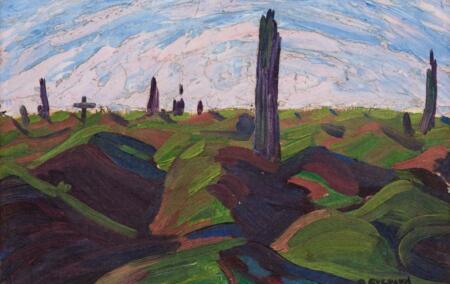
On 15 July 1916, the 1st South African Infantry Brigade advanced into a square kilometre of wood on the outskirts of the village of Longueval, during what became known as “the battle of Delville Wood”. Six days later, of the 3,153 men who had entered the wood, 780 were able to walk out. The rest were dead, wounded or missing, buried under earth that days earlier had been a stand of beech, oak, maple and hornbeam; with a name few South Africans had heard before: Delville Wood.
This month marks 110 years since that battle, and the temptation, as with any round-numbered anniversary, is to treat it as an occasion for ceremony rather than scrutiny. But Delville Wood deserves more than a wreath and a photograph, it deserves an honest accounting of who fought, who was permitted to fight, who has been left out of the story for a century, and, increasingly, the post-1994 government has itself failed to remember with the seriousness their service demands.
Delville Wood earned its grim nickname, “Devil’s Wood”, within days, as German artillery reduced its trees to splinters, however the brigade held its ground through a bombardment so continuous that by the time relief arrived, the wood scarcely resembled a wood at all. Of the roughly 229,000 South Africans who served in the war, some 10,000 died in action or of wounds and disease. The Brigade’s week at Delville Wood alone accounted for a disproportionate share of that toll, and this week, more than any other single episode, fixed itself into South African memory as the emblem of the country’s contribution to the Great War.
For the white South Africans who made up the brigade, and for the country’s collective memory thereafter, Delville Wood became what Vimy Ridge is to Canada or Gallipoli is to Australia and New Zealand: a founding wound. The South African National Memorial at the site, unveiled in 1926 and designed by Sir Herbert Baker, was built to carry that memory forward.
South Africa’s Union Defence Force in 1916 was defined and structured by the racial policy of its time. Combat roles in Europe were reserved for white troops, while black South Africans who volunteered were channelled instead into the South African Native Labour Corps (SANLC). Some 21,000 of them, digging trenches, building roads and moving supplies under military discipline did so without weapons. Coloured South Africans served largely through the Cape Corps, but were allowed to carry weapons, while Indian and Malay South Africans were confined to auxiliary formations.
The Cape Corps’ exclusion from the Western Front is worth dwelling on, because its record elsewhere was not in question. The Corps fought in the East African campaign (modern day Tanzania) and, in September 1918, distinguished itself at the Battle of Square Hill in Palestine, taking its objectives at bayonet point and suffering some of the heaviest casualties of any South African unit in that theatre. That its men were nonetheless barred from Delville Wood, and from the memorial later built to it, reflects the politics of 1916 far more than it does the fighting qualities of the men involved.
It is worth stating plainly, too, that none of this service was compelled. South Africa never introduced conscription during the First World War, unlike Britain from 1916 onward. Every single man who went forth into the fray, whether as a rifleman in the Brigade, a bayonet-fighter with the Cape Corps, or a labourer with the SANLC, volunteered for it, and did so knowing full well the unequal terms on which that service was offered. The war effort was national, but the recognition of it, for most of the twentieth century, was not.
Nowhere is that imbalance starker than in the sinking of the SS Mendi.
On 21 February 1917, the troopship, carrying members of the Native Labour Corps across the English Channel, was struck in fog by the cargo liner SS Darro, which failed to stop and render assistance. The Mendi went down in under half an hour, with more than six hundred South Africans aboard, most of them black labourers who had crossed an ocean to serve an empire that would not let them carry a rifle. The Reverend Isaac Wauchope Dyobha is remembered as having called the men to face death together on the sinking deck:
“Be quiet and calm my countrymen, for what is taking place is exactly what you came to do. You are going to die, but it is what you came to do. Brothers, we are drilling the death drill. I, a Xhosa, say you are my brothers. Swazis, Pondos, Basutos, we die like brothers. We are the sons of Africa. Raise your war cries, brothers, for though they made us leave our assegais in the kraal, our voices are left with our bodies.”
The Darro’s own conduct that night did not escape scrutiny entirely: a subsequent Board of Trade inquiry found her captain guilty of serious errors of judgement and suspended his certificate for a mere twelve months, a penalty many considered scandalously light set against a loss of more than six hundred lives. For decades afterwards, the Mendi’s story belonged almost exclusively to the communities the men came from, kept alive in oral memory and church services long before it found any place in the South Africa’s official commemorative landscape.
It would be comforting to say that 1994 settled the matter, but it did not, at least not quickly. Efforts to commemorate all of South Africa’s WWI fallen, irrespective of race, were declared as policy in the years after democracy arrived, but the practical correction lagged well behind the rhetoric. The Order of Mendi for Bravery, a civilian honour named for the disaster, was only instituted in 2003. It was not until 2014 that the remains of Private Beleza Myengwa, believed to be the first member of the Native Labour Corps to die on the Western Front, were moved into the courtyard of the Delville Wood museum itself, giving one labourer, at least, a resting place inside the memorial his comrades died for. And it took until the centenary in 2016, twenty-two years into the democratic era, for Pretoria to unveil a memorial wall at Delville Wood listing the country’s war dead alphabetically and without racial distinction, and to properly integrate the Native Labour Corps and Cape Corps into the site’s exhibitions. Armed Forces day on 21 February commemorates the sinking of the Mendi, but has yet to achieve the standing of a public holiday or a fixture of the national calendar. Most years, it receives only a fraction of the attention paid to more recent and more politically convenient anniversaries.
In February 2017, on the centenary of the sinking, black, white and coloured descendants of the Mendi’s dead travelled together aboard the frigate SAS Amatola to the wreck site in the Channel, a gesture that would have been unthinkable in the segregated commemorative culture of a generation before. Yet the gesture also illustrates how much still rests on set-piece anniversaries rather than sustained institutional practice. The navy’s own Valour-class frigate SAS Mendi, commissioned in 2004 specifically to carry the name into the modern era, has spent more time in habour than at sea, a small but pointed irony for a vessel meant to honour men who never had the luxury of staying in port.
South Africa’s heritage and military-memory institutions have generally spent the democratic era competing for a shrinking share of an already constrained cultural budget, reliant on a mix of public funding, ticket revenue and goodwill that has left several flagship sites in real financial distress.
None of this diminishes what any of those men did, at Longueval, or Palestine, or German East Afrifa, or in the Channel. They were not conscripts; they went by choice, and that is precisely why the authorities’ slowness to reciprocate is hard to excuse. A government that inherited the injustice of who was allowed to fight has a particular duty not to prolong it in how it remembers who fell. Remembrance is not sentimental upkeep; it is a discipline, one that requires correcting the record, not only in centenary years when the cameras are present.
The sacrifices deserve a proper place in the new school curriculum and the national commemorative calendar, rather than remaining a diary date observed mainly by the armed forces and a handful of descendants’ associations. And the country’s set-piece war commemorations warrant consistent, senior ministerial attendance, not delegation, in the years that fall between the round numbers.
South Africa has made real, if belated, progress: the 2016 memorial wall, the Order of Mendi, joint commemorations that now name black, white, coloured and Indian dead together. But progress measured in decades is not the same as an institution treating this history with the priority it warrants. On the 110th anniversary of Delville Wood, the appropriate tribute is not another ceremony alone, but a firmer, more durable commitment from government to the men of the Brigade, the Labour Corps, the Cape Corps and the Mendi alike, strands of the same story, meant honoured as equally as they lived and died.
[Image: https://www.straussart.co.za/auctions/lot/7-nov-2016/205]
If you like what you have just read, support the Daily Friend