

The recent controversy over Bokkieweek offers a useful lens on a deeper and recurring question in South African public life: do Afrikaners get to exist as Afrikaners per se, or only as scattered individuals whose cultural preferences must remain private and unorganised?
We know what the political elite and those English South Africans who still harbour grievances from the 1960s would say.
Bokkieweek
Bokkieweek is a 35-year tradition organised by Afrikaner Volkseie Sport. Held this year in Naboomspruit from 6 to 10 July, it brought together thousands of young participants for rugby, hockey, and netball, alongside cultural elements and a clear emphasis on Christian-Afrikaner values. Melanin content and biology are not Bokkieweek’s organising principles. It functions as an independent, culturally grounded alternative, rather than a rival to the state-affiliated sports federations.
Distinguish this from all the various state-supported initiatives in South Africa today, which are, in fact, to some degree organised around melanin content and biology, such as race laws, and racial so-called affirmative action policies, and also various associations in civil society and in business that are marketed for their championing of black (melanin), not Zulu, Xhosa, Sotho, etc., (cultural) interests.
To be clear and unequivocal: The liberal principle is that private parties get to organise peacefully and voluntarily around anything that they want, and that includes biological race.
But the mainstream of Afrikaners national organisations do not, in fact, do so. Pierre de Vos, a white supposed “Afrikaner”, would not be welcome at Bokkieweek. An Afrikaans-speaking Chistian rugby player part of the Afrikaner community – though arbitrarily classified by the state as “coloured” – would be.
Naturally, the reaction from parts of the political and media elite to Bokkieweek was unsurprising.
Panyaza Lesufi denounced the event on social media as “apartheid sport” and “a racist endeavour” that is a “travesty of our democracy”. He described thousands of children singing what he called “the apartheid anthem Die Lied van Jong Suid-Afrika” and competing under the names of “apartheid-era provinces”.
Lesufi urged sports minister Gayton McKenzie to blacklist participants (these are children) from state team selections. McKenzie replied that “this is pure nonsense and we will not allow it – apartheid-nostalgists showing up again”.
Much of the framing originated in a News24 report that presented Bokkieweek as an “apartheid-era Afrikaner-only tournament”.
This rhetoric is familiar: any sustained expression of Afrikaner national identity is treated as inherently suspect and reducible to the policies of the Apartheid period.
In reality, Die Lied van Jong Suid-Afrika is a folk song from the era of Afrikaner national awakening, and was never an “anthem” of the policy of Apartheid.
The provincial names – Transvaal, Orange Free State, Natal, the Cape – long predate 1948 and survived the end of Apartheid, too. They are no more “apartheid-era” than the names of various American states – New York, New Hampshire, Virginia, and so on – are “slavery-era”. I was born under the African National Congress government. I hope “Martin van Staden” is not one day remembered as an “ANC-era name”.
The habit of collapsing Afrikaner heritage into apartheid policy is clearly intended to delegitimise Afrikaners per se rather than serve as true journalistic purposes.
Afrikaner individuals
This episode is hardly isolated.
During my undergraduate years at the University of Pretoria, a tutor argued that historically Afrikaans universities needed to become properly “South African” rather than Afrikaner institutions.
Around the same time, then higher education minister Blade Nzimande signalled strong reservations about the registration of private Afrikaans-medium institutions. In the case of Akademia, he indicated that registration could be withdrawn if the institution remained exclusively Afrikaans. Later comments suggested he would not permit structures that, in his view, excluded certain groups.
I pointed out to the tutor that the practical effect of these positions, taken together, was a double bind: public institutions with historic Afrikaner heritage were to be deracinated in the name of “transforming” into South African institutions, while private alternatives faced regulatory hostility if they retained a clear Afrikaner linguistic and cultural profile.
The unstated premise is that Afrikaners can exist in South Africa as individuals who happen to be Afrikaners, but not as a national community capable of sustaining our (self-consciously) own educational and cultural institutions.
The discomfort with Afrikaner per se organisation is not limited to sports or higher education. It surfaces whenever Afrikaners attempt to maintain schools, cultural associations, or events oriented around our shared language, conception of history, religious commitments, and values.
The objection is rarely framed as opposition to voluntary association in principle, but always presented as a defence of an inclusive “South African” identity that must take precedence. Yet this framing assumes the very thing that requires demonstration: that a single “South African nation” exists and that its requirements override the organic nations that actually constitute our society.
History of “South African nationalism”
There has never been a South African nation in any substantive sense.
The idea originated in the 1910s with generals Louis Botha and Jan Smuts, of the South African Party (SAP), as a project to fuse the Afrikaner and English-speaking white populations into a new national whole.
The National Party (NP) opposed this idea at first, pushing a chauvinistic Afrikaner nationalism that conceived of South Africa as primarily the territory of Afrikaners. Everyone else were welcome guests, but had to live how and where Afrikaners told them. This approach held out for a while, but by the time the SAP and NP formed the United Party in 1934, its unsustainability became obvious.
Going forward, including from the time the re-emerged NP monopolised power in 1948, the idea of fusing the white English and Afrikaans sections of the population into a “South African” whole took centre stage. The NP at this time went to great lengths to emphasise that it was not anti-English, and it even believed that finally separating South Africa from Britain in 1961 would lead the English section to see South Africa as their national home, alongside the Afrikaners.
This proved true.
Later still, from the late 1970s, the NP (tentatively) expanded the concept of a single South African nation to include coloured and Indian-descended South Africans, while tyrannically treating black South Africans as nations developing along their own lines in the homelands.
None of this “South African nationalism” – except as it relates to white English South Africans – ever described social reality.
What makes a nation?
Nationhood has porous and blurred borders, but the core of a people qualifying as a volk or a nation is a shared language, ethnicity, religion, cultural practices, conception of history and present and future, and/or territory, and a reciprocal and conscious awareness of nationhood. Some of these elements are more or less important than others, but the standout, constitutive features are a shared conception of history, present, and future (specifically history), and a reciprocal and conscious self-awareness of nationhood.
There can be no nation if its people do not agree about the core of that nation’s history, or if they have a competing national allegiance and do not recognise themselves primarily as members of the nation.
South Africa is a very linguistically diverse country. We can all speak English for the most part, but ability is not the criterion here. The question is whether that is the language of our hearts, dreams, and prayers. There is no common “South African” language.
I obviously need not elaborate about there being no common “South African” ethnicity. We are not like the Germans, the French, the Japanese, or the Thai.
Nor does one need to point to our religious diversity: South Africa is largely Christian, but we do not share a denomination. Afrikaners themselves are held together religiously by a shared Reformed heritage but could never stay in the same church group.
We do not have a shared conception of “our” history, origin story, or our trials and tribulations. And even if we have factual agreement about what actually happened, we have wildly different interpretations of those facts and events.
Let me illustrate: like him or hate him, Marco Rubio (the Secretary of State of the United States) is thoroughly American in national outlook. He identifies his national history with the arrival of the British on the east coast of North America and the revolutionary war that established the United States of America in the eighteenth century. He does not identify his national history with that of Cuba – from where his immediate ancestors immigrated – Spain, or Italy. Despite his own personal history, he has “read himself into” the mainstream American civic national story, with its shared conception of history.
Back on the homefront, do Zulus, Sothos, Xhosas, or Anglo South Africans in general share Afrikaners’ romanticism about Hendrik Bibault’s cry of “Ik ben een Africaander!” in 1707 and what this meant? Do they see Jan van Riebeeck as a notable national father? No – and why should they abandon their own national identity for this purpose?
On this score alone, there is no common South African nationalism. There can never be a South African nation unless all the constitutive parts of this supposed nation agree (in broad strokes) about what our past is and means. Dream on!
But South Africans also do not possess a self-conscious recognition of ourselves as one people. When the Zulu king refers to “abantu bethu” and when the leaders of the Solidarity Movement refer to “ons mense”, they are not referring to the same group of people.
The Anglos
It is only when that small section of the population organised around what used to be the exclusively white English, Anglicised population speak of “our people” that a “South African nation” is meant.
It is only this Anglicised class, and to some degree the political elite, that have put their hands up for South African nationalism.
The first group is essentially, and has historically been, focused around the white English segment of the population, which specifically after 1961 – when a large portion of their connection to Britain was severed with the formation of the Republic – transferred that “imperial” nationalism to the presumably tabula rasa of a “South African nation”. They did this with the encouragement of the chauvinistic Afrikaner nationalists of that era, not appreciating that the Afrikaners themselves were not really playing ball.
The English projected themselves onto South Africa. Not onto an ethnic or cultural English, Afro-English, or Anglo-Afrikaner status, but onto the patria – the common fatherland.
And the other group, which is even smaller, is the South African political elite. People like Cyril Ramaphosa, Julius Malema, and certainly the top echelons of the Democratic Alliance. These people believe in a largely Anglicised, though by no means necessarily free Western, South Africa.
These are the people who want to ensure that everyone studies in the same language – which is English, not Zulu, Sepedi, or Sotho, but English. They are the ones who seek to tell a uniform story of South African history, like with the latest changes to the school history curriculum. These are people like Gayton McKenzie and Panyaza Lesufi, who do not want to tolerate Afrikaner events unless they are open to “all South Africans”.
These are the only two groups, not necessarily racially defined, that as a national characteristic believe that there is such a thing as a “South African nation”.
State and nation
What does exist is a territorial state that contains multiple nations – Afrikaner, Zulu, Indian-descended, and others – that have chosen, repeatedly and in different ways, to live together without assimilating into one another.
Zulus and Sothos rightly resisted the imposition of Afrikaans in their schools during the Apartheid era. Yet wherever Afrikaners are found in significant numbers, Zulu and Sotho communities are also present.
In the 1990s, Afrikaners possessed the institutional capacity, financial resources, and coercive power either to perpetuate Apartheid or to secure a carved-off volkstaat. They pursued neither course, and chose a shared South Africa.
This was not an act of cultural surrender, but a decision to remain within a confederation of nations alongside peoples they have been familiar with for centuries.
Real multiculturalism respects this paradigm.
It permits nations to maintain their languages, educational preferences, cultural events, and forms of association without requiring them to dissolve into a majoritarian or Anglicised whole.
Many of the people who are opposed to Afrikaner per se organisation do so from the correct insight that Afrikaners are the best organised nationally conscious group in the country. There is not supposed to be anything wrong with this – but to those who mean to do Afrikaners per se harm, this is a great threat.
This harm – the alternative on offer – is not multiculturalism at all, but a homogenising enterprise that treats any organised expression of Afrikaner identity as a threat to an imagined South African nation whose content is defined, in practice, by the Anglicised, cosmopolitan, and essentially secular outlook. It is a statist identity.
This outlook is then presented as the universal default to which all other groups are expected to converge once they receive sufficient instruction.
Shared South African patriotism
The Afrikaner Declaration adopted in 2024 by a network of Afrikaner organisations and leaders stated the position with clarity.
Afrikaners understand ourselves as an indigenous cultural community with deep roots on the African continent. We wish to remain part of South Africa and to contribute to its well-being. We seek appropriate forms of self-determination in language, culture, and education. We have no interest in monopolising or dominating the country or doing harm to anyone. Indeed, the Declaration is made available in Afrikaans, English, Zulu, Pedi, Tswana, and Xhosa.
We do also, however, insist that participation in the South African project cannot be made conditional on the surrender of our Afrikaner national identity. That is intolerable and a nonstarter.
This posture is not a rejection of South Africa. It is a rejection of South African nationalism – the notion that a single nation must be constructed or imposed at the expense of the several nations that actually exist.
Shared patriotism (derived from the Latin patria, meaning “fatherland”) is rooted in a common territorial claim and place of origin, and we have seen a shared South African patriotism in spades. This relates to our shared country, not a shared volk.
Shared nationalism does not exist, and attempts to manufacture one have done and will continue to do harm.
No more
The generation of Afrikaners now entering maturityand leadership carries no personal responsibility for the authoritarian policies of the apartheid period, and they have thoroughly, through word and deed, departed from chauvinism. Whatever reparations or transfers have been deemed necessary have been paid and continue to be paid.
The demand that Afrikaners must additionally demonstrate perpetual obsequiousness or accept the gradual dissolution of our national identity and heritage as the price of belonging, is rejected with the contempt that it deserves. Afrikaners are increasingly unwilling to request permission to maintain our own institutions and events. We are prepared to defend the right to do so on the same liberal principles that ought to protect voluntary association for everyone in the country.
The persistent equation of Afrikaner cultural organisation with “apartheid nostalgia” serves mainly to avoid this substantive conversation.
It supplies ready rhetorical ammunition for those who prefer to police culture rather than accommodate the actual pluralism of our society, where we are meant to be united in our diversity.
Afrikaners are not asking for privileges and have sacrificed all those our ancestors unduly once held. We are, however, asserting that the right to be a nation among nations, within a territorial state that all have chosen to share, does not require external authorisation.
The days of asking for permission to exist, or apologising for choosing ourselves, are over, and this sentiment becomes steadily more confident by the day.
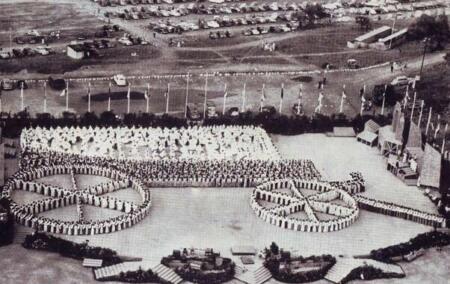
[Image: Nasionale Raad vir Volksang en Volkspele 1955 | PICRYL.com]
The views of the writer are not necessarily the views of the Daily Friend or the IRR.
If you like what you have just read, support the Daily Friend