

“If this was a war of machines, there would be no war.” Dmytro Kutovyi was speaking at the Kharkiv Media Hub located off the main square of the eastern Ukrainian city.
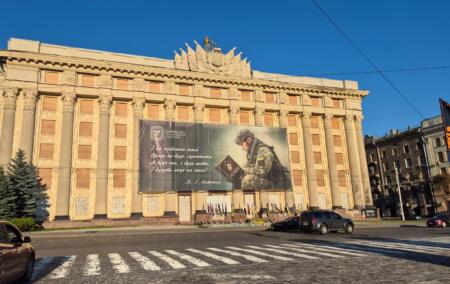
At the other end of the cobbled square, reputedly the largest in Europe, sits the boarded-up and burnt-out regional administrative office, struck by Russian cruise-missiles in March 2022 shortly after Moscow’s full-scale invasion.
Kharkiv, Ukraine’s second-largest city after Kyiv, was a key symbolic and industrial target.
Kharkiv held out then as it does now, pushing the Russians back, but not out of bombing and missile range. It’s a cat-and-mouse game – what Dmytro refers to as a “war of eyes” – with Russian drones targeting civilians and their services, from restaurants to gas stations. Every night is punctuated by wailing sirens, phone apps indicating the range of the incoming.
The closer one gets to the Russian border, only 30kms away from the centre of the city, the greater the threat.
As you head towards the north, in the direction of the district of Saltivka, you slip under drone netting.

[Image: Greg Mills]
Most petrol stations have been targeted by drones, along with many businesses and the nation-wide postal service. Occasionally, with Russian fibre-optic drones now capable of ranging up to 40 kms, civilian cars are hit, “to terrorise and give the operators target practice.”
Saltivka has been the target of constant Russian attention since the beginning of the war, now one of the city’s most devastated areas, given the relentless Russian missile, drone, and guided aerial bomb attacks.
Seldom a day goes by in Kharkiv without several strikes, sometimes with devastating effects. In the first week of July, a Russian missile strike hit a five-story residential building in the city, killing ten, including two children, and injuring 16 more. On the day that wrote this, 15 July, Russia struck Kharkiv’s Kyivskyi district with a guided aerial bomb, injuring at least nine people. A giant explosion shook our building as air defences blew up a Shahed drone overhead. The day before, Kharkiv and 21 other settlements in the Oblast were attacked, with two people being killed, and 16 injured, and damage to a warehouse, a petrol station and a multi-story residential building.
Before the war, the population of the city was nearly two million, consisting of 1.6 million permanent residents, 300,000 students, and regional commuters. In the immediate aftermath of the invasion, by May 2022, according to some estimates, the city’s population fell to less than half a million.
It has since risen to around 1.3 million, which includes some 200,000 who have fled the fighting elsewhere.
The Kharkiv Media Hub has assisted more than 2,500 journalists who have come through this eastern Ukrainian city to report on the war. It’s difficult to keep global public interest alive in an international community which has become either numbed or bored by Russia’s actions, and in their silence, accepting of its impunity.

[Image: Greg Mills]
Realising that journalists would require a go to place, and fixers, Dmytro and Natalia Kurdiukova set up the Hub in 2022. In 2014 they had established a media outlet known as ‘Nakypilo’ or ‘That’s Enough!’.
The Media Hub has supported itself through small grants and, increasingly, its own film productions and art exhibitions, the latter helping to keep a thriving cultural side to Kharkiv alive and well. Its latest exhibition is entitled, fittingly, ‘After, not yet’.

[Image: Greg Mills]
Kharkiv always has enjoyed two sides of life: the industrial and the cultural. Karazin University, one of 23 in the city, continues to churn out graduates from its 16,000 students, despite the security conditions demanding on-line studies. The university was founded in 1804, making it the oldest continuously operating one in the country. Its Faculty of Radio Physics, for example, ploughs on with research into technology that will enable the identification and clearance of plastic landmines. Midway through the meeting in their lab, we had to move into the hallway as the city siren once more wailed.
Kharkiv has been here before. In the Second World War, the city was captured by the Nazis in October 1941, recaptured by the Soviets in March 1942, though swiftly lost once more, and finally permanently retaken in September 1943 as the Germans backpedalled all the way to Berlin. Up to 70% of the city’s buildings had by then been destroyed, leaving the pre-war population of 900,000 reduced to less than 200,000.
Kharkiv had been strategic to Soviet military industry, its mammoth Tractor Plant being instrumental in the design and development of the Soviet T-34 tank, the Kharkiv (or as the Russians preferred, Kharkov) Aircraft Plant and the Kharkiv Turbine Plant among others, producing a catalogue of military hardware, including Su-2 aircraft, artillery tractors, 82mm mortars, sub-machine guns, ammunition, and other equipment.
The Nazis believed that control of this vital economic centre would collapse the Soviet economy. They were wrong, not least since Lend Lease kept the Soviets in the war when they were at their lowest ebb.
In the same way, Putin believes that he can terrorise people into submission. Just outside Kharkiv is the Polish War Cemetery, or Pyatykhatky. Opened in June 2000, this site is located in the forest park where 3,809 Polish officers and 500 intelligentsia from the Starobilsk camp were executed by the Soviet NKVD, Stalin’s secret police, forming part of what is known as the Katyn massacre, after a village in western Russia, where 4,500 of the 22,000 victims were murdered.
But the one lesson Vladimir Vladimirovich Putin is learning is that Ukraine is quite unlike Russia in one important respect: it does not operate as a hierarchical top-down society in the Moscow model, but is horizontally organised.
“We don’t want or need a king,” says Natalia. This is why drone manufacturers, numbering some 450 at last count, from garage operations to large-scale outfits producing more than 100,000 monthly, have sprung up. They have been seeded by a combination of defiant nationalism, market-driven funding, and bright minds.
“Science is in our GNA,” says Оleg Glukhov, head of the radio physics faculty at Karazin University. But it’s taken more than that. The system of tokens given for each Russian or their equipment eliminated from their war has introduced a grim market driver into the procurement of weapons systems. The more successful units have more tokens (and thus money) to choose their preferred weapons, producing a positive (and for the Russians, vicious) cycle. Half of the drone procurement budget is, in this way, spent directly by the units on stuff that works best for them.
And there are other measures with which to beat the maths of war which demographically and economically, at least, favour the Russians.
In a small suburban house on the outskirts of Kharkiv is a decoy factory set up by Oleg, a captain in the army. He and four tradesmen produce lookalike replicas of expensive equipment for $20 a pop, the aim being to get the Russians to expend expensive materiel on wood and foam. And it’s working. It is estimated that, in 2025 alone, their 4,500 replicas cost the Russians $15 million in missile and drone firepower. There are at least a dozen similar firms producing decoys so accurate that it is impossible to tell the difference from the air.
The Ukrainians live true to the Russian doctrine of maskirovka, encompassing military deception and operational concealment. It’s war as theatre, but also war as national survival.
Ukraine’s horizontally organised society in practice means that people get on with things whatever the state does or thinks, a version of a ‘let’s make a plan’ spirit. This gives one an insight into how people survived and ultimately defeated the Nazi occupation. There is no option.
“Why shouldn’t we be Ukrainians, just as Rumanians or Hungarians or Poles exist,” asks Natalia? While Russia is supposed to represent order, the opposite holds true.
Through the area near Korotych en route to Kharkiv crossed by a triple-line of freshly built tank trenches, barbed wire, dragon’s teeth, and berms stretching across the farmland, funnelling traffic down a road which would, in the event of an invasion, carry armour, we passed a group of cyclists out training. How very Ukrainian.

[Image: Greg Mills]
Why do Ukrainians fight on in spite of the maths, in spite of the hardship?
“It’s because we don’t want anyone to tell us what to be or to do,” says Natalia, whose family is spread the length and breadth of Ukraine due to the war.
“Our job,” after the war, “is going to be to build our country on the things that we share, beyond not being ruled by Russia, to culture, music, society and inclusion.”
In this way, everyone is Ukrainian.
Dr Mills has been in Kharkiv.
[Image: Regional office of the Kharkiv Oblast, boarded up since being heavily damaged in a 2022 missile strike. Greg Mills]
The views of the writer are not necessarily the views of the Daily Friend or the IRR.
If you like what you have just read, support the Daily Friend