

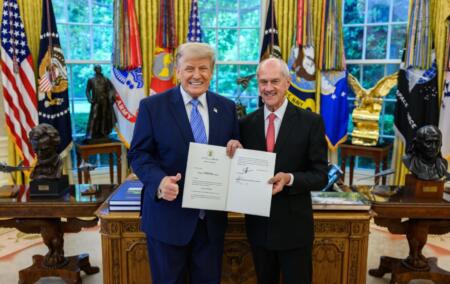
It’s rare that a South African diplomatic appointment attracts any public notice, and even more so for an appointee to be invited onto a radio talk show to discuss the objectives of his posting. But Roelf Meyer’s appointment as ambassador to the United States is hardly an ordinary one, and what he had to say has garnered an uncharacteristic amount of attention.
Following what’s been doing the rounds on social media and the podosphere, Meyer’s mission to Washington is focused on halting the refugee programme, which has brought over 8,000 South Africans to the US, with thousands more reportedly hoping for admission.
Meyer did not in fact specifically refer to the refugee programme, but rather to the executive order that established it. As he told the programme’s host: “There’s the executive order issued by President Trump in February last year, which still stands, and we have to find a way to get around that or at least try and get it revoked, which is not going to be easy because it’s President Trump and it’s the White House that sits behind that.”
The executive order made two policy determinations: aid to South Africa would cease, and the refugee policy. The cancellation of aid initially provoked consternation in South Africa but seems now to have been accepted. This leaves the refugee matter as a live issue. It has become the most visible manifestation of the deterioration in US-South African relations. Depending on one’s perspective, it is either a humanitarian lifeline or an ignorant insult to South Africa’s democracy.
No question, though: for the South African government, it is embarrassing. It contests the framing of South Africa as a non-racial, miracle nation with unique moral authority with one of a vengeful, racist society with a government complicit in the suffering of what the White House has called “disfavoured” minorities. And it probably hits close to home, because it reveals a strain of racial nationalism in the African National Congress and the South African state which they have preferred to contain for domestic consumption, and which the outside world has for the most part politely ignored. The arrival in the US of over 8,000 people willing to accept refugee status is greatly to South Africa’s discredit.
The South African government will be wanting to have this shut down. But what seems to have been lost in the conversation is the opening paragraph of the Executive Order, which summarises US grievances against South Africa.
“In shocking disregard of its citizens’ rights, the Republic of South Africa… recently enacted Expropriation Act 13 of 2024… to enable the government… to seize ethnic minority Afrikaners’ agricultural property without compensation… South Africa has taken aggressive positions towards the United States and its allies, including accusing Israel, not Hamas, of genocide in the International Court of Justice, and reinvigorating its relations with Iran.”
I have previously expressed disagreement with this framing. The expropriation legislation, for instance, is not ethnically specific, and its proponents are unlikely to want to limit its application to any particular group. – Black property holders have not been exempted from the attention of a rapacious state, nor would I think they will be in future. But the narrative put forward here owes more to American preconceptions than South African realities.
The Economist perceptively wrote last year that for the Trump administration, South Africa was “DEI in the form of a country”. Diversity, Equity and Inclusion policies, racial quotas, allegations of racism and debates over “white privilege” became defining issues within the political environment that produced MAGA. Ironically, South African policymakers borrowed many of these ideas from the United States. South Africa has consequently become a convenient symbol for an American audience of where that politics supposedly leads.
More interesting, however, is that second part, which points to South Africa’s global positioning, specifically relating to Israel and Iran. This has been a long time coming. The ANC has for generations regarded the US as an enemy, though in government it was initially able to leverage the afterglow of its moral prestige, its dominance in Africa and reasonably adroit diplomacy to keep things cordial.
This began seriously to fall apart under President Zuma. Party documents were hostile to the West in general and the US in particular, while the mismanagement of the state accelerated the dysfunction of its diplomacy.
President Ramaphosa subsequently ramped up the brewing confrontation. Ivor Chipkin has written that President Ramaphosa needed to find a revolutionary narrative to legitimate his leadership and unify his party. There was nothing domestically that could do this (though I would disagree and say that Expropriation without Compensation represented an attempt to do so), and he turned to the global stage, attempting to present South Africa as a leader of resistance to imperialism. Hence a refusal to condemn Russia’s invasion of Ukraine, increasingly warm bonds with Iran, and the stridently anti-Israel stance, culminating in the ICJ case. Israel has now become an all-purpose bogeyman.
Note that this is not just about Trump. South Africa’s stances had become clear under President Biden and were publicly called out by his ambassador.
The reality is that relations between the two countries are now seriously impaired, and South Africa bears at least as much responsibility for this deterioration as the United States. Indeed, it may bear more, having challenged Washington without the diplomatic sophistication needed to preserve broader cooperation.
This makes Ambassador Meyer’s task extremely challenging. This is not about refugees; they are merely a manifestation of the larger collapse in relations. Even discontinuing the programme would be a superficial matter with no fundamental bearing on things. So, in all likelihood, would Trump’s exit from office.
This is a structural issue, not a personal one. While the ANC remains in charge of foreign affairs, the US – whether under Trump or any future President – will face a South Africa that is resolutely intent on standing in opposition to it. Whether any of South Africa’s positions are commendable ones is beside the point. They make a cordial, cooperative relationship well-nigh impossible.
This is something the ANC is prepared to accept. It wants good relations with the US, provided they are entirely on the ANC’s terms. For this reason, there has been no evident response to the various conditions that have surfaced for a reset in the relationship: condemning “Kill the Boer”, exempting US firms from racial empowerment demands, and so on. To respond, even to give the impression that something is negotiable, would be a betrayal of the ANC worldview.
For his part, Ambassador Meyer has no power to negotiate anything. The US wants what the ANC is not prepared to discuss, and for which it is prepared to make the country accept considerable pain. At best, the ambassador’s mandate is to explain, although this is all fairly well understood, anyway. That’s part of the problem.
The ambassador mentioned that he had been attempting to speak to people in leadership positions where this was possible: in politics, in business and in civil society. This is probably all he can do, and for what it’s worth, this is what I’d advise him to do. South Africa’s mission in Washington may be its largest, but it has by all accounts been disengaged, and lax in attempting to build relationships. The ambassador claims that he has been positively received by Democrats and Republicans. If he can open some doors in this way, he will be doing South Africa a service.
Interestingly, it seems that Ambassador Meyer’s counterpart in Pretoria, Ambassador Brent Bozell III, is up to something similar. He’s been giving the impression of enormous energy in meeting think-tanks and interest groups, taking in heritage sites and announcing joint projects among US and South African groups. It’s what I would have advised him to do. Modern diplomacy, after all, is not confined to state office-bearers. Where governments are at odds, it falls to the non-diplomats to keep up the cross-border links.
For the moment, though, official relations are at an impasse, with little prospect of improvement. The refugee programme will remain in force for the foreseeable future; if it is cancelled, this will probably owe more to a shift in the dynamics of US domestic politics than to a change in the relationship between the two countries. For Ambassador Meyer, there is no point in trying to intervene. He is confronted with a much larger conundrum. If he doesn’t realise that now, he will shortly. South Africa should understand that too.
[Image: https://x.com/RSAinDC/status/2058343951027900703/photo/1]
If you like what you have just read, support the Daily Friend