
Oleg,* 30, wheeled himself into the consultation room, a wry smile on his face. Tugging at his beard, noting we were still chatting to Andriy, he said cheerily: ‘I’ll go for a smoke, and will be back. But I need to leave at one for my music lesson,’ he said as he whirled his wheelchair towards the door.
We were in the Unbroken rehabilitation centre established under the leadership of the Mayor of Lviv Andriy Sardovyy. Set up shortly after the full-scale Russian invasion, the facility was created so Ukrainians would not have to travel abroad for complex post-injury care. It quickly expanded to include specialised facilities such as the St. Luke Hospital (handling severe burn units) and a Children’s Mental Health Centre. Multidisciplinary teams including surgeons and psychiatrists collaborate to unite reconstructive surgery, physiotherapy, prosthetics production, and psychological rehabilitation for war-wounded adults and children all under one roof.
By mid-2026, Unbroken had treated over 27,000 wounded Ukrainians.
Andriy, also 30, was a combat medic in Mariupol in the 1st Marine Battalion, working in the basement of the Illichstal steel factory, the other focus of defence alongside the more famous Azovstal works. Wounded in the leg and suffering from concussion, he was captured trying to break out of the encirclement in a van. His leg was already infected from wading through sewers in trying to escape, but the only time he received treatment was ‘when the Red Cross visited. We were given Soviet era bandages to cover up their wounds to make photos with them. This was the only time we saw the Red Cross,’ he adds.
‘When the Red Cross left the prison, we were tortured by the Russians. They hit us with sticks, shocked us with electricity, hit our wounds and struck us on the back of the head. They told us if they hit us on our heads enough times, we would turn into idiots. They hit those with worse wounds than me,’ he adds. The torturing could last ‘an hour, or an hour and a half’, the aim being to get the Ukrainians to admit to war crimes, ‘to killing civilians.’ One prisoner ‘who was tortured all night was released six months ago, and is now a crazy man.’ The dehumanisation regime including forcing the prisoners ‘to eat their own poop’.
An estimated 70% of former POWs have chronic psychiatric problems and ‘are not well. We only survived because we were young and strong.’ Andriy was moved around, first within the Donetsk region in occupied Ukraine, then to Volgograd in Russia and finally to Kavrov, from where he was released. During their imprisonment they were fed ‘Russian porridge, very few vegetables, and occasionally a fish head and bones. We were so weak we could not walk properly, and had to hold the wall to walk.’
Worse than his physical wounds is the mental trauma – ‘the most difficult thing I have had to face. Before coming to hospital and starting treatment here [at Unbroken], I was close to suicide.’
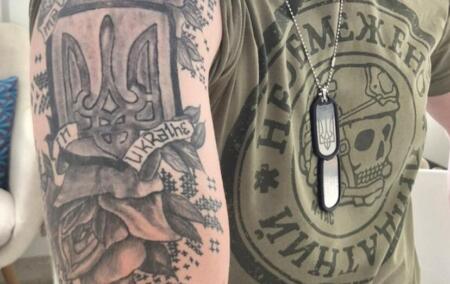
Andriy has, since regaining his freedom, inked his arm: the outside, a stylised version of the Ukrainian Tryzub (Trident), symbolising protection, dating back to 10th century Kyivan Rus; on the inside of a Cossack warrior with the motto ‘Blood for blood’.
Oleg was conscripted in 2020 into the army. His father was serving in the Azov Battalion. ‘I wanted to join up again with him when he rejoined in 2014, but he told me to finished my veterinary studies.’ As a result, when he went into the army, he joined Azov’s K9 unit, a banner of which is attached to the back of his wheelchair. As result of his medical skills, Oleg became a surgeon in Azov. Like Andriy, he was captured trying to break out with a group of 15. As a result of the ‘daily torture to get information from me about Ukrainian positions, although he was unhurt when taken prisoner, he suffered spinal damage.
‘They beat us, electrocuted us, used fire on us, and drowned us,’ he says. Captured in May 2022 he was released in October 2025. From April 2023 he could no longer walk. ‘They told me to get up after interrogation, and I could not’. He was left to lie in a room, cared for only by his fellow prisoners. ‘Most of us were fellow Azov fighters, some 300 of us. Thirteen were killed during our stay in prison.’
Oleg’s fiancé sat with us in the room, working on a puzzle while we spoke. ‘I believe that I will walk again,’ he says, lifting his legs into the chair’s footplate. But the mental challenge is the greatest. A lot of other guys are on the edge, some of them not coping, having to be fed with a spoon.’
When he asked his guards why they treated them so badly, Oleg says ‘they said they were unhappy with their lives. They had to work two or three jobs to make a living. They were unhappy with the ‘special military operation’, and would moan about how expensive everything had become in Russia, especially fuel.
‘We have to understand,’ he says, ‘that they grow up in poor personal circumstances and condition, with a media that is politicised, an environment that includes a lot of aggression. They usually only have three paths available to them: become a policeman, go to prison, or go into politics. They are prisoners every way, prisoners of their circumstances.’
Andriy’s father, 63, was imprisoned by the Russians and sentenced to 18 years. Similarly, Oleg’s father, 53, remains a POW. ‘I don’t hate the Russians,’ he says. ‘Rather, their actions require treatment, and they need to be isolated from other societies to prevent the infection from spreading.’
Andriy and Oleg are among the thousands of Ukrainians taken prisoner by the Russians. The official registry of missing persons includes more than 16,000 civilians, while a team of Yale University researchers estimates that as many as 35,000 Ukrainian children have been forcibly abducted, many of whom may have been adopted, sent to military camps or placed in foster care. This is the same tactic adopted by the Nazis in their abduction of Aryan-looking children during the Second World War.
By the middle of 2026, Ukraine has brought back 9,446 people from Russian captivity, including 457 civilians, though thousands remained, some such as Denys and Nazari’s fathers arraigned under spurious charges.
When Russia launched its full-scale invasion journalist Maksym Butkevych joined up the Ukraine Armed Forces, only to be taken prisoner in June 2022 and accused of war crimes, for which he was sentenced to 13 years in prison. He was released in October 2024 in a prisoner swap. ‘The most important thing as a prisoner is not to be forgotten. Our guards frequently would tell us that no one remembered us.’
War has a human face, though Russia’s treatment of Ukrainians would suggest otherwise. The paradox is that behind this lies the frailty of ego and corresponding misjudgement.
Putin’s premise of victory has built on the advantage of maths and the fear which shapes his own government. This underestimates the driving nationalism of the Ukrainians, especially after the twin events of the Orange Revolution in 2004 and the Euromaidan protests ten years later, and the galvanising impact of the 2014 Russian seizure of Crimea and parts of the Donbas.
No matter the bravery of individuals, history teaches that in the wrong system, and with the wrong allies, victory is always going to be difficult. The opposite also holds true.
Greg Mills is with the Platform for African Democrats, interviewed the former POWs in Lviv and Kyiv.
* Names have been changed at the request of those involved.
[Image: Greg Mills]
The views of the writer are not necessarily the views of the Daily Friend or the IRR.
If you like what you have just read, support the Daily Friend