

Last week an important and surprising deal was done between an AI company and a media content company. But I need to get this out of the way first:
I have been writing professionally for 15 years, starting with a novel in 2011. AI-assisted writing only arrived somewhere around 2023, but it took off in 2025 as the LLMs got pretty good at it. I was not interested in using it; I have been writing (and enjoying the process) without AI for so long that I have no desire to hand off what is an energising and creative activity. It is rarely drudgery and I never suffer from writer’s block.
On the other hand, it also became apparent to me in about 2024 what a fantastic research tool AI was, assuming one was smart enough to check sources and avoid hallucinations. I now use it for all research for my columns and my books. I rely on it. It has given non-fiction a muscular set of tools – both for me and just about every other writer I know (fiction is a whole other can of worms, a subject for another day).
But here is the problem. I have been known to use the word ‘genuinely’ occasionally. I can no longer do that, because it is one of the “must-be-using AI” words. Ditto “quietly”. Ditto “delve”. Ditto ‘it’s not X, but it’s Y’ (a perfectly acceptable narrative device, now verboten). It gets worse. While writing an article or column I may be moved to ask AI something like “tell me what has changed in quantum computing this year?” It will spit out a paragraph or two of facts buried in English-language prose. I will extract the facts I need, and I will sometimes copy and paste (gasp, horror) an entire phrase or sentence, especially when well-articulated.
Which leads to the obvious paradox. Did I write the column/book/blog? Yes. Did I use AI? Yes. Did AI write the entire column/book/blog? No. What percentage of the words on the page came from AI output? I don’t have the foggiest idea, because I don’t keep score and nor should I.
Oh, and I also edit using AI. Always. Every single article/book/blog, because it saves my human editor a lot of irritating fixes. Here is my Claude prompt, verbatim:
“Please copy edit the attached column. Fix only punctuation, typos, spelling and obvious grammatical errors. Use British spelling. Please use only the en dash. You may make recommendations as to style and voice but make no changes”
Note that last sentence. What happens is that the AI editor may notice a clumsy sentence and then tell me so in a Word comment. Sometimes it suggests an alternative. Sometimes I use it, sometimes I leave it as is, and sometimes I make my own change.
You see the problem, of course. Do I use any AI tools when I write? Yeah. Does AI write my articles/books/blogs? No, heaven forfend! Do I get recommendations from AI which sometimes I take? Yeah, I do.
I suspect that most writers who read this will sort of nod in agreement. That is the process now, and the interplay of writing purity and AI-miasma is contested territory for which there will never be a proper map.
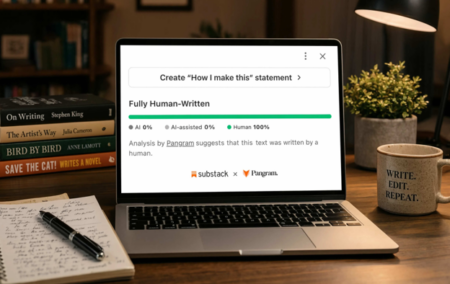
This brings me to the news item that popped up last week. Substack (the world’s largest independent writing platform with many hundreds of thousands of contributors and millions of readers, which also plays host to my columns) now offers readers a way to check whether a column was written or partially written by AI. Unsurprisingly, it has released a toxic plume of fear and loathing amongst many contributors to the platform. (I nervously ran my most recent column through the filter and was relieved to see its “this-was-written-by-human” verdict, actual screengrab pictured in the graphic accompanying this column).
In any event, one assumes that Substack will cloak this in sanctimony, bragging that they offer readers an option to spot (and presumably dismiss) AI-slop. But for the non-English speaking writer who uses AI for help before publishing, or some totally innocent scribe who genuinely uses “genuinely” a lot, or for the writer who does in fact unashamedly use AI to write up her ideas because she simply can’t write very well – this feels like unfair discrimination.
The company that has provided Substack with this tech is called Pangram and my (AI-assisted) search tells me this (and I quote, directly, no rewriting, not in my own words, AI written, OK?):
“Pangram is a Silicon Valley AI company founded by Stanford-trained machine learning researchers Max Spero and Bradley Emi. Its core product is an AI text classifier designed to distinguish human-written prose from AI-generated or AI-assisted writing by analysing patterns of authorship rather than simple statistical quirks. The company argues this approach is substantially more accurate than earlier AI detectors.
In July 2026, Substack announced a partnership with Pangram to help combat what CEO Chris Best called “Claudefishing”—content presented as human-authored when it is largely AI-generated. Readers can now voluntarily scan posts, comments and Notes to estimate the extent of AI involvement, while writers can explain their creative process and challenge incorrect classifications. The goal is transparency rather than banning AI, although the move has sparked intense debate over detector accuracy and false positives.”
Those last two words are the nub of the problem. It is considered immoral, even deceitful to use AI to write. A false positive can (at least for professional writers) be a Scarlet Letter, carried for life. Also, as an aside, I must note that the invention of the word “Claudefishing” is rather brilliant.
Anyway, I call bullshit on AI detectors. I don’t care about AI slop or excellence in written material, whether it be non-fiction or not. If a writer wants to use a little or a lot, that’s fine with me. I either like what I read or I don’t, and I still believe that cream will rise to the top, and it is likely to be human cream.
(I bet if I run this through the detector it gets flagged AI because I used “genuinely” three times. No, wait, now it’s four!)
Steven Boykey Sidley is a professor of practice at (ex-JBS, University of Johannesburg) and a partner at Bridge Capital and a columnist-at-large at Daily Maverick, Daily Friend and Currency News. His new book “It’s Mine: How the Crypto Industry is Redefining Ownership” is published by Maverick451 in SA and Legend Times Group in UK/EU, available now.
[Image: reve.art]
The views of the writer are not necessarily the views of the Daily Friend or the IRR.
If you like what you have just read, support the Daily Friend