

The political vocabulary we continue to use is not just redundant, it impairs our ability to make accurate political judgements, to assess political policies, and to chart a new political future.
It is time to cleanse the Augean stables of words that stand for non-existent political positions and serve no greater function than to abuse those we do not like. Primarily I refer to the words “left” and “right”, but there are also trailing in their wake designations and words equally redundant: “conservative” for instance, or “radicalise”, or “progressive”. It is relatively easy to say what is going wrong; it’s more difficult to say how to get it right, as this mini discourse will demonstrate.
Tennis Court
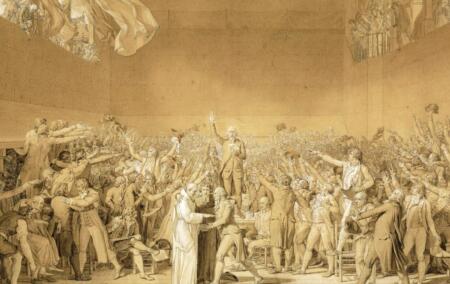
Everybody knows that left wing and right wing are derived from the French revolutionary parliament that assembled in an indoor tennis court and split into delegates that filled the benches on the left or the right of that meeting place: delegates on the left in favour of equality, those on the right in favour of monarchy.
I don’t want to chart a long and involved semantic evolution of those terms that later came to denote, respectively, the positions in British politics of the Whigs/Labour/socialists on the left, and the Conservatives on the right, of Tom Paine on the left, and Edmund Burke on the right.
The “left” and the “right” came to connote entire worlds of values, preferences and cultural affiliations. If you were young, “progressive”, mildly iconoclastic, poor and low church, and offended by inequality and class privilege, you were on the left, if you were older, esteemed the past and the status quo, Anglican, militaristic and aristocratic, you were on the right.
In the popular imagination, the left was associated with virtue, the right with vested interest, the left with the rule of the people, the right with rule by the anointed elite. The “left” were doves, the “right” were hawks.
The Collective
But even in the heyday of the use of these designations, there were odd commonalities: they both valued the collective: the “left”, for instance, was the international working class, the “right” the nation, expressed by its flag, its anthem and its sovereign institutions.
These distinctions hold no longer. Today neither side backs freedom, both sides love and espouse high taxation and pervasive regulation, and both sides make the individual subordinate to the state. However, the distinctions are still the currency of political discourse, in spite of the fact that they seriously confuse our arguments and our debates, and worse still, create abrasive but spurious rivalries. Does one hold communism to account for being “left wing” or “right wing”?
Brexit
The confusion is nevertheless easy to unravel. For me, it all stems from Brexit.
The vote for Brexit was opposed by the BBC, by all the legacy media, by all political parties in the Commons, and by the British Prime Minister himself. And yet the Brexit vote was won, and it was won by the voters of the so-called Red Wall – the millions of Labour faithful from the British Midlands and the North, the people whose loyalty to Labour stretched back for generations. And if they were Labour supporters it meant that they were by definition “left wing”. They voted primarily on their concern for uncontrolled immigration … yet the media had been uniformly portraying the Farage-led Brexit protagonists as “right wing”.
Still today, just to identify immigration as a concern provokes a residual allegation of being “right wing”, in spite of the evidence to the contrary.
The AfD party in Germany, implacably opposed to uncontrolled immigration, is “far right wing” (Google declares unblushingly: “The Alternative for Germany (AfD) is a far-right… political party …”), and the same goes for Marine le Pen, who is always stigmatised as being “far right wing”, thus begging the question: what distinguishes “right wing” from “far right wing”?
Yet, all across Europe, the people most vociferous in their rejection of immigration are the non-metropolitan working people, the people who, I boldly speculate, are traditional voters for socialist-leaning parties.
This anomaly, which exists in plain sight, is never allowed to disturb the “right wing-left wing” paradigm, and the eloquent objection to a British marriage with Europe by those doughty Labour warriors Michael Foot and Tony Benn is conveniently forgotten.
Blair
The anomaly stretches further. Labour Prime Minister Tony Blair was through and through a socialist, and therefore – nominally – “left wing”. Yet he championed causes which we did not then, and do not now, consider to be characteristic of “left wing” beliefs. As we know, he championed the war in Iraq, much to the disgust of left-wingers such as George Galloway. Perhaps more importantly, he established the British Supreme Court, which has powers to overrule the decisions of the British Parliament.
This is an astonishing betrayal of the democratic impulse that has driven the exercise of power into the hands of the British electorate since 1688, and who are now displaced as the final democratic authority of the people by an unelected elite of jurists. Blair unashamedly stood for – and seems to continue to stand for – that most elitest position: the creation of obedient citizens who conform to the instructions of a class of their betters.
Trump
So who then is “left”, and who is “right”?
Commentators routinely call Trump “right wing”. Why? For the many who regard Trump simply as a buffoon, his buffoonery makes categorisation into a politically ideological position meaningless. But I’ll say this for him, his regard and love for the American blue-collar class is real, and for me, quite moving, and his concern for their welfare yields nothing to the hand-wringing socialist orthodoxies of a Bernie Sanders. These are the people the “leftist” politician Hillary Clinton called the “deplorables”, remember?
You can call Trump’s foreign policy chaotic, but he displays an open-minded sense of cordiality with leaders of the traditional enemies of the West such as Putin, Xi Jinping and Kim Jong Un, who are routinely vilified and “othered” by “left wing” leaders of Europe. These seem to me to be inviting the prospect of war by talking up its likelihood.
But why do we continue to associate a militaristic propensity with the “right” when the armies of the West have traditionally been and continue to be served by working-class men and women who seem only pleased to be putting their lives at risk by serving the “right wing” officer class.
Crime and punishment
Here’s another spurious “left wing-right wing” differentiation.
It is true that, traditionally, the liberal view of criminality is that it is a consequence of social conditions rather than individual culpability. In terms of this view, criminals need to be rehabilitated rather than punished. But crime and punishment and the response of a civilised society to it do not conform to so simple an approach.
No-one is likely to call me “left wing”, but I have no time for a punitive judicial system, and, on many grounds, I am opposed to stuffing bad people into prisons where they are kept at the taxpayers’ expense before being released to perpetuate their lives of felony. I would like to see a punitive judicial system replaced with a restorative judicial system.
The arguments for or against such a suggestion can be debated elsewhere; I am simply making the point that our attitudes to crime, and our methods of dealing with it do not match a “left-right” typology, and I note that so-called soft-on-crime socialists love handing down draconian sentences of incarceration to those found “guilty” of “hate crimes”.
The development of surveillance societies has been largely if not exclusively the achievement of “left wing” governments. And if I am in favour of castration for certain categories of rape, does that make me an enemy or an ally of the generally regarded “left”-leaning women’s movement?
Typecasting
Well, one could go on. At heart the real point is this: what on earth do journalists, commentators and pundits mean when they use these terms, except merely to type-cast? Do they mean anything that allows us to understand our differences? And this is not a minor or a contrived issue. People everywhere take very seriously their identities as being “left” or “right”, and hold their putative opponents to account on the basis of what they mean by these categories.
The Uniparty
Here is an example of where the typology can be so counter-productive.
In Britain, in spite of the emergence of the so-called “uniparty”, in terms of which Labour and Conservative are regarded as having indistinguishable values and policies, commentators continue to lump together the Conservatives, Reform and Restore as all being parties of the “right”, and many voters are apparently in despair because the “right wing” vote will in the next election be split three ways, thus opening the door to another Labour victory.
More particularly, Rupert Lowe, leader of Restore, is being pilloried for splitting the “right wing” vote between Reform and Restore, thus ensuring that neither party gets into office. But the “right-left” binary thus invoked by this argument misrepresents the choice voters face. Reform and Restore are not simply parties of the “right” standing for “right wing” ideologies.
If I were a voter in Britain, I would feel seriously aggrieved by an argument that held me accountable for splitting the “right wing” vote, should I (for instance) vote for Restore. This is because I would not be voting for Restore simply because it is “right wing”; I would be voting for Restore because it sets out a manifesto I believe in and support, and a manifesto that no other party puts in front of me.
New typology
So, what do we do?
I hereby offer with scant humility and maximal hubris, a new political typology. Of course, it is certain that it will never achieve popular support … but hey … they say that by way of an infinite concatenation of consequence, a butterfly moving its wings in an Amazonian jungle can cause a hurricane in central Asia.
So here goes: I suggest that in today’s world, all people can be meaningfully differentiated by these two terms: Equalisers and Liberators.
Nearly everyone today is an Equaliser. Equalisers valorise equality (and its putative subsets, fairness, justice, kindness) over freedom. Liberators valorise freedom over equality. It’s as simple as that. I am not telling readers of this column anything they do not know when I remind them that equality can only be achieved by means of coercion. Equalisers pretend to be at ease with this consequence of the system they favour, largely because they envisage equalisation by force as being applicable to everybody but themselves.
Equalisers seek out and achieve high profile and remunerative careers in politics, in law, in the academy and in the higher echelons of the civil service, and notwithstanding their nominal support for equality, they somehow want to bring it about by means of their own entirely non-equal positions of leadership.
You see equalising elites trying everywhere to wallpaper their hypocrisy by their public declarations of being just ordinary working-class boys and girls (think Andy Burnham, think Rachel Reeves). That great equaliser Tony Blair is one of the least equal people in Britain, having amassed a fortune of over R1-billion in the business of equalisation. The equalising political elites in South Africa are uniformly plutocrats pretending to be revolutionaries. I suspect I am addressing the converted on this issue.
An equalising world
An equalising world demands regulation. But regulations that protect people from the consequences of their stupidity will create a society of stupid people, and incorporating morality into coercive law diminishes individual moral capacity.
Don’t we all want a world characterised by wisdom and probity? Regulation inhibits and discourages entrepreneurial creativity and invention, and transfers the responsibility of “creating jobs” and of “growing the economy” from the producers to the regulators who uniformly create nothing themselves.
Regulators love policies: policies to cover everything, including, as Dawie Roodt once wittily observed, drinking coffee. But policies are always coercive and enforce old solutions on new problems. An equalising world has to be managed, a liberated world manages itself. The more equal the world gets, the less prosperous it gets, because prosperity is the result of the achievements of unequally gifted people.
Liberators
What kind of politician then would a Liberator be? And how would he or she liberate the people?
Liberating politicians are probably people who don’t want to be in politics at all. That makes them rare; do they in fact exist?
Well, wasn’t the late Frederik Van Zyl Slabbert an unwilling politician? And I think it fair to say that Mandela himself was only in politics as a means to an end: the liberation of the people?
I believe Lowe, who has a remunerative role in business, is an unwilling politician. He gives away his entire parliamentary salary. What about Milei? What about Rand Paul? I don’t know, although I do know that outside of politics Rand is a medical specialist and his father, the senator Ron, was a gynaecologist who would no doubt have been a substantially wealthy man had he stuck to his profession.
I readily concede that I am summoning up for my characterisation of the liberating politician views long since and widely expressed by thinkers such as, for instance, Thomas Sowell or Milton Friedman or Adam Smith or John Stuart Mill or Frederick Bastiat or Murray Rothbard, and many others – putting old wine into new bottles. But maybe, by creating a dynamic new category of political thought, we may do a better job of promoting our vision than we do by surrendering ourselves to that desultory default category, “right wing”.
A liberating politician liberates us from the yoke of state coercion; that is to say from taxation and regulation. (Of course people are far from wanting to be so liberated, because it means having to shoulder the responsibility for their own successes and failures. Liberation makes people vulnerable. No wonder the political world has been gifted to the equalisers.)
What else can we say about the politics of liberation?
A Liberator does not believe the state has either friends or enemies, only vested interests. A Liberator knows that trade does not take place between countries, but between buyers and sellers, and never needs the “helping hand” of politicians or civil servants. He or she does not represent political parties that boast of having “values”, because values exist in people, not organisations, and in any case, in politics (as in life) it’s what we do that matters, not what we believe.
A liberating politician knows that every single statute passed serves a vested interest. A liberating politician knows it is liberating for all people to be free to live their lives as they want to, subject only to the conventions of the common law. And, underpinning it all, he does not believe a state has a coercive right to help itself to the income earned by individuals.
Defence
So what then is the legitimate job of the liberating politician? Does the state have any role at all to play in the lives of liberated citizens? Yes, it does. The state, being a sovereign entity, must protect its borders from incursion of any kind, and within its borders, it has the obligation, as far as it is possible to do so, to protect its citizens from criminality.
Kindness
Being a Liberator does not absolve us from the obligation of care and kindness, but care and kindness are individual virtues, not expressed by means of collective acts of philanthropy, especially when exercised with other people’s money.
Getting philosophical
Why is it better to be liberated than to be equalised? We are all unequal across multiple dimensions of talent and character, to say nothing of our experience of triumphs and disasters not of our own making.
But isn’t it part of the challenge of humanity: to know we must do our best with the hand we were dealt? That our destiny is to be uniquely ourselves, and that there is joy in fulfilling such a destiny? That each one of us is the monarch of our own realm? That there is pleasure to be derived from the achievements of those who are, shall we say, more equal than ourselves? That valuable contributions to the common weal can be made by unequally gifted people?
Liberators want to liberate everyone into the possibility of being themselves, even if they are born into misfortune There is a nobility in such a view of things.
And although we find ourselves living in an equalising world, nothing stops us from being Liberators in our own lives, and maybe thereby infecting a few people in our vicinity with the virus of freedom.
[Image: Drawing by Jacques-Louis David of the Tennis Court Oath ]
The views of the writer are not necessarily the views of the Daily Friend or the IRR.
If you like what you have just read, support the Daily Friend