

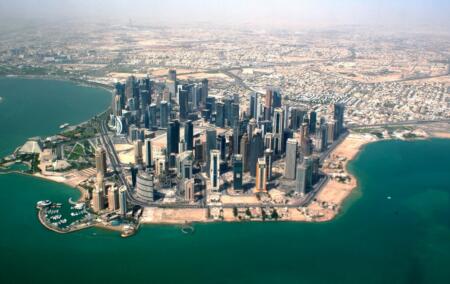
Understanding Qatar’s role in Middle Eastern geopolitics is crucial to understanding the geopolitics of the Middle East as a whole, and the way Islamism has served as a powerful tool of foreign policy for Qatar*.
A vision of the Israel/Palestinian conflict, a vision of the region, and a role for Qatar in the conflict was produced by the Muslim Brotherhood (Brotherhood).
Qatar is profoundly dedicated to the ideology and theology of the Brotherhood. The Brotherhood was founded in Egypt in the 1920s, in response to the great debate over Islamic weakness, piety, modernisation and how to overcome centuries of Islamic retreat and decline.
Qatar is both the major supporter of Hamas and the mediator used to negotiate for the release of Israeli hostages from Hamas after its invasion into Israel in 2023. Hamas was established in 1987 as a Brotherhood branch in Gaza. It is also dedicated to keeping Gaza and Hamas as a powerful lever of influence against the Palestinian Authority (PA) in the West Bank.
Fatah2 and Hamas represent the Sunni divide between the conservative Sunnis (the Saudis, Emirates, Egyptian military regime, Moroccans) and the radical Sunnis (the Qataris, Turks, and the Muslim Brotherhood in Egypt).
The 1995 Coup over Qatar’s Modernisation
The Brotherhood fled from Egypt to Qatar in the 1950s. It was essential to the founding of Qatar’s Ministry of Education and helped establish Islamism as the ruling creed from the 1960s to 1980s.
It promoted a fusion of Salafi Islam and Brotherhood thinking. The Salafi movement is a broad set of Islamic movements that strive to emulate the practices of al-salaf al-ṣāliḥ (“the pious predecessors”), the early generations of Muslims during and after the lifetime of the Prophet Muhammad.
At this time, Qatar was an emerging state with a population of approximately twenty-five thousand, and it had little governmental structure. The Brotherhood’s ideology, network, and influence led to a mutually beneficial relationship with the royal family. Oil and natural gas gradually replaced traditional industries like pearling and fishing, hugely increasing the wealth of the ruling family.
This wealth and an influx of Brotherhood members led to the development of the education system. The Brotherhood gradually developed strategies using the language of ‘human rights’ and ‘civil society’ to proselytise. In the 1990s it became the great patron of an Islamic movement which expanded religion into regional influence and power.
Qatar has always been an absolute monarchy ruled by the Al Thani family. In 1995, crown prince Hamad bin Khalifa Al Thani overthrew his father in a bloodless coup. He had been advocating, for many years, for Qatar to expand the monetisation of its liquified natural gas reserves. His father was opposed to expanding, modernising, or developing Qatar too quickly.
Al Jazeera and the promotion of Islamist voices
In 1996 the Emir founded Al Jazeera, to be under the influence of Islam and to promote Qatari interests. Al Jazeera advanced the narrative over Arab politics, the Arab mind, and the Arab street. It covered the Gaza war and shaped how the world saw it.
Israel’s global standing fell considerably because of this.
It’s impossible to exaggerate the power and importance of Al Jazeera, which broadcasts into 150 countries. It broadcasts in Arabic and in English. This is profoundly influential, reaching well beyond its own viewership.
Al Jazeera journalists claim to have editorial independence, until the dictatorship requires them not to have it. Al Jazeera journalists are not literally given what to say or have their articles written for them. However, when the geopolitical needs of Qatar require, articles have to align with the regime’s view.
In English texts Al Jazeera frames Hamas in Western terms as an illegitimate anti-colonial and anti-imperial force, not in terms of the Muslim Brotherhood’s religious vision, which is how it frames it in Arabic.
Al Jazeera won’t cover Hamas as an oppressive force in Palestinian politics, even though Hamas significantly oppresses Gazans. The terminology of ethnic cleansing, genocide, apartheid, and war crimes is front-and-centre of reportage in Western coverage of the Gaza war.
Hamas murders Palestinians who resist the organisation; it has retaken every part of Gaza that the IDF doesn’t control; it demands the sole right to control all the aid coming into its area. These issues are not covered by Al Jazeera.
Israelis are framed as abstractions, as institutions of blockade, occupation and settlement, not as individuals with families and histories. Israel closed the Israeli branch of Al Jazeera during the war.
Al Jazeera doesn’t cover the influence of the most extreme versions of Palestinian politics, the Palestinian national cause, and Palestinian Islam dominant in Palestinian politics. It only represents individuals with personal stories with appropriate visuals.
Al Jazeera covers the Palestinian case, issues, and experience vastly more than any other major international outlet. No Jewish experience, no Israeli narrative, no Israeli experience has ever been covered. The Qataris hated Israel and expressed this in rabid anti-semitism, not just anti-Israel sentiment. This was spread worldwide by Al Jazeera.
Support for Hamas and Palestinian schism
Nearly every Arab government disliked Hamas when it took over Gaza in 2007. They understood that Hamas was a branch of the Brotherhood, and therefore a threat to their leadership.
The Egyptians had faced terrorist activity by the Brotherhood for decades. The Saudis had been de-radicalising after 9/11 and after the Riyadh bombings in 2003.
Arab states supporting Palestinian independence did so to resolve the issue, thereby ending an irritant in Arab politics: the radicalisation of the Arab street. Qatar thought that a major obstacle to achieving a Palestinian state was the schism between Hamas1 and Fatah 2 in Palestinian politics.
In 2007 Hamas violently took over Gaza from Fatah, thereby deepening the schism. Qatar and Turkey became Hamas’s principal patrons, though Qatar had a greater presence on the ground.
In 2012 the Emir of Qatar became the first head of state to visit Gaza. This broke Hamas’s diplomatic isolation internationally. The Emir pledged about $400 million for building roads, housing, and reconstruction projects.
Hamas’s government was de facto legitimised. Qatar wanted to deepen the schism and own half the Palestinian story, to contribute influence over the story, and to benefit from the power of the story in Arab conversation.
Hamas’s rise and Qatar’s patronage
Qatar allowed Hamas’s political leadership to live in Gaza. An office was established in 2012. Qatar claimed that America had asked it to open the office to create a channel to Hamas. (There is a Hamas office in Cape Town.)
Qatar granted Hamas’s leaders diplomatic influence and publicity to remove its complete dependence on Iran. Hamas then had direct access to Al Jazeera and thereby to the Arab world. The Arab world would hear only Hamas’s version of events happening in Gaza.
Qatar provided the economic base in Gaza for Hamas to rule and be sustained. Qatari money ended up being used by Hamas to build the largest tunnel network in the history of warfare.
Netanyahu’s policy and withdrawal from Gaza
Qatar’s influence over Gaza wasn’t secret: Israel actively approved of Qatar’s actions and justified them as being in defence of Israel. Originally this was Israeli prime minister Benjamin Netanyahu’s policy as a way of stabilising Gaza.
When Netanyahu returned to power in 2009, he tried to avoid war at all costs, because every invasion and withdrawal had ended in bloodshed.
Warfare was put on hold from 2009 and until 7 October 2023. Netanyahu’s policy was to have Qatar fund Hamas, stabilise the Gazan economy, prevent hunger, and make Gaza stable enough to never explode.
This policy was the great promise which put him back in power.
The First Intifada erupted in 1987, by which time Israel had ruled Palestinians for 20 years. By 1992 the issues of occupation, peace, and ending the occupation overwhelmed Israel. It became the new civic religion of the Israeli left. In 1999 President Bill Clinton convened negotiations to realise a full Palestinian state with then Israeli prime minister, Ehud Barak.
This collapsed disastrously. Clinton has always blamed Yasser Arafat for the collapse. This occurred at the time when the Oslo Agreement was supposed to negotiate the borders of two states. The failure of Oslo resulted in the Second Intifada, and saw Fatah and Hamas carry out about 173 suicide bombings against civilians and volleys of rocket attacks.
Consequently, the Left-wing in Israeli collapsed and the Right took over government. The next government of Ariel Sharon also had no answer to the problem. Israel couldn’t rule over the Palestinians for ever, but for security reasons it couldn’t withdraw either.
For Sharon, the way to separate the Palestinians was unilateral withdrawal from Gaza, which he undertook in 2005. About ten months after the withdrawal, Hamas carried out its first tunnel operation by kidnapping soldier Gilad Shalit and killing two others.
Meanwhile In the north, six years after Israel pulled out of Lebanon in 2000, Hezbollah launched a major cross-border attack and sent tens of thousands of rockets Into Israeli cities. Sharon’s successor, Ehud Olmert, found himself embroiled in the Second Lebanon war, Neither Hamas nor Hezbollah could be deterred by anything Israel did. Olmert was never able to advance his plan for a unilateral withdrawal from 90% of the West Bank.
In 2008 Olmert made an offer to the new Palestinian leader, Mahmud Abbas5. It was a genuine offer, but Sharon was by then facing corruption investigations and went to prison for bribery.
Israel’s GDP and Qatar’s spending on Hamas
Meanwhile Israel’s GDP per capita doubled under Netanyahu in that period, while Palestinians continued to live under military rule. Israelis thought they had tried everything, but everything collapsed into endless bloodshed, endless insanity, massive rocket volleys and the emptying of cities.
In response, in 2007, Israel invented the Iron Dome interceptors. Israel also spent billions building bomb shelter rooms in every dwelling in the north and south which was within range of short-range missiles.
Netanyahu invested more in R&D per capita than any other country. The gap between Israel and its enemies only grew. From 2018 Qatar sent $30 million a month into Gaza, completely coordinated with Israel. Cash in large bags went to Hamas.
Qatar was sending vast amounts of money to Hamas which wanted to eliminate Israel, and Netanyahu was allowing it. In Netanyahu’s defence, most Israelis agreed with his approach. They saw it as a reasonable path to take at the time.
Where Qatar’s money went
Qatar has always claimed that its money was intended for humanitarian purposes, but how the money was actually spent was up to Hamas.
A report issued in 2025 concluded that the money Israel allowed into Gaza went to Hamas’s military wing and the construction of the tunnel system that led to 7 October. It was built over 15 years.
The tunnel system was never made available for civilians to use. Effectively, Qatar funded an invasion force. This allowed Hamas to broadcast its invasion and massacre of Israelis. The broadcasts were then loaded onto Israeli social media. This contributed to drawing Israel into a war.
The Gaza War Narrative
Terrible wars have been fought in the Middle East by western allies, with hundreds of thousands of dead, just in the past decade alone.
Not one of them received anything like the coverage of Gaza in the western press.
Piers Morgan would say: “Well, you know, there could have been a much more sophisticated and complex coverage of Gaza, including how Hamas didn’t let civilians into those tunnel systems.”
The reality was, in Hamas-controlled territory, journalists either reported what Hamas wanted or a journalist’s life was in danger. If a journalist ended up in the interstitial spaces between Israeli and Hamas forces, there was a considerable chance of his being shot by Israeli forces.
The Israeli forces don’t want to take the risk of shooting a CNN crew in Gaza while it’s filming. Al Jazeera, however, is the major outlet, able to get original, first-hand imagery by being able to deploy crews on the ground.
The disturbing ceremonies Hamas conducted when it released Israeli hostages by humiliating them were produced by Al Jazeera.
The people managing the ceremonies on the ground were in contact with Al Jazeera newsrooms in Doha telling them what to do and how.
Qatari funding in the West
Qatar has a tremendous influence because of its vast wealth. It has a sovereign wealth fund in the hundreds of billions of dollars. Qatar is the biggest foreign spender of money for lobbying in the United States.
It’s certainly not the Jewish lobby which has been libelled as being the most powerful lobby in Washington.
Its sovereign wealth funds and various other controlled sources? allow Qatar to fund huge swathes of western economies, particularly in Britain. Its money engenders very close relationships with western universities, research institutions, think tanks, sports teams, politicians and corporations.
It has taken great pains to be extremely generous in its business dealings. In 2025 American universities reported receiving $1.1 billion in Qatari gifts, donations, and contracts. It’s the country spending the most money on American higher education in the world. Anti-Israel campus activism is partially funded by Qatar.
These relationships created access for Qatar to the Trump administration. Qatar gave Trump a luxury Boeing 747-8, valued at an estimated $400 million. When the Qataris call, the Trump administration answers.
Qatar’s influence in academia
Qatar’s largesse goes some way to explaining why Middle Eastern studies departments at top universities have been unwilling to teach about Israel at an academic level. It’s not possible to understand the modern Middle East without understanding the role of Israel.
What and how do Israeli Jews think happened to them in their history? Where do they come from? What is their historical experience? What do they understand about the world? How do the other nations of the Middle East understand Israel? How does each represent the other?
These are fascinating, valuable and central questions of academic study of the Middle East. Universities are failing if the subject of Israel cannot be taught and learnt because it’s inappropriate politically. These institutions no longer fulfil their social function. Scholarship is being ideologised and not critically examined.
Conclusion
Rettig Gur posits that it is almost impossible to overstate the depth of Qatar’s involvement in this conflict, and the profound ways in which Qatar has reshaped Palestinian politics.
There are other governments which revile Israel: the Spanish, Irish and South African governments, to name a few. None have had a percent of the direct influence in shaping the information environment that Qatar has had.
The Qataris, like Hamas, believe that Israel should cease to exist. Qatar might be the single biggest agent outside the land of Israel to achieve this.
* This article is a précis based on the transcript of Haviv Rettig Gur’s podcast: “What does Qatar want?”. Rettig Gur is a seasoned and extremely perceptive and knowledgeable journalist, historian and political analyst. He was one of the best analysts to come to prominence after 7 October 2023. His podcasts reveal an extraordinary knowledge of Israel, Jews and the Middle East. Many have been vital in tackling the current pandemic of libels and antisemitism being heaped on Israel and Jews globally.
Notes
1. Hamas – Hamas is a Palestinian Sunni Islamist nationalist and militant movement that has governed the Gaza Strip since 2007. “Hamas” is the Arabic acronym for the “Islamic Resistance Movement”. It is designated as a terrorist organisation by the United States, Israel, the European Union, and others. Hamas is dedicated to the destruction of Israel and the establishment of an independent Islamic state.
2. Fatah – was established in the late 1950s by the Soviet Union and Palestinian diaspora figures. It is a major secular political party and the largest faction within the PLO. It governs the West Bank. Though it originally used armed struggle, Fatah transitioned in the late 1980s and 1990s toward diplomacy and a two-state solution approach with Israel, but it periodically expresses similar sentiments to Hamas.
3. Benjamin Netanyahu is the prime minister of Israel.
4. Yasser Arafat was one of the founders of the PLO. Fatah is the political arm of the PLO which he led from 1959 until 2004. Ideologically it is Arab nationalist and socialist.
5. Mahmud Abbas is Arafat’s successor and has been serving as the second president of Palestine and the Palestinian National Authority in the West Bank since 2005.
[Image: Kazuo ota on Unsplash]
If you like what you have just read, support the Daily Friend