


Every creature has needs, and therefore values whatever meets those needs.
A thing can only have value for a specific valuer. Value is nonsensical without a valuer. If the creature has multiple needs, in a context of limited supply it will make trade-offs that reveal which of those needs is most compelling.
The economist Thomas Sowell made the same point with regard to human affairs when he said: “There are no solutions, only trade-offs.” One possible implication is that no matter how much you value something, there may be a time when you will value something else a bit more and sacrifice the former to the latter.
When people voluntarily exchange things, we deduce that both of them value the thing received more than the thing given – in other words, you get something of greater value to you than you gave. That is the miracle of voluntary trade – all parties are better off.
Furthermore, we can use a third thing as a store of value to use in future trades. We call that thing money. That is, we exchange money for something we value less than the money so that later on we can exchange it for something we value more than money. That allows price (in units of money) to function as a universal signal of relative demand (needs or values).
Because we define values relative to each other, we can also assign a cash value to them. The market price is the overall summed signal, but there will be a distribution of prices individual people are willing to pay or receive in exchange for anything.
Occasionally we run into an assertion that something is priceless, that we can never justify exchanging it. The list includes a human life, your reputation, the crown jewels or the Mona Lisa, God and sexual virtue. We know that some people will exchange any of those for one of the other, for example, sacrificing their life to preserve their sexual virtue or visa versa.
That however does not mean others would be willing to do the same. I had a look at the distribution of prices that people are willing to consider in relation to some of those supposedly priceless things, in particular sexual virtue and God.
In exchange for sex
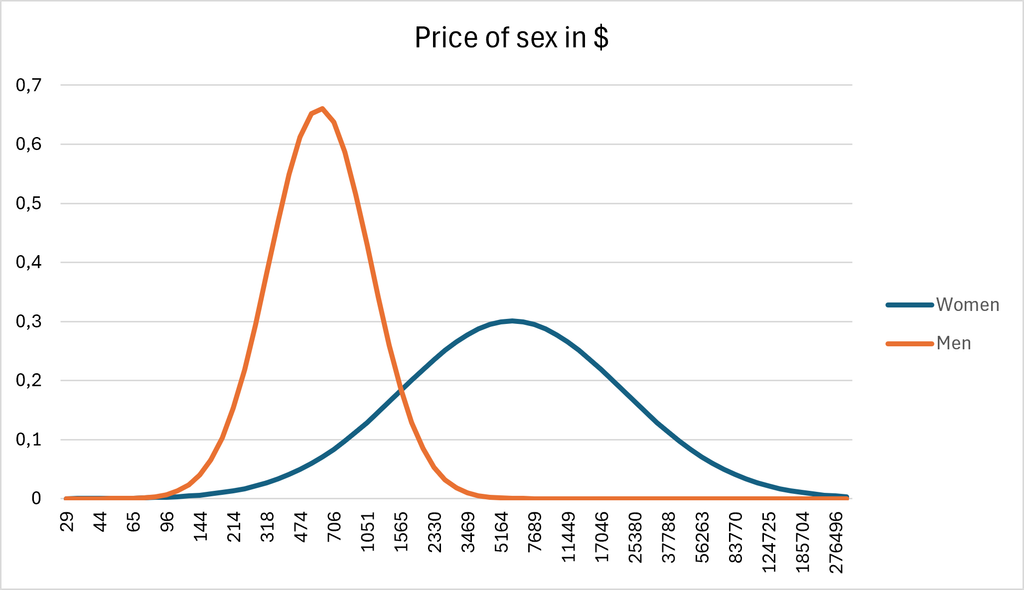
I looked at prices and the proportion of women and men (relative to the population) in several prostitution markets in the US – from streetwalkers to the most expensive high-class hookers. From that I constructed two curves showing the distribution of the dollar amounts women would accept in exchange for sex and men would be willing to pay.
You can see those curves in the graph below.
I’m told statistics is for those who can’t handle the excitement of accountancy, but it is quite amazing what you can deduct from a bit of statistical analysis. [If you want to see where you fall pick a Rand number you would accept (or pay) to have sex with an average looking member of the opposite sex. Divide by 7.49 and look the result up on the graphs.]
What I learned was that women place a far higher value on selling sex than men place on buying it – ten times higher on average but with much more variation. The average woman in the US prices sexual services at $5,897.35 (R44,171.2) but the average man is only willing to pay $589.29 (R4,413.8) for it.
Only 1 in 13,423 men (0.0075%) would be willing to pay the average woman’s asking price, but as many as 1 in 24.3 women (4%) would be willing to have sex for what the average man would offer. The price at which equal numbers of men and women are willing to buy and sell it is $1,225.8 (R9,181.2). That amounts to 11.2% (1 in 9) of both groups.
Are there any women who think sexual purity is priceless? US government agencies currently price a human life at $10 to $13.1 million (R74.9 to R98.12 million).
Only 1 in 95.7-316 million US women (about 3) would demand that sort of price for sex. In other words, very few women would literally rather die than have sex for money. $5.59 million (R41.87 million) is the amount required by a sainthood rarity of sexual virtue (1 in 7.4 million, or only 21 US women).
No men at all would pay that much for the privilege, so these women will never have their virtue tested.
It is safe to say most women, even those whose price is below average, are safe from ever realistically facing temptation. At the other end of the extreme, 1 in 1 million women (probably more) may be willing to pay men for sex.
Virtually every man (prior commitments add considerably to the potential price) is willing to pay at least the streetwalker price of $62.35 (R467), although women rarely are – less than 1 in 3000. High-class hookers (5.9% of women) ask for, and probably receive, $742.25 (R5,559.5), because something like 36.8% of men are willing to pay that much.
Chances are slim
The absolute maximum the sex market sees is twelve times that – about $8,907 (R66,713). As many as 37.8% of women would be happy with that but given that only 1 in 3 million men would, the chances are slim. Relying on prices from historical periods, I once estimated that prostitutes tend to see it as the equivalent of swapping sex for an outfit, such as a dress, compatible with their social class.
I also looked at what the average Christian, committed enough to attend and give to the church, is willing to contribute over a lifetime. I took that to be the monetary value they placed on God because it reveals their preference for spending the remainder on other things.
It came to the price of a new Toyota Corolla, around $66,756 (R500,000).
That is considerably less than the government estimate of a human life, and 7.5 times a single top-end commercial sex encounter.
On the other hand, the true saint values God far more. Given that they value their sexual purity 320 times as much as the average puritanical woman, a proportionate valuation of God would equal 1.8 human lives. (The puritanical correction is because my “God” price is that of the one third of Christians who attend church regularly.)
While it’s possible that some people genuinely consider some things priceless, those cases are very rare. Everything is almost always potentially exchangeable in some context – but mercifully we are also very unlikely to face an extreme like Sophie’s Choice.
It’s probably wise to let free price signals do the work of bringing supply and demand together for everything, rather than let a central authority make value decisions for us.
[Image: by wirestock]
The views of the writer are not necessarily the views of the Daily Friend or the IRR.
If you like what you have just read, support the Daily Friend