

The National Minimum Wage Commission will soon determine next year’s mandatory wage levels. The exercise rests on a persuasive but perverse moral claim.
Written submissions to the National Minimum Wage Commission on the minimum wage level for 2027 closed on 4 September, after a mere 30 days having been afforded for comment.
The Free Market Foundation urged the Commission to recommend no increase at all, saying minimum wages are “instruments of exclusion that consign millions of South Africans, particularly the young and low-skilled, to enforced idleness”.
The Foundation for Rights of Expression and Equality (Free SA) said much the same, saying a hike “risks shutting even more unemployed and inexperienced South Africans out of the formal labour market”.
They are right. And yet they will be ignored.
The Commission will recommend inflation plus a dollop of cream. The Minister will gazette it. The rate will rise from R30.23 an hour on 1 March, as it has every year since 2019.
Meanwhile official unemployment reached 33.6% in the second quarter, with 8.5 million people out of work. The broader definition of unemployment gives a rate of 46.3%. Among those aged 15 to 24, the unemployment rate is 62.8%.
The moral case for a minimum wage is that some wages are so low that paying them constitutes exploitation, and a decent society does not permit exploitation. It appeals to vague, subjective notions like “decent wage”, or “living wage”.
This moral case intuitively feels right, but it is wrong. It is assumed to be common cause by socialists, but it shouldn’t be. If we’re ever going to make progress against unemployment, it needs to be answered.
The case for minimum wages
Here’s the reasoning. Someone with no savings and no alternative is not really free to refuse an offer of employment, at any wage. Where employers are few and workers many, the employer determines the pay, and the worker takes it. A wage floor corrects that, cheaply, and it reaches people whom unions never will: domestic workers, farm workers – those least able to bargain for themselves.
That is not a stupid argument. But it rests on a false premise, and on a hidden assumption.
The false premise is that not having a choice is not a matter of greedy capitalist exploitation. It is a function of life: “In the sweat of thy face shalt thou eat bread.”
The hidden assumption is that the alternative to a low wage is a higher wage. For millions of South Africans, the alternative to a low wage is no wage. A minimum wage might lift a few people from R20 an hour to R30, but for many R20-earners, it simply destroys their job and offers nothing in its place.
When a person judges that work at R25 an hour beats no work at all, and an employer agrees, the state steps between them and forbids it – for their own good, against their own stated preference.
Every time a person or a company considers hiring someone to do a job of work, the very first question is, “How much will that cost?”
An unsatisfactory answer means a job is not created, and that non-event is never recorded in the economic statistics of the country.
A minimum wage is not protection from exploitation. It is a prohibition on the poor making their own bargains.
Wages are prices
The confusion arises because we discuss wages as though they occupy a special moral category. They do not. A wage is the price of labour, and it behaves like every other price. It is no different from the price of a loaf of bread made by a baker. Paying little for bread that is freely offered at a low price isn’t exploitation. It is how the baker stays competitive, and keeps making a living.
Prices are not rewards for effort or virtue or time. They are signals matching what people want to what others can supply.
Fix a price below the market-clearing level and you get a shortage: rent control produces housing waiting lists; price caps for medicines or fresh produce cause stock-outs and empty shelves.
Fix it above, and you get a surplus: the European butter mountain or wine lake, and the American cheese caves.
A minimum wage is a price floor on labour. A price floor produces a surplus of the thing priced, and a surplus of labour is called unemployment. That is not an ideological claim. It is what the words mean. It is basic economics.
An inconvenient pedigree
South Africa’s original minimum wage law was not devised by people who loved the poor. It was devised by people who wanted to price black workers out of jobs.
The Industrial Conciliation Act of 1924 excluded pass-bearing black workers from participating in industrial council wage agreements, while extending those agreements to their wages anyway.
The Wage Act of 1925 created a Wage Board to set minimum rates, described as a “civilised” wage. Today’s equivalent would be “living wage”.
Officially, the law prohibited discrimination on racial grounds, which sounds admirable, until you realise that it prohibited black workers from undercutting the “civilised” wages paid to white workers – relieving them of a rare competitive advantage. Achieving racial exclusion through race-neutral law was a stroke of genius.
Sectors where cheap black labour was required, such as agriculture, mining and domestic service, were simply exempted from the minimum wage law. (Sound familiar? The Extended Public Works Programme is exempted from minimum wage law today.)
William Hutt, then professor of economics at UCT (and not quite as liberal as he might seem, having advocated a weighted franchise to entrench white rule), set all this out in The Economics of the Colour Bar in 1964.
The instrument of a minimum wage has changed hands. Whether intended or not, it has not changed in its effect.
The insiders
The union movement’s role in the liberation struggle was real and honourable. Fosatu built shop-floor power from 1979; Cosatu, launched in December 1985, mounted the stayaways that helped make the country ungovernable. Nobody disputes the crucial role unions played in enabling organised struggle against apartheid, and ultimately, achieving South Africa’s liberation.
But in 1990 Cosatu became the labour wing of the Tripartite Alliance, and – like the South African Communist Party – has co-governed ever since without once contesting an election. It holds a permanent seat at Nedlac, whence almost all labour legislation issues.
Union membership is about 3.8 million out of a working-age population of 42 million, and the public sector now accounts for about half of Cosatu’s affiliate membership.
So, a bloc representing under a tenth of working-age South Africans holds a veto over the terms on which everyone else may seek work – and it uses it. When Treasury proposed a youth wage subsidy in 2012, Cosatu opposed it and counter-protested a Democratic Alliance-led march in support of it.
Unions represent their members. That is their job, and their right. The difficulty is that their members are the employed, whose interests diverge sharply from those of the unemployed.
Every rand added to the cost of hiring benefits the insider and bars the outsider.
An artificially high-wage floor is especially detrimental to young job-seekers, with nothing of note on their CVs. For 18-year-olds, a low-wage job is the first rung on the ladder. In South Africa, the first few rungs are missing, and yet the solons at the Department of Labour are puzzled why youth unemployment is sky-high.
What the numbers show
The Department of Employment and Labour’s own research says that South Africa’s minimum wage as a function of the median wage, known as the Kaitz ratio, increased by 10% between 2019 and 2024. The mid-2024 ratio of nearly 80% of the median wage places South Africa in the top fifth of 63 countries surveyed.
We have a rich-world wage floor and developing-world productivity.
The Development Policy Research Unit, which does the Commission’s own modelling, found the minimum wage cost roughly 227,800 jobs in 2024 alone, and between 322,000 and 543,000 since 2019.
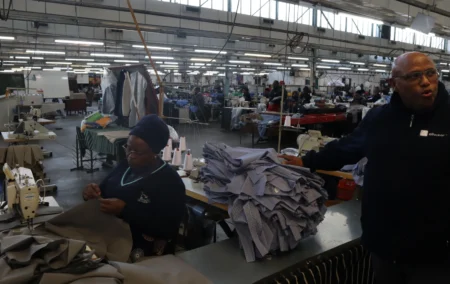
The law is also widely ignored. The Department concedes that 40% of employers don’t comply. In the critically stressed textile town of Newcastle, 92% of factories hold no bargaining council certificate, because the council’s rate exceeds what they can pay and still win orders. Those who get raided simply shut up shop, and the clothing orders go to countries with cheaper labour.
Nicoli Nattrass and Jeremy Seekings documented the mechanism: a union and its city-based employer allies raised wages in low-wage regions, and the work went to Lesotho and China.
Small firms are told the exemption process protects them. It is a fig leaf: relief of at most 10%, for at most twelve months, conditional upon a comprehensive profitability, liquidity and solvency audit. It might cost more to comply than they’ll save. For a firm that cannot afford the minimum wage in the first place, that’s no remedy at all.
Government does not believe its own law anyway. It pays Expanded Public Works Programme workers R16.62 an hour, 55% of the minimum it enforces on everyone else. There is no shortage of applicants. Clearly a lot of workers think that a non-decent, non-living wage is better than no wage at all.
How wages actually rise
Post-war Japan exported cheap textiles, tin toys and plastic gadgets made by badly paid workers. When I grew up, “Japanese” was the by-word for cheap, low-quality junk.
But wages climbed as productivity climbed and Japan increasingly catered to the high-quality end of the market. The work of making cheap junk at low wages moved to Korea and Taiwan, where the pattern repeated.
The pattern repeated. China followed. Hourly manufacturing wages trebled to $3.60 between 2005 and 2016, overtaking Brazil and Mexico and rivalling Portugal and Greece. China is now shedding low-end manufacturing because its workers cost too much. It has crossed what economists call the Lewis turning point, the point at which the over-supply of cheap rural labour is fully absorbed, wages rise, and future growth is challenged by labour shortages.
Much of the low-wage labour went to Vietnam. The consequences were predictable: manufacturing wages almost tripled to nearly $5 an hour between 2010 and 2022. Extreme poverty fell from about half the population in 1990 to under 1% by 2020. Unemployment is 2.2%.
In none of these cases did a commission gazette the wage increases. Wages rose because employers competed for workers who had grown scarce and productive.
Demand raised wages. Legislation followed, and took the credit. Legislating higher wages first puts the cart before the horse, and means the demand for labour will never arrive.
South Africa tried the reverse. We legislated the wages of a rich country and waited for the productivity and labour demand to turn up. We’re still waiting. It isn’t hard to follow the logical cause-and-effect chain.
What to do
If we want things to change, we must stop doing the same stupid things over and over again. Simply raising minimum wages – and deliberately raising them faster than inflation – will not make South Africa rich. It will not make its workers productive. It will not create demand for employment.
It hasn’t done so for 30 years, and it won’t do so next year, either.
So, here’s what we should do. Abolish the national minimum wage. Entirely. Ditch the sectoral wage determinations.
Repeal section 32 of the Labour Relations Act, which lets the Minister extend a bargaining council agreement to firms that never sat at the table – a provision the Free Market Foundation challenged and lost in 2016, and which is no more defensible now.
Leave unions wholly free to organise, bargain and strike, and to win whatever terms they can – but let their agreements bind only the firms that signed them.
Freedom of association means little if it excludes the freedom not to associate. Contract law means little if one can be bound by contracts to which one never consented.
Wages would then be set how every other price is set: in a negotiation between the parties to the transaction. Some would be low. And that’s okay. In a developing, growing economy, a low wage is a rung, not a ceiling.
The choice facing South Africa’s unemployed is not between a low wage and a decent one. It is between a low wage and nothing at all.
We have spent thirty years assuring them that nothing is the more dignified option, and that lower unemployment is just around the corner. It is time to admit that this is a lie, and that our policy must change if we want to see change in society.
[Image: Newcastle-textiles.webp]
[Caption: A clothing factory floor. Ninety-two percent of Newcastle’s clothing factories hold no bargaining council compliance certificate. (Photo: Joseph Bracken for GroundUp.)]
The views of the writer are not necessarily the views of the Daily Friend or the IRR.
If you like what you have just read, support the Daily Friend