

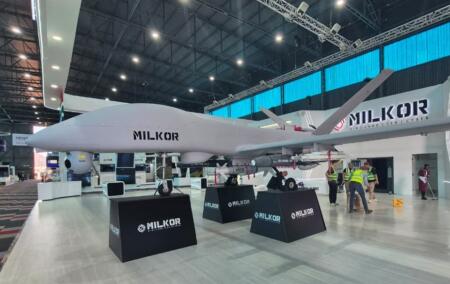
Every two years for three days in September, the SA defence industry holds its trade show at Waterkloof Air Force Base. In years gone by, when there were exhibitors from across the world, it was a magnificent occasion.
Last week, the Africa Aerospace and Defence (AAD) exhibition looked a lot smaller and less busy than in its glory years.
The show was launched 25 years ago by SA’s defence industry association, Africa Maritime and Defence association (AMD), in cooperation with the department of defence. That was at a time when the world was interested in SA as it emerged from an international arms embargo, with a recently signed multi-billion-dollar arms fund. This was also a time when global defence sales began dropping in the wake of the cold war’s end. Defence firms from around the world exhibited at the event, out of hope that SA would be a potential customer.
A lot has changed since. The South African National Defence Force (SANDF) budget for new equipment has dried up, along with equipment availability, and official emphasis is now placed on building ties with countries other than those in the West.
Since we joined the BRICS grouping in 2006, the ANC has been particularly keen to build ties with Brazil, Russia, India, China, the four original members of the now 11-member group. But the BRICS don’t seem all that interested in close defence ties and, anyway, most of our exports are to Europe, and everywhere other than the BRICS.
Most of our defence industry is booming due to exports. Defence exports tripled last year and, with global tensions rising, are likely to continue on this trajectory, at least over the next few years. From relying heavily on the local market during apartheid, the industry has since looked outward and has shown it can compete internationally.
It has the engineers and design skills to compete in the most sophisticated areas of defence technology.
Some of the well-established private defence companies generate more than 90 percent of their sales outside South Africa.
And strong demand abroad has also greatly helped Denel, the state-owned defence company, which was in the red for years. For the past two years, it has been in profit, largely due to the contribution to its bottom line from Rhinemetall Denel Munition (RDM), a joint venture with German defence giant Rhinemetall. Denel holds a 49 percent stake in the joint venture, which makes 155mm artillery shells. These are in great demand from European countries stocking up on ammunition since the Russian invasion of Ukraine, particularly Germany and Sweden, who have placed multi-billion-rand orders.
Glory years
One reason that the AAD show just might be well past its glory years is that the ANC-dominated government has put the show on a footing based on false assumptions.
The ANC above all wants to attract BRICS exhibitors, which is in line with SA foreign policy, but that’s not where much of the business lies. And if SA companies do deals with Russia and China, they won’t be able to sell into Europe.
According to figures released by the National Conventional Arms Control Committee (NCACC), the SA government agency that must approve all arms sales, Europe accounted for 42 percent of defence exports, the Middle East, 23 percent, Africa, 20 percent, the Asia-Pacific region, 12 percent, and the Americas, 3 percent. Munitions supplied by RDM, the 155 mm artillery shells, accounted for short of half of the exports, according to DefenceWeb.
While the Europeans are our big customers, we are putting a great deal of emphasis on trying to sell to our BRICS friends. India is a customer for Saab-Grintek’s integrated suite for warning aircrews against radar, missile, and laser threats, while providing countermeasures for aircraft, but the data show there is not much else that is sold into the BRICS market.
We have effectively chased away the US, and the presence of European countries at the show is pretty slim.
Italian defence company Leonardo had a stand at the show; there were a few German and Canadian exhibitors.
For years, the US Air Force flew a C-17 transport aircraft, the second-largest strategic airlift aircraft in its fleet – the giant Lockheed C5 Galaxy is its largest – Blackhawk helicopters, predator drones, and a C-130, their air transport workhorse, to AAD. Along with all of this came a Reaper drone and an impressive US Air Force Band to entertain the crowds.
After SA’s naval exercises with Russia and China in January 2023 were followed by other incidents, there was no chance that the US would return to the show. The ANC seemed unconcerned about the US pullout. After all, its foreign policy thrust is to seek closer defence ties with the BRICS grouping rather than the West.
If there is not a large domestic buyer, defence companies see little reason to spend millions on their stands.
Little left
The SA defence budget has not kept up with inflation, and spending on salaries leaves little left for spending on maintenance and new equipment. For the last few years, the SANDF has spent close to 70 percent on salaries, leaving little for new weapon systems or much else. By contrast, in the UK, salaries make up about 25 percent of the defence budget.
While there have been upgrades, the last major round of procurement was about 30 years ago when the corvettes, submarines, the Hawk fighter trainers, and the Gripen fighters were bought. The purchase of new Badger infantry fighting vehicles to replace the ageing Ratel has been stalled. New items are purchased, but not in sufficient quantities to ensure a modern and ready force.
The stretched defence budget and SA’s shifting foreign policy priorities have meant much of the world has lost interest in either selling to the country or partnering on defence projects. And countries in the expanded 11-member BRICS grouping don’t seem to be keen either.
There seems to be diminishing interest even from the BRICS and countries that display their independence from the US, like Turkey, in the show.
In 2024, on the ramp used by the Americans in previous years, the Chinese People’s Liberation Army Air Force parked their military strategic airlifter, the Xi’an Y-20 Kunpeng. And next to the Y-20, also on the spot used by the US in past years to park their planes, was the Brazilian Embraer C-390 military airlifter.
But this year, there were no Chinese or Brazilian planes on the apron. It was almost empty, aside from the unserviceable C130 the SANDF had put on display.
And the only Brazilian company at the show was Embraer. China companies had a large presence, albeit smaller than before, but that of Turkey and Russia was considerably scaled back from two years ago. Turkey is not a BRICS member but has rapidly expanded its defence sales to the continent in recent years.
Defence exports are now a big contributor to our balance of payments, and one would expect that the state would encourage this. But the industry is frustrated that the approval process for defence exports from the NCACC can take up to six months. In NATO members, the approval process can be as short as 24 hours.
Long delays
Despite complaints from AMD that some of its members are losing their reputation and deals because of long delays in the approval process, there has been no move to improve the process.
So, while our industry is having enormous sales success in Europe and mainly Western-aligned countries, we are trying to partner with countries that are either hostile or distance themselves from the West. And meanwhile, the government is frustrating its foreign exchange earners with long delays in the approval process.
[Image: Medium altitude, long endurance (MALE) drone produced by Milkor of South Africa. Ricardo Teixeira]
The views of the writer are not necessarily the views of the Daily Friend or the IRR.
If you like what you have just read, support the Daily Friend