

Four years ago, in a conference room at the DIRCO building in Pretoria, Ethiopian and Tigrayan negotiators signed the deal that ended one of the deadliest wars, not only of this decade, but of the last half-century. South Africa hosted the talks and took quiet pride in its role in ending the bloodshed.
That agreement is now dead. War returned to northern Ethiopia on 23 September, and two weeks later the situation looks increasingly perilous. Federal forces have retaken Mekelle, drones have struck military sites in Addis Ababa, and witnesses this week reported Eritrean soldiers driving through the Tigrayan town of Adigrat.
The peace that carries our capital’s name has collapsed, and with it, part of South Africa’s claim to lead on African peace.
The Pretoria agreement did not fail overnight. It may have “silenced the guns,” but it left the hardest questions open. Eritrea, whose army fought alongside Ethiopia in the last war, was never at the table.
The dispute over western Tigray was left unresolved, and disarmament talks stalled. The Tigray People’s Liberation Front split into rival camps, and Addis Ababa exploited the divisions. Meanwhile, the African Union’s monitoring was thin, and the guarantors, South Africa among them, treated the signing as the finish-line rather than the start of the serious groundwork.
Now an alliance of ethnic militias and tribal groups openly seeks to topple the federal government, though some of its members say they do not intend to take up arms.
Ethiopia will first have to deal with the Eritrean troops on its territory, but an assault on the Eritrean port of Assab looks increasingly likely. On 5 October, Prime Minister Abiy Ahmed began a new five-year term by insisting, once again, that Ethiopia must have an outlet to the sea, a long-standing ambition he has voiced ever more loudly.
Assab lies only 80 kilometres from the Ethiopian border, at the end of a road that was once Ethiopia’s main route to the coast. To the east of the port sits a refinery built in 1967, when Eritrea was part of Ethiopia, the country’s first refinery; to the west, an international airport with dual civil and military facilities and a 3,515-metre paved runway.
The Eritrean capital, Asmara, lies 700 kilometres from Assab by road, much of it unpaved. For a military that relies mainly on open-top trucks for mobility, defending this crucial coastal town would be a struggle. And reports of Eritrean troops on Ethiopian soil have now handed Addis Ababa the self-defence pretext it needed.
Real money
South Africans should care, because we have real money in Ethiopia. Vodacom now controls Safaricom, which runs Ethiopia’s second mobile network and had hoped to break even by early 2027, while Standard Bank has been positioning itself for one of the first foreign banking licences in half a century.
South African exporters, contractors and retailers depend on a single supply line. About 97 per cent of Ethiopia’s freight moves through Djibouti, along a highway that branches towards Assab. A war for the port would turn that road into a military route, starve the economy of fuel and imports, and weaken the birr further.
The damage would not stop at Ethiopia’s borders. Assab sits beside the Bab el-Mandeb strait, opposite a Yemeni coast contested by the Houthis. Shipping lines had only just begun returning to the Suez route when the Houthis launched a lightning advance to seize much of Yemen’s western coast. Saudi-backed forces have since recaptured key ports, such as Mocha, in a fresh counter-offensive.
Fighting on the African shore of the Red Sea would push insurance and oil prices higher still: costs South Africans will feel at the pump. More ships would be diverted round the Cape; there would be a gain for bunkering and ship services in Namibia, Mozambique and Tanzania, but a strain on Transnet terminals that are already struggling with the traffic they have.
The larger stake is South Africa’s regional and global standing. Our foreign policy rests on sovereignty, territorial integrity and African solutions through the African Union, which is headquartered in Addis Ababa.
If the AU’s host state seizes a port from its neighbour, Pretoria will face a hard choice. It can speak out and risk friction with a partner in which South African companies have invested heavily, or it can stay quiet and watch its credibility drain away, while Egypt and the Gulf states shape the outcome, potentially through further use of force. Silence would be the worse choice.
So far, Pretoria has chosen silence. President Cyril Ramaphosa met Prime Minister Ahmed at Addis Ababa’s international airport on 7 October, in what was described as a “courtesy call”. The Pretoria agreement was not on the agenda.
Act now
South Africa can and should act now, before any shots are fired at Assab. It could state plainly that any attack on Eritrean territory would breach the AU charter, drawing on the standing it earned in 2022 and its ties to Addis Ababa, Nairobi and the AU Commission.
It could push for a new process: one that brings Eritrea to the table this time and builds real monitoring. And it could work with South African firms on contingency plans, from evacuating staff to protecting supply lines, so that business is not left to improvise in a crisis.
The failure of the Pretoria agreement is not South Africa’s alone, but it bears our name. Whether we let it fade into history or use its failure to shape what comes next will say a great deal about the kind of regional power South Africa intends to be.
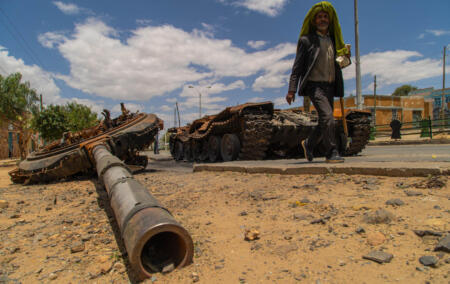
[Image: A destroyed tank on the main street of Edaga Hamus, in the Tigray region, June 5, 2021. Yan Boechat/VOA – https://www.voanews.com/africa/children-shot-bombed-and-knifed-tigray-war, Public Domain, https://commons.wikimedia.org/w/index.php?curid=107365798]
If you like what you have just read, support the Daily Friend