

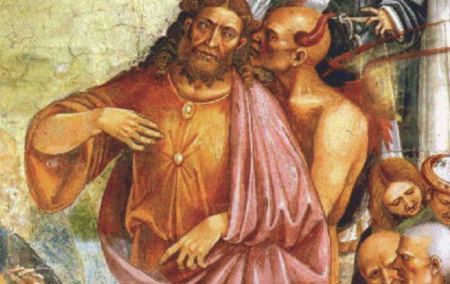
Peter Thiel, the billionaire venture capitalist, technology entrepreneur and political powerbroker (and one of the mega-tech-bro cabal), has developed a weird preoccupation, even an obsession. It is the Antichrist. So disturbed is Thiel by him (it?) that he now frequently gives alarmist talks about the subject in private forums, lectures and interviews. The subject is obviously increasingly near and dear to his amygdala.
Not, mind you, as in a metaphor or allusion to describe a disliked politician, regulator or competitor. He means the actual biblical Antichrist, the evil figure who will emerge towards the end of civilisation, establish dominion over humanity and prepare the ground for Armageddon.
More surprisingly, no one seems particularly disturbed by this. Therein lies a story, but first some background.
Thiel is not some itinerant preacher who has wandered into tech. Born in Germany and raised partly in South Africa, he co-founded PayPal, became Facebook’s first outside investor, helped establish Palantir and built Founders Fund into one of Silicon Valley’s most influential investment firms. His 2014 book Zero to One shaped a generation of Silicon Valley thinking. He was an early supporter of Donald Trump and helped finance JD Vance’s political ascent. He is libertarian, anti-regulation, contemptuous of democracy and convinced that technological acceleration will save us. He is also exceptionally intelligent, unusually well connected and enormously wealthy – Forbes puts his fortune at close to $40 billion.
This is why his excursions into Christian eschatology are more interesting than they would be coming from a man standing on a street corner with a sandwich board.
Thiel started getting into the more end-times mythologies in about 2004 (at least as far back as I can find), blathering on about Armageddon and Hobbes’s Leviathan and the Apocalypse and Satan. It is probable that no one really noticed because he was not yet that influential or well known. By early 2008, when his essay “The Optimistic Thought Experiment” appeared in the Hoover Institution’s Policy Review, he was chairman of Palantir and a partner in Founders Fund, which would soon back SpaceX. His position has become more extreme (and more public) ever since.
So why is one rich guy with comically apocalyptic leanings worth writing about?
Let’s leave aside that the possible next president of the US (Vice President Vance) owes much of his political career to him. Starting with a series of private lectures in San Francisco in September and October 2025 and continuing in recent weeks, Thiel has pushed the biblical envelope. An example – “Some people think of [the Antichrist] as a type of very bad person,” Thiel said in one leaked recording. “Sometimes it’s used more generally as a spiritual descriptor of the forces of evil. What I will focus on is the most common and most dramatic interpretation of Antichrist – an evil king or tyrant or anti-messiah who appears in the end times”. He described himself as a “small-o orthodox Christian” and suggested that critics of unregulated technology – climate activists, AI safety researchers, anyone calling for government oversight – are not merely political opponents but “legionnaires of the Antichrist”.
OK then.
Let’s simplify this – he is using his bully pulpit, influence and reach to say that anyone supporting any government regulation of any kind over tech or climate (and presumably other sectors) is an emissary of the Beast. While he has specifically called out Greta Thunberg and uber-AI doomer Eliezer Yudkowsky, he is also talking about most of us who are, to a greater or lesser extent, reasonably concerned about the potential downsides of some of the dizzying changes we are seeing around us. We are all damned, apparently, the spawn of Satan and deserving of existential punishment.
There’s more. In his recent series of sessions in Nashville (a four-part continuation of the brazenly titled San Francisco series “The Antichrist: A Four-Part Lecture Series”) he went after none other than Pope Leo XIV, presumably in response to the pontiff’s anti-AI encyclical Magnifica Humanitas of 24 May. Going after Greta is one thing; going after the pontiff is an entirely different matter, because not only does it back the Catholic presidential aspirant Vance into a conflict corner, but it also pisses off more than a billion adherents.
Is anyone taking him seriously? Yes. Thiel has found a receptive audience not among the devout, but among a subset of the tech elite and the politically disaffected – people for whom the language of apocalypse feels proportionate to the stakes of a world they believe is slipping out of control. This is not to say that Antichristism is about to sweep the globe. But given the extremism now taken for granted almost everywhere, including in countries that were once bastions of tolerance and critical thinking, one could be forgiven for raising a concerned eyebrow.
But what Thiel appears to want is not converts but a vocabulary. Debates about AI and climate conducted in the language of risk management are debates that regulators can, and do, win. Move them into the language of good and evil and the regulators become the enemy – not mistaken, but damned. (Of course, given that Thiel’s Palantir sells mass surveillance and data-analysis tools to governments, one wonders about his commitment to the professed libertarianism that has fed his ramblings about the Antichrist.)
Which brings us back to the question – what’s with Thiel and the Antichrist? Perhaps the answer is that there is nothing especially mysterious about it at all. Plutocrats have always harboured eccentric convictions, but earlier generations of the super-rich kept their stranger beliefs to private quarters, partly out of decency and partly out of prudence – shareholders, customers, governments and congregations could make them pay.
Thiel’s lectures were supposed to be private too. But when they leaked (as I am sure he knew they would), there was no discernible cost. No board rebuked him, no client walked, the vice-president kept his distance from the pope rather than his patron, and most of the rest of us just blinked briefly. Thiel has discovered he can say all of this without meaningful consequence (Musk discovered much the same thing, albeit without the Book of Revelation). Once enormously powerful people learn that the old boundaries of decorum no longer apply, there is little reason to expect them voluntarily to stay within them.
Thiel is perhaps less an aberration than an early adopter among the mega-wealthy. Say what you want, believe any irrational nonsense you choose. It’s not going to hurt you at all and it will get you the attention that this age demands.
Steven Boykey Sidley is a professor of practice at (ex-JBS, University of Johannesburg) and a partner at Bridge Capital and a columnist-at-large at Daily Maverick, Daily Friend and Financial Mail. His new book “Checkmate: How Shoprite Checkers rewrote the rules and won” is published by Jonathan Ball
[Image: The Devil whispers to the Antichrist; detail from Sermons and Deeds of the Antichrist, fresco by Luca Signorelli, 1501, Orvieto Cathedral]
The views of the writer are not necessarily the views of the Daily Friend or the IRR.
If you like what you have just read, support the Daily Friend