
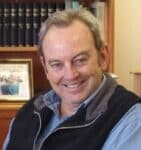
Martin Schonteich is a consultant with the Institute for Security Studies, a former SA prosecutor and a well-respected expert on countering the corrupt. He has opined for Polity on this thorny topic and Legalbrief Today has conveniently summarised his views which are certainly worthy of consideration. Here is what Polity published, as summarised:
“For many South Africans, holding people accountable for corruption means investigating and prosecuting those responsible. Successful prosecutions are essential to upholding the rule of law and combatting impunity, writes Martin Schönteich, Institute for Security Studies (ISS) consultant and former SA prosecutor. But, he points out, ‘complex cases typically involve huge amounts of financial and digital evidence, many accused, complicated corporate structures and transactions across national jurisdictions. Successful prosecution needs good investigations, forensic expertise, international co-operation and functioning courts. ‘SA’s capacity to investigate and prosecute corruption cases is constrained: in August, Parliament’s Scopa noted a vacancy rate of almost 50% in the Hawks). It expressed concern about the many corruption referrals that had not resulted in prosecutions. Those implicated in major corruption may also have considerable resources to repeatedly challenge proceedings says Schönteich. He observes that ‘by the time someone is convicted, the bribe has been paid, the contract manipulated, the money hidden or the public institution damaged. A conviction years later cannot undo the damage’. He argues that SA ‘must fight corruption further upstream, arguing that state institutions possess an array of administrative, regulatory, financial, disciplinary and civil powers that can be used to combat corruption. Many can be exercised without a criminal conviction, and some do not depend on a criminal case being brought’. ‘When corruption is uncovered, the immediate question should not simply be whether someone can eventually be prosecuted. It should also be what can lawfully be done now to stop the wrongdoing and prevent further harm.’
Schönteich illustrates the point by referring to a suspicious financial transaction, for example. ‘When the statutory requirements are met, the Financial Intelligence Centre can direct an institution not to proceed with a transaction for up to 10 days while it makes inquiries. The SIU can institute civil proceedings to recover state losses and prevent potential losses. The Special Tribunal can grant suspension orders and interdicts that halt disputed contracts or other conduct while a case is being decided. An unlawful contract can potentially be stopped without waiting for a corruption prosecution. Financial regulators such as the Financial Sector Conduct Authority and Prudential Authority can restrict activities, suspend or revoke licences and remove or debar individuals from parts of the financial sector. The Auditor-General also has corrective and preventive powers. A material irregularity can be referred for investigation and trigger remedial action. If a failure to take action by those responsible for a public institution’s financial management results in financial loss, the Auditor-General can issue a certificate of debt requiring repayment to the state.’ He adds that National Treasury, through its List of Restricted Suppliers and Register for Tender Defaulters, can restrict access to public procurement and prevent a prohibited supplier from simply moving on to the next government contract. He says legal powers mean little if the institutions entrusted with them lack the capacity or willingness to act. He acknowledges some institutions are actively disrupting corruption: ‘SIU figures reveal that its 2025/26 financial year interventions prevented roughly R1.9bn in state losses and led to contracts worth over R25.7bn being set aside through court proceedings.’ SA does not need to wait for more criminal convictions before acting against corruption. Much of the legal authority to intervene exists. ‘What is needed is the institutional capacity, leadership and political will to use it. And when those entrusted with these powers fail to act, they must be held accountable.”
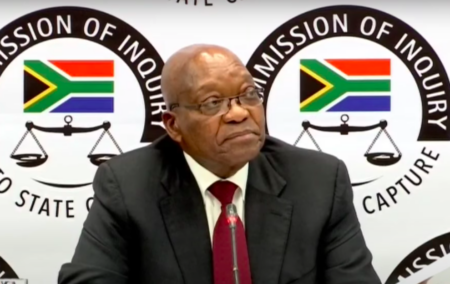
Taking a step back from the minutiae of the points raised above, it is important to note that the victim of the corruption in SA is all too often the poor because tenderpreneurism has run rampant and almost invariably involves the looting of departmental coffers or state owned enterprises. There are estimates in the public domain that state capture, as examined by the Zondo Commission, involved losses of some R1,5 trillion during the few years the Commission covered. As reported in Polity, the sums that the SIU either recovered or protected recently pale into insignificance when the scale of the problem of grand corruption with impunity in SA is looked at through the lens of a definition of corruption that highlights that it involves theft from the poor. It is accordingly right that before the issuing of orange overalls to those involved in corrupt activities, the first order of business ought to be attention to raking back their loot.
Judge Navi Pillay, the latest Nobel Peace Prize winner, describes corruption vividly:
“Make no mistake about it, corruption is a killer … The money stolen through corruption is enough to feed the world’s hungry 80 times over… Corruption denies them their right to food and, in some cases, their right to life.”
To rake back loot swiftly removes much of the incentive to indulge in corrupt activities. The crime we call corruption is both secretive and calculated in nature. Three features of the calculation secretly made before a corrupt activity in undertaken are:
Firstly: “will we be caught out” and,
Secondly: “if we are caught, will it be possible to hang on to our loot.”
Thirdly, a follow up question is “will we do time in jail if we are caught and will we forfeit our loot by order of court”.
In SA the corrupt appear to regard the prospect of being caught, tried and punished properly to be remote. Their fall-back position is that they will be able to conceal their loot and use it to mount an expensive defence in an overworked criminal court in which their counsel will run rings around the under-resourced and inexperienced prosecutors who are unable to discharge the heavy onus of proof beyond a reasonable doubt, leading to the acquittal of the corrupt accused persons. There are also opportunities, given the high levels of corruption in the current criminal justice administration, for making dockets disappear, causing witnesses to lose their memory or fluff their lines in court or to simply bribe the investigating officer to muck up the case.
A viable counter to these scenarios is indeed to “rake back loot” at an early stage of the investigation of the matter. The SIU is not part of the criminal justice administration, but it does have the power to seek relief in court enabling it to seize, freeze and ultimately secure forfeiture of the loot it is able to identify and track down in the early stages of an investigation. The SIU needs a proclamation by the president to leap into action. Its powers are similar to those used in civil litigation by private non-state victims of corrupt activities who are also able to secure identical relief long before any prosecution is mounted.
As greed is usually the motivating factor when corruption occurs, it is a great disincentive to corruption were the state to work early and hard on cases in which seizing, freezing and eventually forfeiting the loot of the corrupt is achieved. The loot can be followed up worldwide and where it has been used to acquire assets, whether offshore or in SA, it is possible to obtain the same relief in respect of the ill-gotten yachts in the Caribbean, the apartments in Dubai or the artworks in India. To rake back loot upfront rather than at sentencing stage, years later, in a criminal case is preferable by far.
The business of raking back loot does not have to occur in the context of a pending criminal trial. Civil proceedings are possible and they enjoy a much easier burden of proof for the looted party. A mere balance of probabilities suffices in civil cases whereas in a criminal trial proof beyond a reasonable doubt is required before relief is granted.
It is probably true that the big issue today is the lack of political will to rake back loot when corruption is uncovered. This conclusion, damning as it is, flows from the lack of follow up by government to receipt of a memorandum from Accountability Now, following consultations with senior officials as long ago as August 2020, when the “how to” of raking back loot was explained in some detail in the paragraphs of the memorandum quoted below:
- The availability of Mareva Injunctions or “freezing orders” in most relevant jurisdictions around the world is an avenue open to government and to SOEs for the purpose of recovering loot through the civil courts of the world.
- This is how it works: the looted entity engages specialist attorneys and forensic auditors to track and trace the destination in which the loot of state capture currently finds itself. These steps are taken with a view to approaching foreign courts having jurisdiction to issue an order preventing dissipation of loot. These orders can be made in respect of loot of all kinds and in respect of assets (whether movable or immovable) purchased using the loot.
- The forensic tracing of the loot and assets purchased with it takes place using sophisticated IT with the necessary artificial intelligence to do so (this facility the technology is not available to the NPA, hence the delays in the VBS Bank matters). Using the SWIFT banking system and account details it is possible to track and trace loot no matter how many times it is moved to conceal it.
- As the proceedings are of civil nature in the courts around the world, it is not necessary to discharge the high criminal threshold of “proof beyond a reasonable doubt” in the application to freeze the assets traced.
- The experience in practice is that once a freezing order is obtained the looter realises the game is over and does not oppose the forfeiture of and seizure by the creditor of the frozen assets.
- The procedure is available in Dubai. Google “Mareva Injunction Dubai” for a fascinating trip through cyberspace detailing how the remedy is used in the Emirates.
- It is neither necessary nor desirable to wait for the outcome of criminal proceedings before invoking the Mareva injunction procedures. Indeed, the element of surprise and the need for a rapid response both render it desirable to allow the civil case to precede the institution of criminal proceedings.
- The claimant in each case in SA is either the looted SOE or the department of state, province or municipality that has been looted. A resolution instructing the local lawyers to institute the proceedings must be placed before the foreign court hearing the application for the freezing order.
- Other civil remedies can also be considered. Lord Hain has suggested that the bankers to the looters are culpable in law for ignoring or even facilitating suspicious transactions. Certainly, those auditors and accountants, lawyers and consultants who participated in, facilitated or turned a blind eye to the corrupt activities could also be sued for damages for aiding and abetting the politically exposed persons who are usually implicated in looting. As most of them are insured, success in court translates into payment, not empty judgments.
- It is suggested that government consider the use of the Mareva injunction as a means of recovering the loot of state capture wherever it may be found in the world. In the local courts an anti-dissipation order a la Knox-D’Arcy is an available remedy. Experience teaches the international debt collectors that it is unusual for the looters to retain loot in the area of jurisdiction in which it is purloined.
The memorandum may have been disregarded because of a resolution of the NEC of the ANC which instructed cabinet, as a matter of urgency, to set up a new single stand-alone anti-corruption body with the attributes required by the Constitutional Court in the Glenister litigation. [ See https://accountabilitynow.org.za/paul-hoffman-has-anc-finally-had-its-eureka-moment-on-corruption/ ]
In short:
According to a media release issued by the NEC on Tuesday 4 August 2020 as reported in the Citizen newspaper:
“The NEC called upon the ANC-led government to urgently establish a permanent multi-disciplinary agency to deal with all cases of white-collar crime, organised crime and corruption. Furthermore, the NEC called upon all law enforcement agencies to carry out their duties without fear, favour or prejudice,” said Magashule.
He said the NEC fully supported its president, who is also South Africa’s head of state, Cyril Ramaphosa’s decision to refer all allegations linked to the procurement of Covid-19 goods and services to the Special Investigative Unit (SIU).”
The consultations with government mentioned above occurred in the same week, but there has been little or no appetite in the corridors of power in SA to follow up on either the advice given or the NEC resolution taken.
The best cure to the lack of political will to take on the corrupt by first raking back their loot is to put different politicians into the decision-making roles in government. That is the task of registered voters.
Paul Hoffman SC is a director of Accountability Now. He was lead counsel in the Glenister litigation.
[Image: https://commons.wikimedia.org/wiki/File:Jacob_Zuma_at_the_Zondo_Commission.png]

The views of the writer are not necessarily the views of the Daily Friend or the IRR.
If you like what you have just read, support the Daily Friend