

On 14 October India’s foreign minister, S Jaishankar, said that India is uncomfortable with the label “middle power”. Speaking at the Bloomberg New Economy Forum in New Delhi, he pointed to the world’s largest population, an economy of about $4 trillion, and decades of growth ahead. He indicated he prefers “powers in the middle”. Ten days earlier, at the Munich Leaders Meeting in the same city, he had said it’s easier to say what a middle power is not, rather than what it is.
While South Africa is often described as a middle power, it’s worth asking what the description requires.
Political scientists define a middle power as a state with more influence over global affairs and its own region than the average state, and less than a major power or superpower. That more academic wording is useful for describing where a country ranks, but it doesn’t help to understand what keeps it there. Influence must rest on something; a meaningful middle power is one that other countries must plan around, and that can act without asking a larger power for permission. From that basis, we can apply four tests.
First, the country has something others need and cannot easily buy elsewhere. Jaishankar called this a world of choke points, where even sanctions act as one. South Africa passes this test. It holds about 83% of the world’s platinum group metal reserves, according to the US Geological Survey’s 2026 Mineral Commodity Summaries. It supplied 96% of the chromite ore the United States imported between 2021 and 2024. The survey also estimates that it holds about 70% of the world’s manganese resources.
Second, the country can supply the basics of its own defence. A 2020 commentary from India’s Observer Research Foundation argued that power begins with self-sufficiency in defence production. A country that buys its weapons and ammunition from a patron will find that the patron expects loyalty in return.
Third, the country keeps its promises. Partners sign contracts on the assumption that goods arrive on time and that the money is accounted for.
Fourth, the country can empower others. Jaishankar said the test is countries with “the power to empower”, a phrase he attributed to Prime Minister Narendra Modi. A middle power makes its partners stronger through investment, skills, equipment or access to its market.
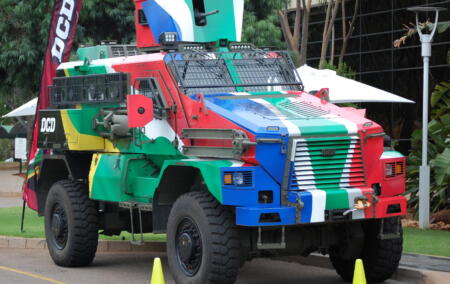
Denel shows how South Africa fares on the last three tests. Business Day reported on 13 October that the state arms maker told parliament’s defence committee it was chasing a pipeline of more than R30bn of potential business. According to its 2025/2026 annual report, revenue rose 15.8% to R1.473bn in the year to March 2026. The operating loss was R364m, against R370m the year before. Denel received its ninth consecutive audit disclaimer. Its presentation projected a negative cash position in September 2026 and said some legacy debt remained unpaid.
A contract with Algeria usefully focuses the issue. Denel said guarantees for it were in the final stages of being issued, but until they arrive, a foreign government that wants South African equipment is waiting on paperwork. Separately, an advance payment for a G6 artillery upgrade is being held as collateral, and Denel is still working to access it. A company in that position cannot strengthen a partner. Indeed, it is struggling to serve the partners it already has.
The cost of this showed up again this week. On 13 October, Formula 1 announced a 10-year deal to hold the African Grand Prix in Rwanda, at a purpose-built circuit near Kigali. The last race on the continent was the 1993 South African Grand Prix at Kyalami. South African sports minister, Gayton McKenzie, said Rwanda had worked on it longer and deserved it. Rwanda’s government has critics, and it has used sport for years to polish its image. Those legitimate criticisms and concerns do not change the result. A much smaller country did the preparation and the work, and it was awarded the race.
The same presentation made a crucial geopolitical point. It told parliament that “the friend today can be an enemy tomorrow” and that geopolitics had become very fluid. Group chief executive, Tsepo Monaheng, said the recovery would be judged by delivery. That is the correct standard, and it applies to the country as well as to the company.
South Africa holds the ‘middle power’ title by rank. On substance, it passes one test and fails two. Its minerals earn it a seat at the table, but once the conversation turns to equipment, skills and reliability, the country has less to offer than it likes to think.
The government can change that. It should settle Denel’s guarantees and cash position before it chases new orders. Any further help from the shareholder should come with delivery milestones that are reported to parliament in public. A defence industry that finishes what it starts would give South Africa something to bring to the “reasonable degree of convergence” that Jaishankar wants among middle powers.
India can claim it has outgrown the label because of its size. South Africa is smaller and has to earn the title through what it delivers. At present it has not shown that it can.
[Image: Ricardo Teixeira]
The views of the writer are not necessarily the views of the Daily Friend or the IRR.
If you like what you have just read, support the Daily Friend