

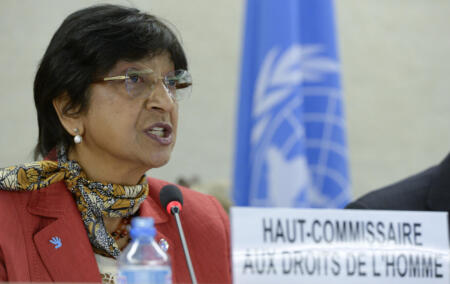
Navi Pillay’s contribution to international justice deserves recognition. But the Nobel Committee’s praise for her independence invites closer examination of the UN commission she chaired.
The Norwegian Nobel Committee’s decision to award the 2026 Peace Prize to South African jurist Navi Pillay has been warmly received, particularly in South Africa. That is understandable. Pillay has had an extraordinary career, from confronting apartheid to helping develop international criminal law. But the Committee has gone further than recognising her achievements. It has specifically praised her independence, integrity and commitment to universal legal principles, while including her recent chairmanship of the UN commission investigating Israel and the Palestinian territories among the reasons for honouring her. That invites a difficult question: how well does her recent record bear out those claims?
Pillay’s earlier achievements are real. She worked as a lawyer in a country where race and gender determined who could practise and who could expect justice. She defended political prisoners and challenged apartheid, a system whose dismantling was both necessary and overdue. At the International Criminal Tribunal for Rwanda, she helped establish important jurisprudence recognising that rape and sexual violence could constitute genocide. She subsequently served at the International Criminal Court and as UN High Commissioner for Human Rights. There is no reason to diminish any of this. Equally, there is no reason to treat a distinguished past as a guarantee of sound judgement in every later appointment.
I want to be explicit about how I intend to examine her record. Pillay’s commission did not deny that Hamas and other Palestinian armed groups committed war crimes, or that sexual violence occurred on 7 October 2023. I will not suggest otherwise. Nor will I dismiss serious evidence of unlawful Israeli conduct or pretend that circumstantial evidence is inadmissible when proving genocide, as some of Pillay’s critics have.
Pillay was appointed in 2021 to chair the Independent International Commission of Inquiry on the Occupied Palestinian Territory, including East Jerusalem, and Israel. Its mandate covered abuses by all parties, not simply Israel. But it was unusually broad and open-ended, extending to the underlying causes of the conflict, including discrimination and repression. By then, Pillay had already taken a public position on related matters. In June 2020, she endorsed a South African BDS Coalition statement urging sanctions against Israel, including trade measures and a military embargo, and describing Israeli policies as apartheid. The immediate context was threatened annexation of parts of the West Bank.
Opposing annexation, occupation or settlement policies is not evidence of prejudice against Jews, and human rights lawyers are entitled to campaign for causes they believe just. The concern is narrower and more serious: someone who publicly endorsed punitive action against a state, while adopting contested legal characterisations of its conduct, was subsequently asked to chair an inquiry examining that state’s behaviour. Prior advocacy does not prove a predetermined outcome. But it does create an appearance of prejudgement that requires more than assurances of personal integrity to dispel.
An episode the following year hardly improved matters. In a July 2022 interview, fellow commissioner Miloon Kothari spoke of a supposed ‘Jewish lobby’ influencing criticism of the commission and questioned Israel’s membership of the United Nations. Pillay initially defended him, arguing that his remarks had been misrepresented. Federico Villegas, then president of the Human Rights Council, wrote to Pillay reminding commissioners of their obligations of discretion and impartiality. He warned that Kothari’s comments could reasonably be understood as stigmatising Jewish people. Kothari apologised. Pillay also clarified that the commission did not question Israel’s UN membership, which deserves acknowledgement. Nevertheless, the chair’s initial response to a colleague’s language invoking an antisemitic trope raises questions about judgement, and the objections came from the Council’s own president, not just Israel’s supporters.
Israel’s refusal to cooperate with the commission needs similar care. In February 2022, more than eighteen months before the Hamas attacks of 7 October, Israel’s ambassador in Geneva formally rejected cooperation with the commission, arguing that its mandate and composition were discriminatory and that Israel had no reasonable expectation of fair treatment. The objections were therefore not invented in response to the atrocities of October 2023. They were directed at a commission whose independence Israel had questioned from the outset.
That does not necessarily make Israel’s objections correct. Governments under investigation have obvious reasons to question their investigators, and Israel’s refusal genuinely limited the commission’s ability to gather evidence. But the distinction is important, particularly because Israel subsequently invited a different UN representative, Pramila Patten, to examine allegations of sexual violence arising from 7 October. Her team visited Israel between 29 January and 14 February 2024, receiving the government’s cooperation and visiting attack sites. Patten’s mission was not a full criminal investigation, but it was authorised to gather, analyse and verify evidence.
On 4 March 2024, Patten reported reasonable grounds to believe that rape and gang rape had occurred at three or more locations during the attacks. Her team examined thousands of photographs, many hours of gruesome video footage and witness testimony. Regarding hostages held in Gaza, it found clear and convincing information of rape and other forms of sexual violence. Patten also acknowledged limitations in the available evidence and rejected certain allegations that could not be substantiated. Her conclusions were nevertheless affirmative.
Three months later, Pillay’s commission issued its own detailed findings on 7 October. It documented the deliberate killing and abduction of civilians, torture, mutilation and sexual violence. Its report described women found undressed, restrained and injured, identified a pattern of sexual violence across several locations, and concluded that Hamas and other Palestinian armed groups had committed serious war crimes. These were substantial findings, which should not be overlooked.
Yet the commission stopped short of independently verifying rape. It cited its inability to visit crime scenes, obtain certain original testimony or access victims and witnesses, together with difficulties concerning forensic evidence. Its report expressly acknowledged Patten’s earlier findings but did not reach the same conclusion independently. The difference is not that one UN body recognised sexual violence while the other denied it. Both recognised it. The question is why they reached different conclusions about rape, and whether the commission’s evidentiary approach adequately explains that difference.
There is an elementary issue here. Rape is often committed without a surviving eyewitness, a usable forensic sample or footage of the act itself. Of course nobody should be required to produce a literal recording of a rape before investigators can reach a conclusion. Pillay’s commission did not demand that, and it would be unfair to imply that it did. It accepted witness accounts and other indicators of sexual violence. But the point of an investigative standard is to assess evidence in combination, including circumstantial evidence, without setting requirements that make particular crimes practically impossible to verify.
This is where a comparison with the commission’s later work becomes useful. Paragraph 14 of its June 2024 report described sexual-violence findings as corroborated by a witness or witnesses interviewed by the commission and supported by digital evidence. Its March 2025 report on sexual and gender-based violence allegedly committed by Israeli forces against Palestinians described corroboration through witnesses or digital evidence, and expressly discussed UN guidance allowing reliance on a single credible primary source in appropriate circumstances. The overall standard, ‘reasonable grounds to conclude’, remained the same.
It would be too quick to declare that this proves a double standard. The investigators faced different forms of evidence; some Palestinian detainees survived and could provide direct testimony, whereas many Israeli victims could not. The 2025 report also rejected or declined to verify some allegations against Israeli personnel. And the more flexible UN guidance was not invented to accommodate allegations against Israel. Nevertheless, the reports describe their corroboration requirements differently. Given the disparity in their conclusions on rape, readers are entitled to ask whether that difference made a practical difference, and if not, why the commission did not explain its approach more clearly.
The September 2025 report accusing Israel of genocide presents a related issue about standards and inference. Genocide is not simply a synonym for a large number of civilian deaths or even for war crimes. It requires an intention to destroy, in whole or in part, a protected group as such. The commission relied on statements by Israeli leaders, the pattern of military operations, civilian casualties, displacement, restrictions on humanitarian supplies and destruction of healthcare and other infrastructure. These are serious matters. The possibility that Israeli forces committed unlawful attacks or collective punishment must not be dismissed merely because Israel was fighting Hamas.
The commission’s framing is also revealing. Its September 2025 report begins its summary of factual findings with the sentence: ‘On 7 October 2023, Israel launched its military offensive in Gaza, which included airstrikes and ground operations.’ The Hamas-led massacres and hostage-taking that precipitated Israel’s response are absent from that opening sentence, while Israel’s major ground operations began only on 27 October. The commission had documented Hamas’s atrocities in an earlier report, so this cannot fairly be presented as a denial of those events. But in a report assessing genocidal intent, such a selective opening chronology is difficult to defend.
Nor is the use of circumstantial evidence itself objectionable. The International Court of Justice explicitly recognises that genocidal intent may be inferred from a pattern of conduct. In Croatia v Serbia (2015), however, it insisted that genocidal intent must be the only reasonable inference from that pattern. Pillay’s commission acknowledged the test and concluded it was satisfied. The proper criticism is therefore not that it used circumstantial evidence, but whether it applied that test convincingly.
There are also questions of attribution. Rockets fired by Palestinian armed groups have fallen short and killed civilians in Gaza, and the precise contribution of such incidents to the war’s casualties remains uncertain. Not every death in Gaza can automatically be attributed to Israeli military action. Nor is the scale of killing irrelevant to the question of intent. The International Court of Justice has itself considered whether perpetrators exploited the opportunities available to them to destroy members of a protected population. Neither consideration disposes of the genocide allegation, but both belong in an assessment of whether genocidal intent is the only reasonable inference from the evidence.
Israel’s stated objectives included defeating Hamas and recovering hostages, while Hamas maintained extensive tunnels and other military infrastructure within densely populated areas. These considerations do not excuse unlawful Israeli attacks, and legitimate military aims can coexist with genocidal intent. But they are relevant competing explanations that must be carefully tested before concluding that genocide is the only reasonable inference.
The commission argued that the overall pattern, together with statements and other evidence, excluded other reasonable explanations. That deserves a substantive answer, not an assertion that Hamas caused every civilian death or that Israel could do no wrong. But if the commission’s conclusion is that genocide is the only reasonable inference, its treatment of competing military explanations ought to be especially persuasive. Whether it is persuasive enough is a legitimate subject of disagreement; it is not settled merely by attaching the authority of the United Nations to the report.
The International Court of Justice has not delivered a final judgment that Israel committed genocide in Gaza. Its provisional measures were not such a finding, just as the absence of a final judgment is no vindication of every Israeli action. An investigative commission’s conclusions can matter enormously, but they are not a substitute for a court’s determination on the merits.
The Nobel Committee’s own position is somewhat more modest than some reactions to the award suggest. Its chairman, Jørgen Watne Frydnes, said that deciding whether Israel committed genocide was a matter for the courts, not the Nobel Committee. The award recognised Pillay’s long career, not just the Gaza report. Both points should be respected. Yet the Committee went beyond celebrating past accomplishments: it offered an emphatic public endorsement of Pillay’s independence and integrity, with her recent chairmanship included in the account.
We cannot know what it considered privately. Nobel deliberations are confidential, and it would be wrong to claim that the Committee ignored criticisms simply because they do not appear in its announcement. But its public explanation makes no meaningful attempt to reconcile its praise with the controversies over Pillay’s prior advocacy, her handling of Kothari, and the commission’s evidentiary approach. The Committee is entitled to reach a favourable judgement. The public is equally entitled to question the basis on which it presents that judgement so confidently.
South Africans have good reason to admire lawyers who confronted apartheid, including Pillay. Her contribution to that struggle should be celebrated without reservation. But respect for that history need not involve accepting every conclusion reached later by one of its participants. If the principle at stake is justice applied without favour, then the record ought to be examined regardless of whose reputation is involved. An illustrious past is not a substitute for scrutiny of the present.
[Image: https://www.flickr.com/photos/unisgeneva/12903643414]
The views of the writer are not necessarily the views of the Daily Friend or the IRR.
If you like what you have just read, support the Daily Friend