

Navanethem “Navi” Pillay was at a conference in Courtroom 600 of Nuremberg’s Palace of Justice when it was announced that she had won the 2026 Nobel Peace Prize.
The 85-year-old South African jurist told reporters that the last thing she did before hearing this news was to “deliver the report on Gaza, naming what’s happening there as genocide”.
In the room where Nazi war criminals stood trial after the Second World War, a jurist presented the worst possible allegation against the Jewish state as a guilty verdict. The Norwegian Nobel Committee has given its seal of approval.
The timing was, by all accounts, coincidental. There was nothing coincidental in her choice of words, nor much, if anything, about peace.
Hamas has been quick to embrace Pillay as its poster girl. Senior Hamas official Bassem Naim called her award a “message of hope”. Given the terror group’s explicitly genocidal charter against Israel, I don’t dare imagine what he hopes for.
Former Soviet dissident Natan Sharansky says Pillay’s award “appears to be the greatest possible legitimisation of the now-established consensus about Israel’s war in Gaza”. He warns that “just because the entire world believes something does not make it true.”
Norwegian Nobel Committee chair Jørgen Watne Frydnes told reporters that Pillay’s work on Gaza was “an important part” of the committee’s reasoning.
That work was her report as chair of a UN Commission of Inquiry, which she submitted in September 2025. Its central finding was that Israel is guilty of genocide in Gaza.
Governments, legal experts and human rights groups dispute the commission’s methodology, handling of genocidal intent and the impartiality of its three commissioners.
Political landmines
Frydnes told Agence France-Presse that his committee had taken no stand on genocide, because the International Court of Justice had still to rule on it. That’s disingenuous. A committee that makes a genocide finding a key reason for its most cherished prize does not get to claim it is saying nothing about genocide and who is committing it.
Frydnes saw the political landmines and handed Pillay the prize anyway.
Pillay cannot ply her pro-Palestinian trade in a vacuum. The UN and Nobel Committee give her a platform and a megaphone.
The committee’s citation commended Pillay’s “exceptional courage”. She professed surprise.
“Why would you need courage to speak the truth?” she asked. “You interpret the law, you look at all the facts, so it’s impartial decision-making.”
She was oblivious to the ironies in that statement.
The UN’s own guidelines demand fact-finding that’s “comprehensive, objective, impartial and timely”. As a jurist and former judge of international tribunals, Pillay knows that.
In June 2020, she signed a petition by South Africa’s Boycott, Divestment and Sanctions (BDS) Coalition urging governments to “Sanction Apartheid Israel”. A year later, she was chairing a UN inquiry into the very state she had already condemned.
When fellow commissioner Miloon Kothari complained in July 2022 that social media were controlled largely by the “Jewish lobby”, she brushed it off, insisting he’d been “deliberately misquoted”.
Where’s the impartiality?
A month later, Daily Friend writer Sara Gon set out Pillay’s lengthy, unedifying record of demonising Israel, including her accusation that Israel deliberately murdered children in Gaza in 2014. Gon called for her removal as chair. Pillay stayed in the post.
So much for her courage and impartiality.
Pillay’s early record deserves credit. She defended opponents of apartheid and won for Robben Island prisoners, Nelson Mandela among them, the right to see lawyers. As a judge at the UN’s Rwanda tribunal, she sat on the bench that delivered the first conviction for genocide by an international court and helped establish that rape can be an act of genocide.
She knows that genocide is the hardest crime to prove and requires specific intent to destroy a people.
Pillay should know the difference between genocide and a defensive military response to genocidal Islamist jihadists who embed in hospitals, schools and mosques and use human shields.
Stretch the word genocide to cover a war against Hamas, and its legal force dissipates.
Why does it matter?
Polish-Jewish lawyer Raphael Lemkin coined the word genocide in 1944 to name what the Nazis were doing to Europe’s Jews. Turning it wrongly against the Jewish state casts the descendants of the Nazis’ victims as the new Nazis. That is Holocaust inversion, and why Jews call it a “blood libel”.
Pillay’s defenders say no court has ruled Israel not guilty of genocide. That turns the law on its head. The burden of proof lies with accusers. A jurist, of all people, knows it.
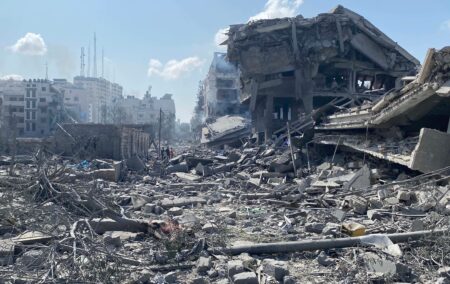
Pictures of flattened buildings do not prove genocide. Mosul lay in ruins after the battle to drive out Islamic State in 2017. The US-led coalition faced accusations of war crimes, not genocide.
Destruction is evidence of war.
In Nuremberg, Pillay reminded world leaders of their “legal obligation to protect human rights and refrain from war”. Three weeks after Hamas started war against Israel on October 7, 2023, she told Al Jazeera that Palestinians were “actually forced to resort to armed struggle”.
That obligation, through her lens, binds some more than others.
‘Peace requires justice’
Alfred Nobel set the bar. His will reserved the prize for work towards “fraternity between nations”, disarmament and peace congresses. He knew that judges generally don’t make peace. Negotiators, ceasefire brokers and reconcilers do.
In squeezing Pillay into Nobel’s will, the committee recasts international law as “peace conferences in their modern form”. Its claim that she “strengthens fraternity between nations” rests shakily on three words from Frydnes.
“Peace requires justice.”
That presents a heavily contested legal and philosophical contention as settled truth.
International law and history scholars have long warned that justice crusades can wreck the very order that keeps the peace. They pose the question the committee ducks: whose justice?
Pillay’s own country chose truth and amnesty over prosecution to move beyond apartheid. Even the Nuremberg trials began only after Germany’s unconditional surrender.
Peace came first; victors decided later what justice looked like.
South Africans are entitled to celebrate their first female Nobel Peace laureate. Equally, they’re entitled to ask why she is feted by terrorists who mass-raped women, children and some men, tortured and slaughtered children in front of parents, parents in front of children, burned families alive and took civilians, including children and babies, to Gaza as hostages on October 7.
Among the hostages was 84-year-old Ditza Heiman, held for 53 days, 48 of them in the attic of a UN Relief and Works Agency teacher. At the UN Human Rights Council on September 15, her daughter, peace activist Neta Heiman Mina, asked: “How could you place the education of Gaza’s next generation with someone involved in holding an elderly woman hostage?”
The Nobel Committee missed a golden opportunity to show that people can hold the pain of innocent Palestinians and Israelis together, in their hands, hearts and heads.
Real peacemakers do that. They know who is and is not a terrorist. Pillay doesn’t fit that bill.
Her prize, aimed at strengthening peace through international law, is already hardening battle lines against peace. It is likely to make the world less peaceful and more dangerous for Jews.
It is possible, as anything is, that the Nobel Committee will “someday bestow its peace prize on a less worthy recipient than … Pillay”, as the Wall Street Journal editorial writers say.
“We doubt it,” they write. “The last thing this prize will do is promote the cause of peace.”
Amen to that, I say.
[Image: B Palestinian News & Information Agency (Wafa) in contract with APAimages, https://commons.wikimedia.org/w/index.php?curid=138775628]
The views of the writer are not necessarily the views of the Daily Friend or the IRR.
If you like what you have just read, support the Daily Friend