

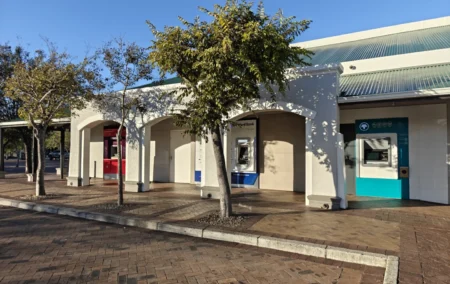
The Reserve Bank wants to open South Africa’s payment and cash systems to new competitors. Then it wants to own them.
At a media briefing on Friday 16 October 2026, a senior Reserve Bank (SARB) official told journalists that the central bank is “asking banks to white-label all ATMs”.
The “white-label” terminology is really a white-wash. It hides a major nationalisation project.
In slides presented to the industry in May, the Reserve Bank’s proposed model reads, in four blunt words: “All ATMs to be 100% NCU Owned”. That even includes the ATMs inside bank branches.
The NCU is the National Cash Utility, a new company that will also absorb the cash centres where banknotes are counted and stored. It is due to be established by March 2027, wholly owned by the Reserve Bank.
Meanwhile, the national payment system – the plumbing that moves money when you pay by card, debit order or bank transfer – has already been taken in hand.
On 2 September, the Reserve Bank ended 27 years of industry self-regulation and split the functions of the Payments Association of South Africa (PASA) between itself and PayInc, the former BankservAfrica, in which it bought a 50% stake last year.
So, the central bank, which by law regulates the banks, now half-owns the company that clears all electronic payments, and wants to fully own the machines that dispense cash and the vaults that hold it.
Good intentions
The problems the Reserve Bank claims to want to solve are real.
Cash still accounts for about 56% of consumer transactions by volume, according to the Reserve Bank’s recent cost of cash study. As more people pay digitally, the fixed costs of vaults, armoured trucks and ATMs are spread over fewer transactions, so banks close branches and machines where they make the least money. The least profitable locations tend to be poor and rural areas, where people rely on cash the most.
The study finds that the poorest households spend about 5% of their income on the cost of using cash, against 1% for the better-off.
Digital payments have their own problems. PayShap, the banks’ instant inter-bank payment system, was meant to be cheap. In practice, the most common fee at the big banks has been R6 to R10 a payment, while an ordinary transfer is often free within an account bundle. And fintech startups have had to rent access through a sponsoring bank.
At first glance, the Reserve Bank’s answer to this problem appears to be excellent.
The National Payment System Bill will let non-banks perform payment activities, such as issuing e-money, without a bank sponsor, and connect directly to the system from mid-2027.
SARB governor Lesetja Kganyago summed up the principle: “If it walks and quacks like a duck, it is a duck, and it should be treated as one.”
Regulate the activity, not the type of institution. That is market liberalisation, and it should be welcomed.
But liberalising a market and nationalising it are polar opposites. One invites competitors in; the other replaces them with a single state provider. The Reserve Bank proposes to do both at once, which is like throwing open the doors of a market and then buying every stall.
Cheap and private
The Reserve Bank’s own figures demolish the case for a state-owned ATM network.
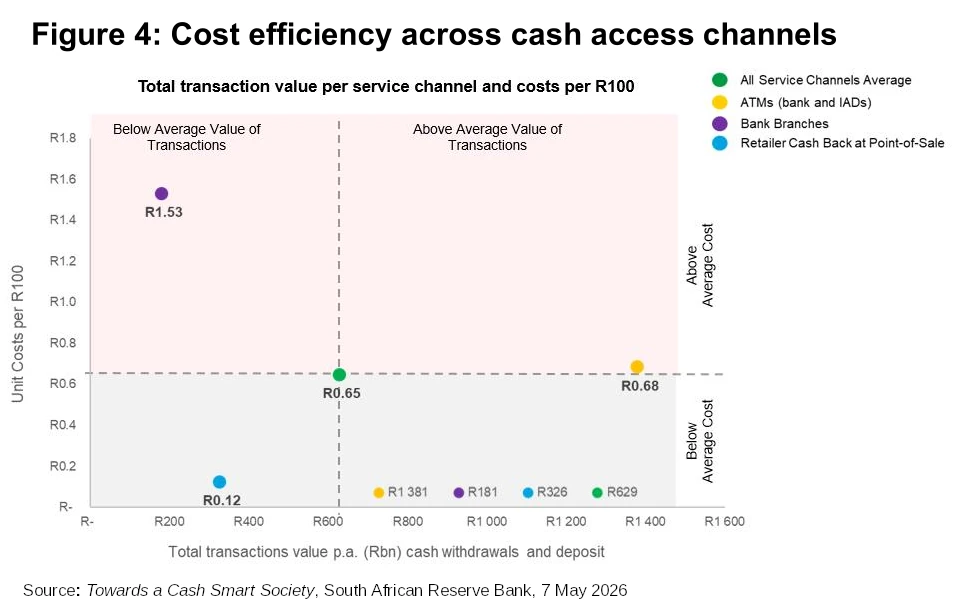
Figure 4 of its position paper compares the cost of getting cash through different channels, per R100 dispensed. Cash-back at a shop till costs about 12c. An ATM costs about 68c. A bank branch costs R1.53. The paper concedes that “retailer cash back at point-of-sale is the most efficient way for consumers to access cash”.
The big grocers recycle as much as R100 billion in cash a year, and supermarkets and spaza shops already trade in the townships and rural towns where the Reserve Bank fears “cash deserts”.
The cheapest channel is private, decentralised, and already exists where poor people shop.
Yet the centrepiece of the plan is a state-owned ATM network – a channel that, even in private hands, costs nearly six times as much per R100.
A National Cash Utility will make it even more expensive. The Reserve Bank’s stated requirement is that every ATM must take deposits in addition to dispensing cash.
About 9,200 of the country’s 30,600 ATMs belong to independent operators that do not take deposits. Many of the bank-owned machines also do not take deposits.
Deposit-taking machines cost more, and need more armoured-truck visits. Gold-plating every machine is an odd way to save money.
Closer to whom?
About half of what cash costs consumers is the time and money spent getting to it. So, the SARB plan helps the poor only if ATMs end up closer to them. But there is no reason to believe they will.
Today, a price tells someone where an ATM is wanted. The withdrawal fee, the rebate a shop earns for hosting a machine, the foot traffic it brings in – these are signals. Profit rewards whoever reads them correctly. This is what Friedrich Hayek meant by the knowledge problem: no central planner can know what millions of local prices know.
Now abolish the price. Make small withdrawals free, as the Reserve Bank wants, and recover the cost “in aggregate” from banks, as its slides propose. Who then has the information, or the incentive, to put a machine in a village nobody has heard of?
The national utility’s managers will face a budget, not customers. Without prices, even a well-meaning planner cannot tell whether a decision created value or destroyed it.
The utility’s own blueprint suggests consolidation rather than expansion. Its preliminary model reduces the country’s cash centres from 109 sites down to 40 or 50, according to one report.
The Reserve Bank’s payments chief says the cost of cash must fall by at least 30% just for the system to tread water. Shrinking to save money and extending into places that never paid their way are opposite strategies. Guess which one a utility under budget pressure will choose?
Concentration cure
The position paper frets that “wholesale cash handling and transportation is dominated by a small number of providers”, and that the failure of a big cash logistics firm “could therefore severely disrupt nationwide cash distribution”.
That is a fair worry. But by what logic is the cure for a market with few providers a market with just one? A quasi-state monopoly is concentration perfected, with the added feature that nobody can compete it away. (I say “quasi-state” because the Reserve Bank, while it is a statutory body, is technically privately owned by about 800 shareholders.)
If one of several cash firms fails, the others pick up the slack. If the one utility fails, there is nobody to pick up the pieces. South Africans have watched Eskom, Transnet and SAA show how state monopolies fail. The Post Office, a state-owned network built precisely to reach every corner of the country, wants another R2.2 billion from government as it braces for yet another loss.
As Dominic Frisby wrote in Life After the State, “Where government gets involved in people’s lives with a desire to do good, it can always be relied on to make the situation worse.”
Already moving
The industry was already heading where the Reserve Bank says it wants to go. SBV, the biggest cash handler, owned by four large banks, switched to a “utility model” in 2019, with the express aim of attracting more players and lowering unit costs.
The Banking Association’s cash committee issued its own request for proposals on white-label ATMs in 2023. Independent operators such as Spark ATM built networks in shops, bars and hotels, filled from the till, without any armoured truck.
Abroad, the shared ATM network the Reserve Bank once cited as its template, Geldmaat in the Netherlands, is a joint venture of three commercial banks, and is not owned by the state or the central bank.
India’s instant payment system, from which the SARB’s position paper also draws inspiration, runs on NPCI, a not-for-profit owned by banks, which later admitted fintechs as shareholders.
Shared infrastructure does not require state ownership. It merely requires rules that keep access open.
Capitec built the country’s biggest retail bank by cutting costs and widening access. The evidence that South African state-owned enterprises can do the same is… well, ask Eskom.
Seigniorage
There is another interest at play of which few people will be aware.
A banknote is an IOU from the central bank that pays no interest. Against the notes in circulation, the Reserve Bank holds interest-earning assets, such as bonds and foreign reserves. The interest it earns on those assets, minus the cost of printing currency, is called seigniorage.
With about R180 billion in cash in circulation, the bank earns a fortune in interest that it never passes on to the cash holders that actually own a share of those assets.
Every rand that moves from a physical wallet into a bank transfer, or a card swipe, or a phone tap, is a rand on which the Reserve Bank no longer earns that income.
Jannie Rossouw, visiting professor at Wits Business School, who broadly welcomes the plan, points out that declining cash in circulation weighs on seigniorage.
“Cash is a public good,” says the Reserve Bank. Sure, but it is also a profitable one, for its issuer.
I won’t claim that is the SARB’s motive for wanting to monopolise the payments and cash systems; I can’t know that. But an institution that earns money from the infrastructure it regulates is not a neutral judge of how much should be spent to prop up a dwindling cash economy.
PASA’s crime
The Payments Association, a non-profit owned and funded by the banks, managed the payment system’s rules for 27 years. What did it do wrong?
The Reserve Bank hasn’t said. Its official explanation is that as it strengthens the system “this self-regulatory model will fall away”.
But that merely describes the decision. It does not explain it. It does not justify it. I could find no published review of PASA’s performance, or why it was inadequate.
And while anecdotes of personal experience are not evidence, I’ve often thought in recent times how advanced and friction-free South Africa’s point-of-sale and electronic payment systems are. I have completely abandoned my cash and cards, in favour of tapping with my phone, which I can do virtually anywhere I might want to pay for something.
When PASA’s functions were handed over, nothing broke, which suggests the machinery worked. PASA wasn’t to blame for PayShap’s fees. Each bank set its own fees. Abolishing PASA does nothing whatsoever about the high fees the Reserve Bank complains about.
Shifting stories
Ask the Reserve Bank who will own the cash utility, and the answer depends on the season.
In December 2025, it told Bloomberg the utility would be co-owned by banks and retailers, and that it would invite Shoprite and Pick n Pay to take stakes. In May 2026, its slides promised industry participants “ownership interests”. On 16 October, the utility was to be wholly owned by the Reserve Bank, with existing owners either paid for their assets or given shares.
The numbers wander, too. The same position paper puts the annual cost of cash at R89.6 billion in one section, “approximately R90 billion” in another, and R88.5 billion in a chart. It says cash is used in “over two-thirds of transactions”, while the Reserve Bank’s own study says 56%.
These are not hanging offences. But a central planner that cannot keep its own numbers consistent within a single document, or settle who is to own its creation from one day to the next, now proposes to decide the locations, prices and service levels of 30,000 cash machines and every cash vault in the country. That is the economic calculation problem in miniature.
There is a richer irony. When the ANC resolved at Nasrec in 2017 to nationalise it, the Reserve Bank called the idea costly and pointless, and Kganyago explained that its shareholders have no influence at all. Ownership, in other words, does not matter: it is already a state entity in all but the formalities.
If ownership does not matter for a central bank, why must the Reserve Bank own every ATM and cash centre outright?
Nationalisation
The only answer on offer is ideological. Cash is “critical public infrastructure”. Infrastructure must be “shared”. “Market forces alone cannot guarantee universal access”.
That is the vocabulary of socialist ideologues, not of economists, and people who reason this way have done nothing to earn our trust with other people’s property.
The payment rails are already half-nationalised. The cash infrastructure is next. The ANC remains on record wanting the Reserve Bank itself fully state-owned. Nobody should be surprised if the next proposal is to nationalise the banks altogether.
After all, why not? The exact same arguments that the SARB used about ATMs and transaction fees applies to the entire banking sector. Banks are also “critical infrastructure”. They also limit their locations and services to high-traffic areas and profitable customers. Their fees, not being zero, are also higher than many people would like.
The SARB’s entire argument for establishing a National Cash Utility, National Payment Utility, and white-label ATMs is the same as the Economic Freedom Fighters’ argument for nationalising the banks.
Nothing is free
The Reserve Bank wants transactions below a certain amount to be free, both at ATMs and on PayShap. Its payments chief once told Bloomberg he hoped to reduce fees “to almost zero”.
Free to whom? An ATM costs money: the machine, the idle cash inside it, the armoured truck, the guards, the insurance. Declaring a withdrawal free does not make those costs disappear. It only hides them.
The SARB’s presentation answers the question: costs will be recovered “in aggregate” from card issuers. The banks will recover them from you, through higher monthly fees, minimum balances or charges for less regulated transactions. The bill for small cash transactions will be spread over every account holder, including those who never touch cash.
Milton Friedman explained the iron rule of price controls: set a price below cost, and you get shortages. Here, the shortage will take the form of ATMs that are free to use but are absent, broken, or out of cash.
Referee and player
The Reserve Bank’s strongest argument against the old order was a conflict of interest. Banks owned both the company that operated the payment system and the body that wrote its rules, so they had no interest in promoting a cheap payment method that would threaten their fee income.
Fair enough. I’ve complained about this myself, on many occasions.
Now look at the new order. The Reserve Bank will be the regulator of banks and payment providers. It will oversee the national payment system. It will be the settlement provider, in whose books every interbank payment clears. It will write the rules for card and high-value payments. It will half-own PayInc, which writes the rules for everyday transfers and PayShap. And it will wholly own a cash utility that it licenses and supervises under its own regulations.
The banks still own the other half of PayInc, so their conflict hasn’t gone anywhere either. When a fintech disputes a PayInc rule, it will appeal to a referee who part-owns the team.
The conflict of interest has not been removed; it has been transferred to the Reserve Bank.
A better plan
Every objective of this reform programme can be achieved without expropriating private assets or creating a state monopoly. I won’t claim to have all the answers, but let’s sketch some solutions that would preserve competition and price signals.
From the SARB plan, keep the activity-based licensing and the access provisions of the National Payment System Bill. They are the best thing in the whole programme.
License retailers, cash-in-transit firms and fintechs as cash wholesalers, with access to Reserve Bank banknotes on the same terms as banks. Let retailers like Shoprite compete with cash handling companies like SBV.
Require whoever runs shared infrastructure, such as the payment switch and the big cash centres, to offer access to all licensed players at published, non-discriminatory prices.
Require every ATM and every banking app to show its fee before the customer commits. Then let competitors undercut each other.
If the government believes there are places no market will ever serve, let it say where, put a price on it, and tender the service to whoever will do it for the smallest subsidy, paid from a budget where Parliament and taxpayers can see it.
And let the Reserve Bank sell its stake in PayInc, rather than buy anything more.
This isn’t always easy. A subsidy tender can be gamed. But a mistake in a competitive market can be corrected by the next competitor. A mistake in a state monopoly becomes the next Post Office.
Speaking to fintech entrepreneurs in September, Kganyago said: “I am a regulator and not an innovator.”
He is right. He should stay in his lane.
[Image: ATMs.webp]
[Caption: The Reserve Bank wants to own every one of these machines. (Photo: Husskeyy, Constantia, Cape Town, 27 April 2025. CC BY-SA 4.0.)]

The views of the writer are not necessarily the views of the Daily Friend or the IRR.
If you like what you have just read, support the Daily Friend