

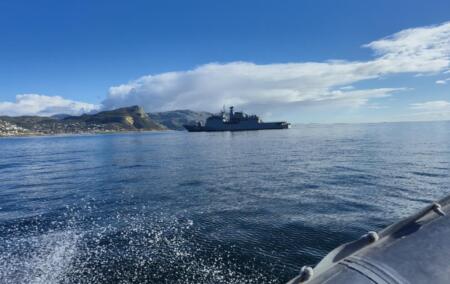
Why IBSAMAR matters, and the need for an increased naval budget.
There’s a particular feeling that comes with zooming across the ocean in the morning light, through the salty air, towards a warship. It’s a childlike wonder, full of joy and excitement, tempered by the adult awareness of the moment. Every opportunity to experience it should be grabbed with gusto, much like splitting a “G” or rapping the entirety of “Ice Ice Baby” at Thursday night karaoke.
Being able to say this is part of my job is an immense privilege. It is also a great way to gain some insight into the complexity of naval operations. Covering the ninth iteration of IBSAMAR, the trilateral maritime cooperation exercise between India, Brazil and South Africa, I was once again given the opportunity to embed with the Indian Navy aboard its participating vessel, the frigate INS Tarkash, alongside my colleague Chris Hattingh (you can read about his experience here).
INS Tarkash is a Talwar-class guided-missile frigate, built at the Yantar Shipyard in Kaliningrad, Russia, and commissioned into the Indian Navy in 2012. Displacing around 4,000 tonnes, she is armed with BrahMos supersonic cruise missiles, surface-to-air missiles, heavy torpedoes and a 100mm main gun, and carries a chetak helicopter for reconnaissance and support. She is part of a navy that has grown into the largest and most capable in the Indian Ocean region, and one that increasingly deploys far from home waters.
Although I joked with the crew that I came for the food, but stayed for the manoeuvers, I consider myself fortunate to have sailed with the Indian navy twice this year, in the Bay of Bengal, and False Bay. The skill and candor of the Indian Navy and its personnel, along with the professionalism and comradery of the Brazilian Navy, have made IBSAMAR an ideal exercise for the SA Navy to gain experience and allies, something South Africa has in short supply.
Unlike IBSAMAR 2024, when participation was limited to one frigate from each navy, this year the tempo went up a level. The South African Navy put forward three vessels, including its sole operable frigate, SAS Amatola, and, for the first time in three years, its sole operable submarine, SAS Manthatisi. They sailed alongside INS Tarkash and the Brazilian corvette BrNS Barroso, both of which had crossed wide oceans to be here.
Barroso, was constructed at the Arsenal de Marinha do Rio de Janeiro and commissioned in 2008. The roughly 2,400-tonne corvette carries Exocet anti-ship missiles, a 4.5-inch main gun and a Super Lynx helicopter. She represents a navy that is the largest in South America and the guardian of what Brazil calls its “Blue Amazon”, the vast maritime zone off its coast.
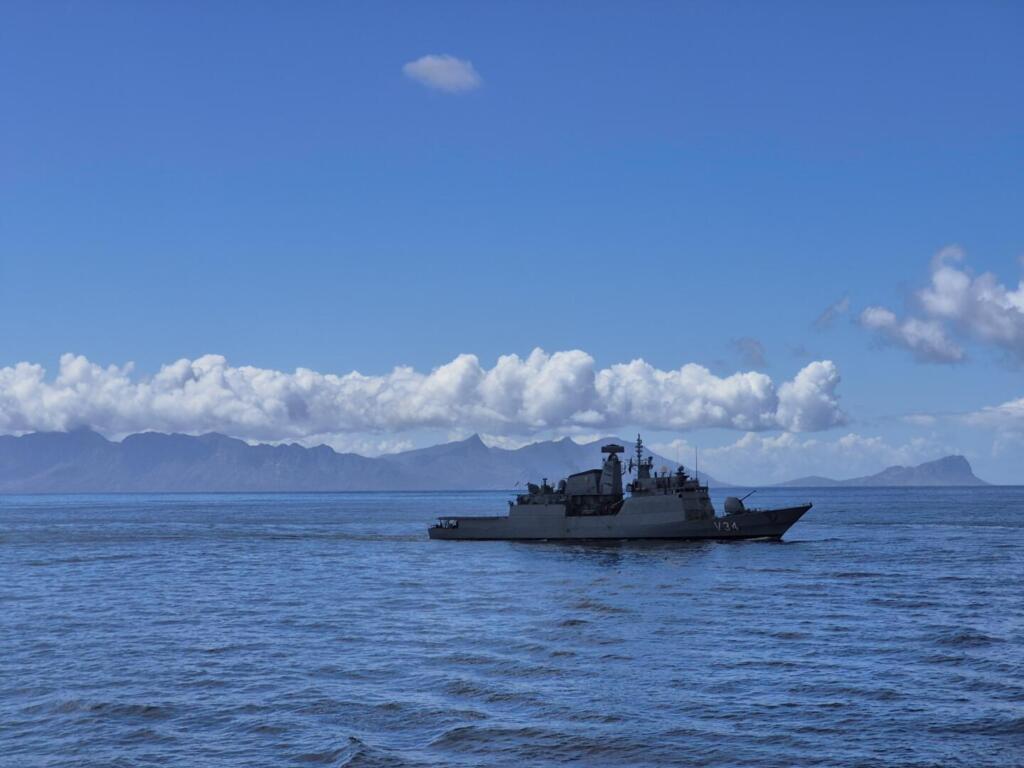
For the SA Navy, the exercise was not only a chance to train, but a chance for its crews to regain confidence in their vessels and in their fellow sailors. Three democracies, three regional players, three navies: one common goal and one partnership.
Military tacticians like to say that when planning, you must remember the enemy always gets a say. At sea, it is just as important to remember that the ocean gets a say too. South Africa’s choppy southern waters offer no respite, but calm seas do not make skilled sailors.
Speaking to the crews, many noted that the seas off Simon’s Town made for a complex operating environment. One exercise day saw its manoeuvres postponed when the famous Cape mood swings prevented aircraft from launching at sea, and the deep swells ruled out main-gun firing at the infamous “killer tomato” (more formally, the SIT, or Ship Inflatable Target). Despite this, the majority of the planned manoeuvres went ahead, with the tempo raised by combined anti-air, anti-surface and anti-submarine scenarios. Indigenous technology was also tested to ease communication between the three crews and eliminate earlier language barriers. Common operating procedures were drilled too, which matters more and more given that all three countries lie along some of the world’s busiest shipping routes.
Come midday, the three navies launched a combined visit, board, search and seizure (VBSS) drill, in which their marine commandos boarded a “suspicious vessel”, played by SAS King Sekhukhune I, and searched it for contraband. Overhead, a Brazilian Navy Super Lynx, a SAAF Oryx and an Indian Navy Chetak provided air cover. Given the scale of maritime drug smuggling off South America and in the north-western Indian Ocean, the Brazilian and Indian marines have become exceptional at these procedures, and the drill was carried out flawlessly.
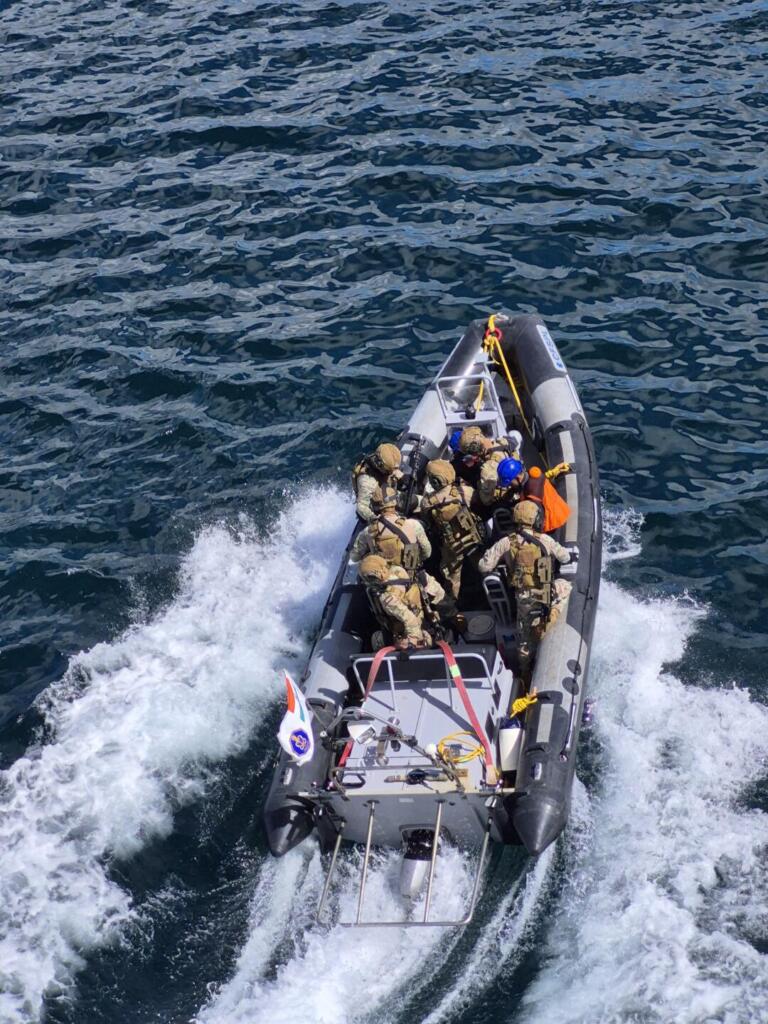
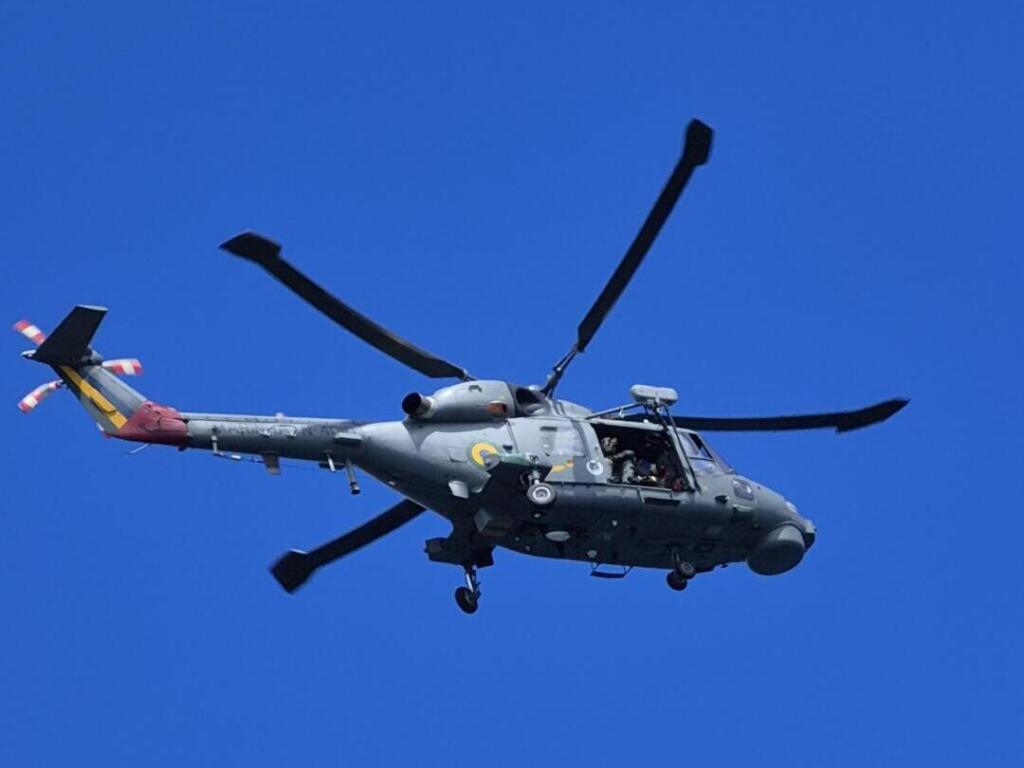
All vessels then sailed in convoy, led by INS Tarkash, to salute the Chief of the SANDF, who was aboard SAS Amatola with the Chief of the SA Navy to witness the conclusion of the exercise. Thereafter, the ships returned to harbour one by one, ushered in by one of South Africa’s most skilled sailors: the same man who captained SAS Amatola during IBSAMAR 2024 and sailed her across the Indian Ocean in February.
As I was writing this and reflecting on the day at sea, Finance Minister Enoch Godongwana tabled the Medium-Term Budget Policy Statement on Wednesday, 21 October. Somewhat surprisingly, defence received an additional R3.8bn, mainly due to UN and SADC reimbursements. Measured against inflation and years of underfunding, however, the increase is little cause for celebration. The breakdown of the defence vote, Vote 23, shows how the increase is distributed, and none of it goes to the SA Navy. The Army and SAAF receive some additional funding, while the largest share, R800mn, goes to SANDF administration.
The performance targets in the same document are telling. The Navy’s target for coastal patrols, a modest four, was only 50% achieved by the end of September, thanks to east coast deployments of the same two inshore patrol vessels that partook in the exercise. Against a projected target of 8,000 hours at sea, the Navy has so far logged 3,297.
This iteration of IBSAMAR was led by India and was originally meant to take place in Indian waters, around the International Fleet Review held in February. Owing to logistical challenges, South Africa hosted instead. The next iteration is to be hosted and led by Brazil. Given the current state of the SA Navy, and the funding available to keep its crews current and confident, it is uncertain whether any South African vessels will be able to sail across the Atlantic to take part.
That reality makes the opportunity to cover an exercise like this bittersweet. It is a reminder of what South Africa could be and what it could do, set against what its closest partners are capable of. Ultimately, a naval alliance is only as strong as naval budgets allow them to be.
Given South Africa’s maritime economy, reliance on shipping, and large area of responsibility, we should not be arguing over why the navy needs more funding. Yet, here we are, once more, watching ships sail on, thread bare; amongst two allies who understand the importance of a well funded flotilla.
Nevertheless, the sea will keep making skilled sailors, the sun will still rise in the east, and the Indian Navy will still serve some of the best food a sailor could dream of.
To the crews of BrNS Barroso and INS Tarkash: fair winds and following seas.
[Image: Ricardo Teixeira]
The views of the writer are not necessarily the views of the Daily Friend or the IRR.
If you like what you have just read, support the Daily Friend