

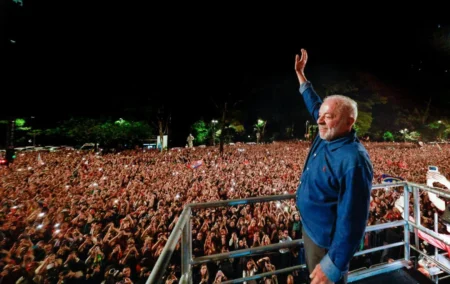
Commentators wept with relief when Lula da Silva beat Flávio Bolsonaro in Brazil’s presidential run-off. They should save their tears for Brazil’s treasury.
Redi Tlhabi wrote her latest Daily Maverick column, she tells us, in tears. When the results of Brazil’s presidential run-off came in on Sunday night, she took to social media to ask someone to assure her it was not a joke.
It was not. Luiz Inácio Lula da Silva beat Flávio Bolsonaro, the eldest son of former president Jair Bolsonaro, by 51.76% to 48.24%, in an upset that shocked the world.
Tlhabi hails the result as a matter of relief for Brazil, South Africa, Africa and the Global South, and pictures Cyril Ramaphosa sighing with relief. It “has given the world breathing space,” she wrote.
Allow me to offer some perspective for those of us whose vision was not clouded by tears. Brazil had a choice between two flawed populists. It picked the one who spends more.
Fair points
Tlhabi is not wrong about everything. The loser has behaved disgracefully. Flávio Bolsonaro refused to concede, calling the result unacceptable because a Supreme Court justice extended voting by two hours. Those two hours produced about 35,000 votes, or 0.03% of the total, against a losing margin of 4.4 million. His own campaign had asked for an extension, because of rain in the conservative south.
That is an ugly echo of his father, who is serving 27 years and three months for a coup plot that, according to the court, included plans to assassinate Lula (as he is commonly known).
She is also right that Amazon deforestation has fallen sharply under Lula, after rising by about 60% under the elder Bolsonaro. She even grants that BRICS should not be romanticised, and that Lula’s enthusiasm for new offshore oil wells sits awkwardly with his green halo.
On Lula’s record at home – which has a lot in common with that of the ANC in South Africa – she offers a single sentence of doubt: “Concerns about crime, corruption and the cost of living cannot simply be dismissed.”
Then she dismisses them.
The missing record
Lula’s first two terms, from 2003 to 2010, deserve credit. His finance ministers kept to the orthodoxy of his predecessor, growth averaged about 4.1%, and the boom lifted some 30 million Brazilians out of poverty. A Chinese appetite for iron ore and soya paid for much of it, but credit where it is due.
Those were also the years in which his government bought its majority in Congress, however. In one case, the Supreme Court convicted 25 people, including Lula’s chief of staff, José Dirceu, for diverting at least $35 million in public money to bribe legislators. Dirceu later received 23 years for his part in a kickback scheme involving the state-owned PetroBras, which flourished while Dilma Rousseff, Lula’s hand-picked successor, chaired the company’s board.
Meanwhile, the state development bank, BNDES, lent to “national champions” at about half the going rate. That was patronage dressed up as industrial policy, and it laid the foundations for the brutal recession that followed under Rousseff.
Lula himself spent 580 days in prison. The Supreme Court annulled his convictions because the case belonged in another court, and because the trial judge was biased. Every defendant deserves an impartial judge, and he did not get one. But annulment is not acquittal on the merits, and the cases were never retried.
His third term has not been any cleaner. In 2025, his social security minister resigned over an investigation into $1.1 billion in unauthorised deductions from pensions, weeks after his communications minister quit on bribery charges. To be fair, the pension scheme began under Bolsonaro. It ran on for two years under Lula.
Fiscally, gross public debt rose from 83% of GDP in 2022 to a projected 92% in 2025, and ING puts the budget deficit at 7% to 8% of GDP. If this sounds like a government living beyond its means, that’s because it is.
The other guy
Tlhabi does not trouble herself to make the case for the losing side, leaving readers to conclude that Bolsonaro must be evil because he’s on the right. Let me remedy that.
The elder Bolsonaro’s government passed reforms that classical liberals had demanded for decades: a constitutional pension reform, formal central bank autonomy and the privatisation of Eletrobras, the country’s largest electricity utility.
It also passed an Economic Freedom Law that eased the burden on business, and cut import tariffs by 10% on 84% of imported goods, unilaterally.
Flávio promised privatisations, spending cuts, and doing away with some of the country’s 38 ministries, as well as a public debt ceiling and the repeal of Lula’s 12% tax on crude oil exports. When he won the first round, the São Paulo stock exchange jumped 7.7% to a record high.
One can say many good things about his campaign.
The Bolsonaros have their own debit column, however. Jair blew through his own spending cap to buy votes before the 2022 election, and wondered aloud what the problem was. He fired Petrobras chief executives for refusing to cut fuel prices. His “secret budget” handed lawmakers public money with little or no oversight. And his handling of Covid-19, with its attacks on masks and its delayed vaccine purchases, earned a Senate recommendation that he be prosecuted.
Like father, like son
Flávio’s own record is no better. Prosecutors alleged that a salary-skimming scheme in his office as a state deputy channelled more than R$2 million through an aide, although the rulings in the case were later annulled. He is under investigation over money he sought from a disgraced banker to finish Dark Horse, a biopic about his father. He calls it private investment.
He promised to pardon his own father if Congress would not grant an amnesty. His security plan promised maximum-security prisons on the El Salvador model, adult trials for 14-year-olds accused of heinous crimes, and a national AI facial-recognition surveillance network.
No liberal should want any government to wield such powers.
Even his market credentials were thin. He adopted Lula’s cash transfers and income tax exemption, would privatise only case by case, and called Lula’s shorter working week “opportunistic” before voting for it.
Neither deserved to win
If asked to choose, I would probably have preferred Flávio Bolsonaro. For all his cronyist and authoritarian tendencies, his economic programme pointed in the right direction, his father’s government actually delivered market reforms, and his Liberal Party is now the largest in both houses of Congress.
But neither man really deserved to win. One refuses to accept defeat and promised to free a coup plotter. The other presided over vote-buying and patronage on an industrial scale. Both bid for votes with other people’s money.
South Africans should know this dilemma well. For three decades, a majority of voters have kept the ANC in power despite its multitude of sins. Its state-centric policies, inspired by socialism and undermined by corruption, should have earned it defeat at the polls many years ago.
Yet Tlhabi celebrates the same policies that have produced zero growth and 40% unemployment in South Africa as a great victory for Brazil and the world at large.
In truth, both candidates were deeply flawed. Both were populists, rather than pragmatic liberal reformers. The defeat of a cronyist right-wing populist does not sanctify the corruption-tainted left-wing populist who beat him.
Selective sovereignty
Tlhabi praises Lula as a champion of sovereignty. Whose sovereignty, one might ask?
He held Vladimir Putin and Volodymyr Zelensky equally responsible for Russia’s invasion of Ukraine. He called it absurd to deny that Nicolás Maduro was president of Venezuela, and when America seized Maduro, Lula’s instinct was moral equivocation.
Sovereignty, in this view, belongs to regimes, not to the people they oppress.
Tlhabi also applauds Brazil’s suspension of X. When Congress refused Lula’s social media regulation, his government sought the Supreme Court’s help instead. That is not sovereignty. It is censorship.
Mounting bills
So, where is Brazil headed?
Abroad, expect more of the same. Lula will lean harder into BRICS as a bulwark against “Western imperialism”, cultivate Beijing and Russia, and cast every quarrel with Washington as a defence of national dignity.
Donald Trump’s 50% tariffs, imposed over the prosecution of his friend Jair, boosted Lula’s popularity, so he has every incentive to keep the feud alive.
Ramaphosa will have an ally. Whether a country that needs American markets should want a quarrel with its president is another question.
At home, the direction is set. Lula revoked privatisation plans for Petrobras and the Post Office on his second day in office in 2023. He taxed crude oil exports to hold down fuel prices. Days before the run-off, Congress passed his amendment cutting the working week from 44 to 40 hours with no cut in pay.
Each of these measures bought votes. None of them created wealth.
The bills are mounting. The central bank held interest rates near 15% for so long that a cut to 14.75% in March was its first in nearly two years. Lula’s party now promises a budget surplus in every year of his fourth term. Goldman Sachs expects higher taxes instead, and no structural reform.
A Congress controlled by his opponents can block new taxes. It cannot easily unwind Brazil’s rigid, constitutionally entrenched spending. Something has to give, and it will be the currency, the inflation rate, or the solvency of the state – probably in that order.
Other people’s money
Lula is 80. He will be pushing 85 when he leaves office, and like his first presidency, his fourth will leave the bill to his successor.
As Margaret Thatcher observed, the trouble with socialism is that you eventually run out of other people’s money. The money Lula used to buy this election will run out long before the voters’ expectations do.
The world may have breathing space. Brazil’s treasury does not.
[Image: Lula-2026.webp]
[Caption: Lula da Silva celebrates his re-election as president of Brazil. (Photo: Ricardo Stuckert, 25 October 2026, for Lula Oficial.)]
The views of the writer are not necessarily the views of the Daily Friend or the IRR.
If you like what you have just read, support the Daily Friend