
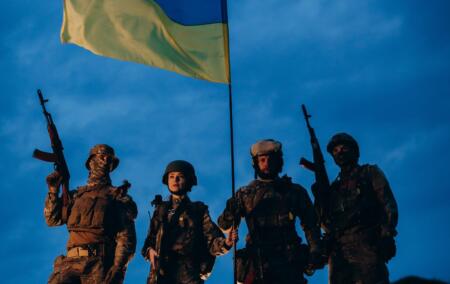
The war between Ukraine and Russia is reshaping our understanding of both present-day and future warfare.
Ukraine confronted Russia’s invasion with predominantly Soviet-era weapons. Weapons alone, therefore, could not have been the game changer in this war. Most Western intelligence agencies expected Ukraine to fall within two weeks: they based their assessments on the level of armaments and the quality of military training, while largely overlooking military leadership.[1]
Yet it was the talent and resilience of Ukrainian commanders that played a decisive role in the war’s first days. The one category of weaponry in which Ukraine enjoyed a significant advantage was the anti-tank systems provided by its partners.
General Valerii Zaluzhnyi, then Commander-in-Chief of the Armed Forces of Ukraine, recalled: “We were interested in weapons capable of producing strategic effects. We were fortunate – God was on our side – and we had them. Above all, these were Javelins, NLAWs, and our own Stuhna and Korsar systems, among others. On the eve of the war, despite immense pressure and difficulties, my comrades and I managed to conduct an exercise at the Rivne training ground to demonstrate how the new tactics could be used. We had very little time, so we developed new tactics and began training accordingly. We held exercises to learn how to employ these weapons. Later, we began conducting exercises at other training grounds. And these weapons delivered strategic results. We destroyed Russian columns on a massive scale and showed the enemy what ‘Kyiv in three days’ really meant.”[2]
When a large-scale war begins – such as the war between Ukraine and Russia – no established plan or doctrine works exactly as anticipated. To explore these lessons, we conducted 14 interviews with Ukrainian military leaders: four generals, three colonels, two lieutenant colonels, three sergeants, one major, and one chaplain. Based on these interviews, we identified four key lessons.
Lesson 1. Taking Responsibility for Decisions
In 2021–2022, Ukraine was under constant pressure from Russian provocations. Massive troop movements along the border and regular Russian military exercises were preparations for the invasion. At the same time, Russian leaders publicly insisted that they had no plans for aggression. The difficulty of this situation meant that even after the United States made Russia’s invasion plan public, President Volodymyr Zelenskyy declined to acknowledge the threat: “Are there tanks driving through our streets?
No… But the impression from the media is that we are at war, that troops are moving along our roads, that we are mobilizing and people are leaving. That is not the case. We do not need this panic.”[3]
Meanwhile, Commander-in-Chief Zaluzhnyi was conducting exercises to repel the aggression, deploying territorial defense forces, and mobilizing the first-category operational reserve. Yet no political decisions were made before the invasion actually began.
In 2022, General Serhii Naiev commanded the Joint Forces Operation and was responsible for repelling Russian aggression.
He describes how he made decisions and demonstrated leadership amid this uncertainty: “On 24 February I still had no official document confirming the Russian Federation’s invasion. I heard a report from my intelligence chief based on unofficial information—intercepted conversations between Russian officers discussing a drone that would fly above a Russian column in Sumy Oblast. There was a great deal of such information at the time. I picked up the telephone and informed the seven commanders under my authority that the Russian Federation would invade at 4 a.m. on 24 February, ordering them to complete preparations to repel the aggression with the forces available to them. These were solely Armed Forces of Ukraine units in seven operational groupings. I made these decisions independently; had the invasion not occurred on 24 February, I would have been arrested for exceeding my authority and faced a lengthy prison sentence.”[4]
The young Lieutenant Colonel Oleh Duchenko describes what happened to his battalion: “We were at a training ground in Oleshky, near Crimea. Within literally half a day, our brigade was surrounded. At the time, I was the battalion chief of staff. The battalion commander was wounded, and I assumed command as we broke out of the encirclement. During the first days I was trying to establish where my personnel were, because only 40 percent of the battalion was present. I assembled the soldiers and told them we had two choices: either we could run home, in which case the enemy would come to us, or we could stay and organize a defense near Mykolaiv.”
Colonel Oleksandr Ihnatiev, who took command of the 110th Territorial Defense Brigade in March 2022, recalls his experience: “After taking over the brigade and reviewing the personnel, I discovered that some of those who had received weapons had gone over to the enemy. Others had been encircled and remained under occupation. In one instance, people who managed to escape from occupied territory reported to me six months after the fighting began. Others remained in occupied territory and worked for the enemy. For example, at my first meeting with battalion commanders, I learned that one battalion had sent its deputy commander. I asked where the commander was, and he replied that the lieutenant colonel was in the occupied town of Polohy but was actively communicating with the battalion, staying in touch, asking questions, and so on. Naturally, I immediately suspected treason and informed military intelligence. My suspicions were confirmed some time later: he was working for the enemy.”[5]
Lesson 2. Integrating Civilians into the Armed Forces
Over recent decades, doctrines governing the development and employment of armed forces have focused on professionalizing military service. The mass mobilization of civilians was regarded as a relic of the Second World War. The war in Ukraine has overturned that assumption. The intensity and scale of the fighting have forced both sides to mobilize hundreds of thousands of civilians.
General Valerii Zaluzhnyi, former Commander-in-Chief of the Armed Forces of Ukraine, reflects on this experience: “Every war is started by professional soldiers. Then they die, and teachers, engineers, and other civilians take their places. It is they who finish the war. We are not going to invent anything new. Yes, unfortunately, the old Soviet mobilization and training system operated, with all its problems. But that old machine worked. Despite digitalization, the old methods still work. The problem is the psychological barrier to going into military service and possibly dying. It can be overcome by convincing people that they will receive good training, quality weapons, and, most importantly, competent leadership that will not allow them to be needlessly killed.”[6]
General Zaluzhnyi identifies two problems that armed forces encounter when mobilizing civilians. The first is organizing the mobilization process itself. In 2022, more than 100,000 volunteers voluntarily reported to mobilization centers in Ukraine.
This overwhelmed the system and caused considerable chaos.
Major Alymov recalls the scene at mobilization centers on the war’s first day: “A friend called me at six in the morning and said the war had started and Brovary was already being bombed. I had warehouses for my business there. I took a toothbrush, warm clothes, and everything I needed and went to the military enlistment office. There were already rivers of people. They were not letting anyone inside because there were so many. They just kept walking around asking who was in OR-1. At the time, I did not even know what that meant. But I said I was OR-1—the operational reserve. I went inside, and the military commissar asked me, ‘Help me organize the process.’ So I started helping.”[7]
Time pressure and the need to enter combat meant that new recruits were often sent into action with no training at all, resulting in avoidable casualties and conflicts with the chain of command. Commanding untrained personnel places an additional burden on officers.
Lieutenant Colonel Oleh Duchenko explains: “There are many nuances in assigning tasks and giving instructions; you have to explain things as clearly and thoroughly as possible. Soldiers need more time to understand the procedures. When inexperienced troops move into positions, someone who really knows the battlefield must accompany them—someone who knows how to report, request assistance, and occupy positions. We now have to work with people who have only just been mobilized. If you compare our personnel with those of other brigades, the difference is enormous, even though the people are much the same. So much depends on the leader. Recently I was at a company commander’s command post and saw him getting down to minute details, saying: ‘Fire ten rounds, throw a grenade, move ten meters.’.”[8]
The task of addressing this problem fell to brigade commanders, who began establishing their own training centers using locally developed standards and methods.
Oleksandr Ihnatiev, commander of the 110th Territorial Defense Brigade, offers an example: “I found a site in the rear, up to 30 kilometers from the line of contact, and organized an ad hoc training center there. I assembled a team of instructors with combat experience and appointed them to teach marksmanship, tactical medicine, land navigation, and other subjects. I formalized the arrangement with an order. Even amid intense fighting, I understood that there was no other way, so I organized an internal rotation of units. Initially, I rotated them by platoon: I would withdraw a platoon from the front line for five days and take it to the training center. Field baths and accommodation were waiting for them. Field medics and psychologists received them. On the first day, the soldiers underwent medical examinations; then they met with psychologists to discuss their condition and assessment of the situation. During the remaining four days, instructors trained them in weapons handling, combat engineering, and other skills. It had an enormous effect.”[9]
The problems surrounding mandatory training for mobilized personnel were addressed only a year and a half after the war began. In June 2023, Ukraine’s parliament, the Verkhovna Rada, passed a law prohibiting participation in combat without basic military training.
In May 2024, another law introduced compulsory basic military training for students and civilians. Nevertheless, most commanders continue to maintain in-house training programs at brigade level. This is because the battlefield is changing so rapidly that basic training curricula cannot keep pace with tactical and technological developments.
The armed forces must be sufficiently adaptable to integrate large numbers of civilians and give them opportunities for advancement. Many of Ukraine’s most celebrated commanders were not career military personnel before the war. For example, Robert Brovdi (known as “Madyar”), the current Commander of the Unmanned Systems Forces, was a successful businessman before the full-scale invasion.
Now, while holding the rank of major, he commands a separate branch of the Armed Forces – a post equivalent in responsibility to that of a general. This suggests that Ukraine’s senior military leadership is relatively flexible in its decisions, prioritizing effectiveness over military convention.
Lesson 3. Implementing Change
In 2022, Russia’s full-scale invasion of Ukraine did not look very different from the Second World War. Massive air strikes, artillery bombardments, and tank breakthroughs were strongly reminiscent of German tactics.
Today, Ukraine’s Ministry of Defense says it plans to produce and deliver seven million drones of all types to the front in 2026.[10] During the first months of 2026, Ukrainian unmanned ground systems (UGSs) carried out 24,500 missions.[11] These figures illustrate the extraordinary transformation warfare has undergone in four years.
Outnumbered and possessing substantially less firepower, Ukrainian commanders have constantly searched for solutions that could inflict devastating losses on Russian forces. From the war’s first days, the Armed Forces of Ukraine had to learn continuously and implement changes.
General Zaluzhnyi describes the role of leadership in that process: “Leadership played an important role here, because we needed to communicate, work as a team, build constructive relationships, and maintain open lines of communication. All of this helped us implement change. By the summer of 2022, we had HIMARS. It is an incredible weapon that played its part in liberating Kharkiv Oblast and Kherson. But we had to train our people. Even more important was understanding the need early enough to send personnel away to learn how to operate such weapons. Negotiating with the Americans over 155 mm artillery was extremely difficult. It was crucial for us to start training before the weapons arrived. We knew that our ammunition would run out in April. Then came the dark months of May and June. We had almost no shells. Yet we kept fighting while pulling people off the front lines for training. Those were difficult leadership decisions.”[12]
During the war’s first three years, Ukrainian forces progressed from Western anti-tank systems to F-16 and Gripen fighter aircraft. This required the establishment of a large-scale system for training personnel while combat operations continued.
In practice, preparing a service member to operate new weapons can take anywhere from six months to three years (in the case of the F-16). The burden falls on the commander, who must direct combat operations while personnel undergo training.
More importantly still, Ukrainian commanders had to devise tactics for employing the new weapons because conditions on the battlefield differed from those covered in training provided by Western partners. Russian responses also forced substantial changes as the enemy developed countermeasures against different strike systems. For example, after Ukraine began using the US-made Excalibur precision-guided artillery round, Russian countermeasures rapidly reduced its effectiveness to virtually zero.[13]
The war against Russia has produced a distinctive model of change implementation in the Armed Forces of Ukraine, and has fueled an explosion of grassroots innovation.
Major Alymov illustrates how the determination to protect personnel can drive innovation: “We had an incident in Vuhledar. We were observing from the ninth floor, the drone operators were on the seventh, and a shell hit the eighth floor. We wanted to stay alive. We were all in shock, and one of the guys said it would be good to install video cameras. I seized on the idea. By evening he had worked out the technical specifications. I immediately called some IT people I knew, and they explained what we needed and how to do it. We obtained cables, laptops, cameras, and software, installed everything on the ninth floor, and moved our observation post to the basement. That is what leadership is about.”
Personnel shortages and the determination to preserve lives were among the strongest incentives to adopt drones and unmanned ground systems. On 3 January 2025, the 59th Brigade became the world’s first assault brigade of unmanned systems.[14]
One of the driving forces behind the transition to unmanned technologies was Sergeant Oleksandr Karpiuk. Before the war, he had been a well-known blogger and volunteer, held two university degrees, and worked in business. After joining the 59th Brigade, he began building its UAV capability from scratch.
He recalls: “Our brigade established the first strike-drone battalion. We drafted the initial concept because nobody understood what 400 people with drones could actually do. So we planned it all out. We based the concept on military principles: gain control of the sky, establish operational situational awareness, coordinate strikes using higher headquarters’ assets, and employ our own assets at operational depth. We wanted to control the enemy’s second and third echelons, maintain awareness 30–40 kilometers into the enemy’s depth, and keep track of surface-to-air missile systems so that higher headquarters’ missiles could get through. We planned all this in 2023 and started moving in that direction. I completed that work only in 2025.”[15]
Sergeant Karpiuk identifies two key factors in introducing new technologies: the creativity of personnel and direct engagement with manufacturers. UAV teams comprise inventive service members with technical backgrounds. Because drone warfare represented a new capability for the armed forces, introducing these technologies required new combat tactics—precisely the task undertaken by creative military personnel. The second factor was the troops’ constant direct contact with manufacturers to improve UAVs for specific missions.
Yet none of this would have been possible without military leadership. This is how Sergeant Karpiuk describes his brigade commander, Vadym Sukharevskyi: “What I liked about him was his ability to command without giving orders. His style was delegation. He would identify someone who was an expert in a particular area, regardless of whether that person was an officer or a private.”[16]
On 10 June 2024, Colonel Vadym Sukharevskyi, commander of the 59th Yakiv Handziuk Brigade, was appointed the first commander of the newly established Unmanned Systems Forces.[17]
Lesson 4. Public Communication
The case of Sergeant Valerii Markus best illustrates the role of military leaders’ communication in wartime. In 2014, Markus joined the fighting in eastern Ukraine against Russian proxy forces. He actively blogged about the war and military life, becoming widely known to the Ukrainian public.
In 2018, he published a book about army life and war, Footprints on the Road (Slidy na dorozi). It became a bestseller and further enhanced his reputation. By the time of the full-scale invasion, Sergeant Markus had hundreds of thousands of followers on social media.
“My friend Ivan Shalamaha, who is now serving as a deputy battalion commander, and I have received an offer from the Armed Forces of Ukraine to build and lead a newly established, independent 47th Battalion from scratch. He will be the battalion commander, and I will be the unit’s senior enlisted leader. We have accepted the offer.”[18]
Sergeant Markus published this post on 26 April 2022, and it attracted tens of thousands of likes and shares. Within weeks, several thousand volunteers had applied to join the battalion. As a result, it was expanded first into a regiment and then into the 47th Separate Mechanized Brigade, “Magura.”
Today it is one of the Armed Forces of Ukraine’s most combat-capable formations, having participated in the 2023 counteroffensive and the 2024 incursion into Kursk Oblast.
Sergeant Markus’s public communication generated several important advantages.
First, volunteers joined the 47th Brigade of their own accord, meaning that their motivation and readiness to fight were considerably higher than those of typical mobilized personnel.
Second, the new brigade’s personnel were exceptionally well qualified. Its volunteers included many businesspeople, IT specialists, engineers, and university graduates. For these reasons, the brigade received advanced Western equipment, including M2 Bradley infantry fighting vehicles and Abrams tanks.
Third, public communication enabled Sergeant Markus to attract substantial volunteer and charitable support. A total of UAH 169 million (approximately USD 4 million) was raised to establish the 47th Brigade.[19]
Four lessons
The four lessons of military leadership discussed in this article by no means encompass the full body of experience that Ukrainian commanders have gained and continue to gain. Several recommendations for contemporary armed forces follow from these experiences.
Strategic-level military leaders must understand their role and responsibilities in the face of potential enemy aggression. They cannot simply await political decisions; at the critical moment, they must be prepared to make difficult decisions, even at the risk of losing their positions.
Command training must prepare officers to lead not only experienced personnel but also those with little experience. Commanders must be ready to take charge of civilian recruits who have completed only basic training and to apply different approaches to their leadership and management than they would with professional soldiers.
War is a continuous process of technological change on the battlefield. Today’s military leaders must not only understand emerging technologies but also know how to integrate them into their units. Moreover, they must be prepared to scale effective solutions developed by themselves and their units across the armed forces.
Finally, in the age of social media, military leaders can no longer remain detached from public communication. They must be able to communicate publicly and use this capability to strengthen their units and accomplish combat missions more effectively.
[Image: by dmytros9]
The views of the writer are not necessarily the views of the Daily Friend or the IRR.
If you like what you have just read, support the Daily Friend
[1] https://www.theguardian.com/world/2022/dec/28/the-battle-for-kyiv-revisited-the-litany-of-mistakes-that-cost-russia-a-quick-win
[2] V. Andrusiv, E. Sasko. How Ukrainians Lead. Chefmedia, 2025 – p.117
[3] https://www.reuters.com/world/europe/dial-down-russian-war-talk-save-our-economy-ukraine-tells-west-2022-01-28/
[4]V. Andrusiv, E. Sasko. How Ukrainians Lead. Chefmedia, 2025 – p.15
[5] V. Andrusiv, E. Sasko. How Ukrainians Lead. Chefmedia, 2025 – p.66.
[6] V. Andrusiv, E. Sasko. How Ukrainians Lead. Chefmedia, 2025 – p.81
[7] V. Andrusiv, E. Sasko. How Ukrainians Lead. Chefmedia, 2025 – p.79
[8] V. Andrusiv, E. Sasko. How Ukrainians Lead. Chefmedia, 2025 – p.82
[9] V. Andrusiv, E. Sasko. How Ukrainians Lead. Chefmedia, 2025 – p.123
[10] https://militarnyi.com/uk/news/ukrayina-planuye-vyrobyty-ponad-7-miljoniv-droniv-u-2026-rotsi/
[11] https://armyinform.com.ua/2026/05/28/syly-oborony-vzhe-otrymaly-ponad-1000-nrk-cherez-dot-chain-defence/
[12] V. Andrusiv, E. Sasko. How Ukrainians Lead. Chefmedia, 2025 – p.120
[13] https://www.washingtonpost.com/world/2024/05/24/russia-jamming-us-weapons-ukraine/
[14] https://24tv.ua/reorganizatsiya-zsu-59-brigada-teper-shturmova-brigada-droniv_n2737640
[15] V. Andrusiv, E. Sasko. How Ukrainians Lead. Chefmedia, 2025 – p.127
[16]V. Andrusiv, E. Sasko. How Ukrainians Lead. Chefmedia, 2025 – p.127
[17] https://www.pravda.com.ua/news/2024/06/10/7460149/
[18] https://www.facebook.com/valerii.markus/posts/5056402657778534