

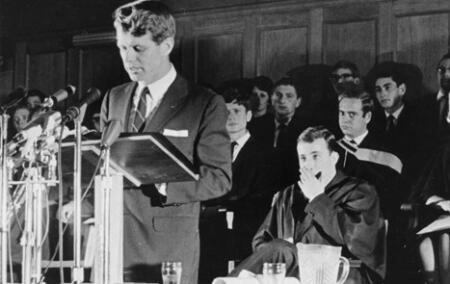
Sixty years after Robert Kennedy spoke at UCT, the university’s future depends on whether its graduates are willing to speak too.
Sixty years ago, on 6 June 1966, Robert Kennedy stood in UCT’s Jameson Hall and spoke words that have long outlived both the man and the moment:
“Each time a man stands up for an ideal, or acts to improve the lot of others, or strikes out against injustice, he sends forth a tiny ripple of hope, and crossing each other from a million different centers of energy and daring those ripples build a current which can sweep down the mightiest walls of oppression and resistance.”
Like the ripples he described, those words have travelled far beyond the hall in which they were spoken, and they are as relevant today as they were then. Kennedy spoke in the dark and divisive days of apartheid. Apartheid has ended; division has not. It is alive and well in South Africa in 2026, and it is taking hold at UCT.
If UCT is to have a future worthy of its past, its graduates must act, participate and vote. That future will be built, or not, on our collective tiny ripples of hope.
The quiet exit
Most graduates who have stepped back from UCT did not storm out. They drifted. Since the removal of the Rhodes statue in April 2015, the university has lived through a decade of upheaval over curricula, language, governance and its very purpose. Each headline brought a small disappointment, and none seemed quite enough to demand a response. So graduates stopped reading the alumni newsletter and stopped giving. Asked about UCT at a dinner, they said it had changed, and moved on.
None of that is unreasonable. That is precisely the problem.
In Exit, Voice, and Loyalty (1970), the economist Albert Hirschman observed that members of a declining institution have two broad responses: they can leave, or they can speak up. The easier it is to leave, the less likely they are to speak. For a graduate, leaving costs nothing; there is no contract to cancel. Speaking up takes effort, and lately it has seemed to carry risk. Two elected members of Council who spoke publicly became the subject of an inquiry that recommended expelling one and suspending the other.
Kennedy’s ripples have a shadow. Every quiet departure is a ripple too, and together they build a current of their own: one that leaves an institution to whoever remains. Universities rarely collapse. They drift, one reasonable departure at a time.
Why UCT is everyone’s concern
It would be easy to treat all this as a private matter between UCT and those who still care. It is not. A university is where a society forms and tests its ideas, and where the people who will run its hospitals, courts, businesses and government departments learn how to think. What UCT teaches today, South Africa will practise in a generation. Its direction will reach everyone who lives here, through the graduates it sends out and the ideas they carry.
For graduates, the stake is also personal. A degree is worth what the institution behind it is worth, and that value is not fixed on graduation day. It rises and falls with everything the university does afterwards. Walking away does not protect it.
The largest voice in the room
Graduates often assume nothing can be done. That is closer to the truth for students. They are on campus every day, but only for a few years, and they depend on the university for their qualifications, which leaves them poorly placed to hold it to account.
Graduates are in a different position. Every UCT graduate is a member of Convocation, a body of about 208,000 people that elects four of the thirty members of the university’s Council. Students elect three. No other constituency with a formal voice in UCT’s governance is as large, or remains for as long.
That voice is not a courtesy extended by the university. It is part of the structure by which UCT is governed, and like any such structure, it works only when it is used.
What a ripple looks like
Kennedy did not ask his audience for heroism. He asked them to stand up, to act and to strike out against injustice, in whatever way was open to them. For a UCT graduate today, the first step is modest. Once a year, Convocation meets at its annual general meeting, and its members vote. Anyone who wants a say this year must register by 13 November: https://devman.uct.ac.za/kidznet/register/1157135/
The AGM is only the formal moment. The Convocation executive and the university can be written to at any time of year, and they should be. Institutions take notice of what they hear often, and from many people. A single letter is a ripple. Thousands of them are a current.
Sixty years ago, Kennedy told his audience that human history is shaped by countless individual acts of courage and belief. UCT’s next chapter will be shaped the same way, or it will be shaped by whoever happens to turn up. The choice belongs to its graduates. It is up to them to register, vote, speak and send forth a ripple.
The views of the writer are not necessarily the views of the Daily Friend or the IRR.
If you like what you have just read, support the Daily Friend