

Moralists warn that “degeneracy” corrodes civilisation and justifies (or creates) strongmen to restore civilisational norms. History says otherwise.
“Why do you defend this degeneracy?”
That was the question pointed at me in 2023 when I dared to defend equal rights for gay people. It is a question with a long pedigree.
Moral decay is among the oldest of laments. As I’ve pointed out before, the belief that society is corrupt and ripe with excess is almost universal. A study in Nature found that people in at least 60 nations have believed morality to be declining for at least 70 years, even though they believe the morality of their own contemporaries did not decline.
The perception, the researchers concluded, is “pervasive, perdurable, unfounded and easily produced”.
Conservatives routinely cite such public opinion as the reason we must return to a more restrictive, conformist society, built upon “family values” and Christian mores.
Fever swamps
In the fever swamps of the alt-right, the word of choice is “degeneracy”. It expresses hatred for people who live differently – gay people and trans people above all, but also single mothers, unwed couples, and other violators of traditional family values. It justifies the call for a strongman to restore the West to its Judaeo-Christian roots.
Andrew Anglin of the neo-Nazi Daily Stormer and Klansman David Duke decried “degeneracy”, pornography and drug addiction in the same breath as they called for the sterilisation and deportation of minorities.
“The goal,” Anglin wrote, “is to ethnically cleanse White nations of non-Whites and establish an authoritarian government”.
A more respectable version of the argument can be found in the essay “The Rot That Bred the Reich”. It describes the rise of Hitler as “a desperate, ferocious immune-system response to a dying culture”, and calls the Nazi reaction “historically understandable”.
It concludes that “extreme decadence invariably invites an extreme, and often brutal, correction”, and warns that unless the West rejects “the new degeneracy, we will summon our own terrible corrective”.
So, one claim is that degeneracy corrodes civilisation and requires a firm moralistic hand. The other is that it predictably, and understandably, breeds right-wing fascism.
Both are wrong.
An old word
The Nazis did not invent their favourite insult. Gobineau used it in his racial theories, and Max Nordau popularised it in Entartung in 1892. Nordau, awkwardly enough, was Jewish and a key figure in the Zionist movement.
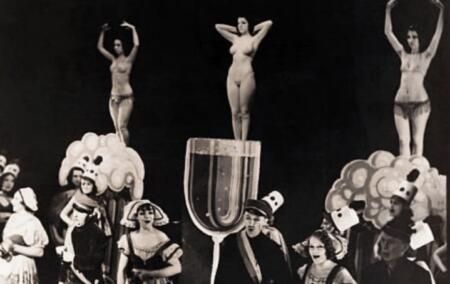
Nor did it take a Weimar burlesque to put the word into politics. In 1913, the pious Prussian house of representatives passed a resolution “against degeneracy in art”.
The “Rot” essay assures us that, “historically and factually”, a “disproportionate vanguard” of Weimar’s cultural revolution was Jewish. The Nazis said the same.
Their 1937 Degenerate Art exhibition was designed to expose a conspiracy of modern art against German decency (though ironically, only six of the 112 artists on show were Jewish).
The word has always been used to condemn risqué art, allegedly sinful lifestyles, so-called sexual deviancy, and the “sick minds” of a decadent society. In other words, it has always been used to judge people exercising their individual freedom to choose how to live their own lives.
Weimar, examined
The “Rot” essay collapses under on its own claims.
If moral licence brought about Hitler, 1928 should have been his year. Those were the Golden Twenties, when Berlin had an estimated 500 erotic venues, and national income rose 25% in three years. The Nazis won 2.6% of the vote.
Then the economy collapsed. By 1932, unemployment was near 30% and industrial production had fallen by almost half. The Nazi vote went to 18.3% in 1930 and to more than 37% in July 1932.
The cabarets predated the rise of the Nazis. Economic hardship coincided with it.
Geography tells a similar story. “Strong resistance [against Nazism] was particularly noticeable in the major cities, especially Berlin,” writes the political geographer John O’Loughlin, of Germany’s most “degenerate” city. The only one of 35 electoral districts to give the Nazis an outright majority was rural Schleswig-Holstein, where public displays of homosexual affection were, one imagines, a less common sight than on Berlin’s Kurfürstendamm.
The Nazis did not derive their support from the disgruntled unemployed, however. Gary King and his colleagues found that they “gave disproportionate support to the Communists”.
It was the working poor – small shopkeepers, domestic employees and family helpers, ruined but not officially unemployed – who gave “the most disproportionate support to the Nazis”.
The Great Depression did much of the rest. Places hit harder by the spending cuts and tax increases of Heinrich Brüning, known as the Hunger Chancellor, gave the Nazis more votes.
Hitler understood this perfectly: “This emergency decree will help my party to victory”, he wrote of Brüning’s last decree.
Hjalmar Schacht put it even better in 1930: “If the German people are going to starve, there are going to be many more Hitlers.” When austerity eased in late 1932, the Nazi vote dipped to 33.1%.
Nazism, then, cannot be attributed to the “degeneracy” of Weimar high society.
Other grievances
The Treaty of Versailles, which is often cited as a catalyst for the rise of Nazism, is more of a rhetorical grievance than a true hardship. It was nine years old when the Nazis won 2.6%, and the Allies had offered to cut reparations by 90% only weeks before the Nazis’ great triumph of July 1932. The humiliation of defeat, however, was real, and Nazi propaganda exploited it relentlessly.
The failure of the institutions of democracy also contributed. From 1930, Germany was governed largely by emergency decree, under a parliamentary system that was barely a decade old.
It would go too far to say moral disgust played no part. The Nazis campaigned on it, and the essay is right that their press relished tales of Weimar decadence. But, as O’Loughlin warns: “Searching for a single explanation… is likely to prove to be a futile endeavor.”
Those who would credit piety with resisting Hitler will find only mixed signals, however. By King’s estimate, 44% of Protestants voted Nazi, against 16% of Catholics. Both were Christians. The Catholics had a party of their own, and a church that offered them, in King’s words, “powerful economic incentives”.
The fascisms of the 1930s were built upon real economic hardship and national humiliation. It isn’t hard to understand why desperate people turned to them. That does not justify them, and it certainly does not make racy literature or erotic theatre responsible.
The pious road to 1914
The essay mourns Wilhelmine Germany – from 1888 to 1918 – as “a society defined by structure, piety, and an organic connection to history”. I’ll grant that it was technologically and industrially advanced, with a high standard of living.
But let’s see how that worked out.
On 2 August 1914, the court preacher Bruno Doehring stood on the steps of the Reichstag and proclaimed that God’s presence led the Kaiser “to take up his sword and call for a crusade and a holy war”.
Nine days later, the Prussian church declared: “The fields are white and ripe for a spiritual harvest”. The war, church leaders hoped, would put an end to what the historian Manfred Gailus calls the “frivolous superficiality of life” induced by too long a peace.
So the pious prescribed war as the cure for decadence. Doehring went on to peddle the stab-in-the-back myth, which claimed the Great War was really lost not on the battlefield, but by the hand of Jewish and communist traitors at home.
Gailus traces “a direct line” from such pastors to the Stahlhelm “and other supporters of the new Nazi Party”.
The “rot”
The “rot”, meanwhile, was well under way. Magnus Hirschfeld, the essay’s chief villain, founded his committee – the very first LGBT rights organisation in history – in 1897, under the Kaiser. The Eulenburg scandal of 1907 to 1909 aired allegations of a homosexual circle around the Kaiser himself. In 1908, the chief of the Military Secretariat died of a heart attack while dancing for Wilhelm II in a woman’s ballet tutu.
As for the Christian soldiers, Mel Gordon records in Voluptuous Panic that the “brutal corralling and rape of foreign women” was reported with some frequency in the early dispatches. The High Command responded by permitting brothels under the supervision of military physicians. “Every frontline soldier was issued a ration book of sex coupons,” with frequency, minutes and class of whore “determined mathematically by rank and combat unit”.
One can accuse them of Prussian efficiency, but not of a great deal of piety.
Libertine youth
In 1661, the moralist Otto Belcampius was appalled by the young women of the Dutch Republic. They were “Jezebels” who exposed themselves shamelessly. “How horrifying! What a disfigured and wicked beauty, begot in hell.”
“Most likely,” write the historians Benjamin Roberts and Leendert Groenendijk, “the only nudity these women were guilty of was wearing sleeves shortened to the elbow.”
In 1648, the Dutch Republic was the richest country in the world. It was also, in the eyes of its Calvinist ministers, going to hell. They blamed the flood of 1651, the war with England, the recession of the 1650s, the loss of Brazil and the plague of 1665 on the vanity, dancing, drinking and fornication of the young.
These accusations “were, however, misplaced”, Roberts and Groenendijk wrote with the deadpan earnestness of Dutch humour. The young, they argued, were doing what young people had always done.
“For ministers and moralists, the youth were a scapegoat.” The real targets were the town councils, which kept to a policy of laissez-faire, feared the “new popery” of the church, and declined to turn the Republic into a theocratic “Dutch Israel”.
The ministers, incidentally, were not all moral exemplars themselves. In Friesland, “the most common sin of ministers was drunkenness”.
Nor was the blame game new. A century earlier, Catholics had called the great flood of 1570 God’s punishment of the Protestant revolt. More likely is that it was punishment for building below the level of God’s sea.
Yet for all the “degeneracy” of the era, it saw the emergence of a distinct libertine culture, particularly among the youth in the 1650s and 1660s. Many embraced secularism, free thought, and challenges to traditional moral codes. Thinkers like René Descartes and Baruch Spinoza operated freely in the Dutch Republic, publishing ideas that were censored elsewhere, while society itself enjoyed high degrees of personal, societal, and religious liberty, despite the presence of a strict Calvinist public church.
It was indeed a Golden Age, but let me not oversell it. The Republic’s freedom had limits. Adriaan Koerbagh died in prison in 1669, convicted of blasphemy. Utrecht banned dancing outright in 1651. After France invaded in 1672, a mob lynched the De Witt brothers, inflamed by propaganda that painted them as corrupt, immoral elitists, and the severest prosecution of prostitution followed as Calvinist influence peaked.
But note the order: social liberalism brought a flowering of intellectual vigour and commercial prosperity. Disasters, both natural and economic, brought the moral reaction. Moral laxity did not cause the disasters.
Puritans and plum pudding
England tried the opposite experiment. In 1647, the Puritans cancelled Christmas. In Canterbury, a mob threw the mayor to the ground, covered him in mud, and started a game of football with inflated pig bladders. Kent’s grand jury refused to indict the rioters.
Enforced piety produced populist disorder. Its collapse produced the court of the gloriously dissolute Earl of Rochester and, in 1660, the Royal Society. It did not produce a tyrant.
Backlash is real, of course. The Ku Klux Klan flourished in 1920s America as a moral force, but it did so by allying itself with Prohibition. The moralists already had the law on their side.
The Dutch, three centuries on
Let’s consider a more recent social experiment.
Before 1960, the Netherlands was “one of the more conservative European states”, with Christian parties in every government. Then, within a decade, it turned into the “Rot” essay’s worst libertine nightmare.
In 1965, 70% of the Dutch thought a girl should remain a virgin until marriage. By 1975, only 21% did. The share of girls aged 16 to 20 who had had intercourse went from 19% in 1968 to 42% in 1974. Pornographic magazines proliferated, and “conservative groups protested but were eventually drowned by the erotic flood”.
Article 248bis, which set the age of consent for gay sex at 21, against 16 for heterosexuals, was repealed in 1971. The novelist Gerard Reve, who published a fantasy of making love to God in the form of a donkey, was found not guilty of blasphemy by the Supreme Court. Koerbagh, three centuries earlier, had died in jail for a good deal less.
There were no outside corrupters to blame. Religious morality, by one account, “was removed and spectacularly so by the Christians themselves”.
So where was the Dutch Hitler? The Dutch Trump? He never came.
Neither did another one come to West Germany, which largely stopped criminalising homosexuality in 1969, less than 25 years after the fall of the actual Nazis.
Some will say the backlash merely took its time, and that today’s populism is a reaction to excesses that began in the 1960s and peaked in the late 1980s and 1990s.
But a correction that arrives half a century late is a strange kind of inevitability. Today’s populists, moreover, have largely created their alleged crises out of whole cloth.
The Dutch populist revolt, when it finally came, was led by Pim Fortuyn, an openly gay man who defended Dutch sexual freedom against Islam. So much for the “immune system”.
What repression hides
To be fair, the relationship between licence and prosperity is not universal. Victorian Britain and Franco’s Spain were repressive, and both grew rich. Piety and prosperity can coexist.
What piety cannot do is prevent the vice it denounces. It merely drives it underground, and makes hypocrites of the respectable.
In 1885, W.T. Stead wrote in “The Maiden Tribute of Modern Babylon” that Queen Victoria’s capital had become “a resurrected and magnified City of the Plain”, with prostitutes “probably not much below 50,000 strong”.
Police estimates were far lower, either because the establishment’s numbers run low, or moralists’ numbers run high, or both. But his campaign against child prostitution shook Parliament, which raised the age of consent from 13 to 16 and, for good measure, criminalised “gross indecency” between men.
Meanwhile, The Pearl, a pornographic monthly aimed at middle- and upper-class professionals, could be bought discreetly by mail order for the princely sum of £25, while the Cleveland Street scandal of 1889 came uncomfortably close to the royal family itself.
Franco’s Catholic Spain was no different. In 1941, the regime decriminalised and regulated prostitution, while Franco’s wife presided over the body meant to eliminate it. Its 1943 report found “notorious debauchery in the upper class of society”.
Barcelona became what one historian calls “the gay capital of the State”, with only six raids on record in the court files he examined from 1956 to 1980. Coaches carried “sex pilgrims” over the border to Perpignan to see Last Tango in Paris, and the zealous customs men who seized their erotica helped to create a black market in it.
As for Spain’s prosperity, it began when technocrats abandoned autarky in 1959 and liberalised trade. Economic freedom delivered growth. The piety was coincidental.
South Africans need no lessons in the futility of moralistic repression. Closing liquor stores on Sunday never stopped drinking around the braai. The apartheid censors took the entire Beatles catalogue off the air over John Lennon’s supposed blasphemy, and yet we all had Beatles albums. Scope magazine was easily available, and its circulation came to depend on regular bannings, with the editor inventing ever-more-ingenious schemes to circumvent censorship laws.
From the Shah to the Ayatollah
Iran ran the experiment in the other direction.
The Shah was corrupt and brutal. But in the three decades before the 1979 revolution, real income per head rose 3.2 times. In the four decades after it, income merely doubled. In 1980, Iranians were richer than Turks and South Koreans. By 2018, they were far poorer than both.
The clerics had railed against moral decline and the decadence of the Shah’s court. Their real allies were corruption, unemployment and repression. Expropriation and sanctions have cost Iran dearly since, but imposed morality has a cost of its own: female labour participation is a mere 17%, thanks to discriminatory laws, and the International Monetary Fund calculates that gender equality in Iran would boost GDP by about 40%.
The long-run cost is also on view in Spain. Using more than 67,000 Inquisition trials, economic historians have shown that the municipalities it persecuted hardest have lower incomes, less education and less trust to this day. They also go to church more.
The authors stop short of claiming strict causation, but note that those places were not poor or especially religious to begin with. “Nobody expects the Spanish Inquisition to still matter today,” they write, “but it does.”
Sound institutions
The 2024 Nobel Prize in economics went to scholars who showed that “societies with a poor rule of law and institutions that exploit the population do not generate growth or change for the better”. The 2025 prize recognised, among others, Joel Mokyr, who stressed “the importance of society being open to new ideas and allowing change”.
That is the lesson of every case above. The Dutch Republic thrived while its magistrates kept the preachers out of government. Weimar’s scientists, painters and filmmakers flourished, and nine Germans won Nobel prizes; all that died when its institutions did. Iran’s clerics captured the institutions, and stagnation followed.
None of this is an attack on faith. One can certainly be both classically liberal and religious. The trouble starts with recruiting the state in service of religious morality.
The success of a civilisation depends far more on sound institutions, economic freedom and the rule of law, than on pious moral codes.
People will always drink, dance, dress provocatively and sleep with those of whom their parents or pastors disapprove. They did so under the Kaiser, under Cromwell, under Queen Victoria and under Franco.
Civilisation survived them all – and more, it thrived.
One simply cannot make a consistent argument that so-called “degeneracy” – to use the needlessly judgemental term of the alt-right – corrodes civilisation or justifies giving power to a moral authoritarian.
History contradicts the theory that “degeneracy” leads inevitably to fascism, war or economic collapse.
What history does show, however, is that the sorts of people who go on about “degeneracy” have a remarkable talent for delivering all three.
[Image: A burlesque cabaret in Weimar Berlin in the late 1920s. Public domain photo]
The views of the writer are not necessarily the views of the Daily Friend or the IRR.
If you like what you have just read, support the Daily Friend