


BERLIN: There’s no better way to experience Berlin than to heed the advice from Karl Baedeker’s definitive 1904 guidebook and “walk the Linden.”
This magnificent main boulevard, stretching about a mile east from the Brandenburg Gate, is an illustrated history of Berlin’s and Germany’s commitment to art, music and architecture.
This is not the Berlin of Hitler or the East German Communists but of Frederick the Great, Prussia’s greatest king, whose passion for music and learning transformed an uninspiring town on the north German plain into a great city.
Unter den Linden (“under the linden trees”) was designed in the 18th Century as a grander, Prussian answer to Paris’s Champs Elysees. From the monumental Brandenburg Gate, the Linden sweeps east past ornate palaces, churches and theaters to the Spree River, where it was crowned by the mammoth palace of the Prussian kings.
When I was visiting a hospitalized friend in Berlin in early November, I paused about half way along the Linden and recorded a two-minute video of what the boulevard was like during my first visit in 1988 before the infamous Wall came down, which includes a story that tells you something important about the difference between East and West.
The imperial palace, older and larger than London’s Buckingham Palace, was massively damaged in World War II. East Germany’s Communist rulers bulldozed its remains from the equivalent of two square blocks in the early 1950s.
After much debate German lawmakers voted in 2002 to rebuild the schloss, which is now the Humboldt Forum, a cultural center, museum and exhibition complex.
A five minute-walk from the Brandenburg Gate is the refurbished Reichstag, home to the German parliament. The building was rebuilt by legendary British architect Norman Foster.
Its centerpiece is the transparent dome accessible to visitors via a ramp that spirals upwards to the viewing area at the top.
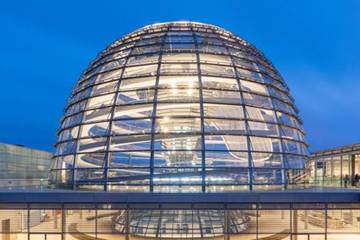
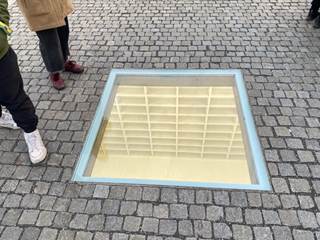
At Bebelplatz adjacent to the Linden’s famous opera house is a window into Germany’s Nazi past.
It was here in May 1933 that fanatical students incinerated 20,000 books written by Jews and perceived anti-Aryan writers in a massive bonfire. The understated memorial consists of a plate glass window through which visitors look down on empty shelves where “dangerous” volumes might have been.
[Image: Barry D Wood)
For three centuries Berlin has been the biggest city between Paris and Moscow.
Arguably its Unter den Linden remains the grandest boulevard in Europe, perhaps the grandest in the world.
The views of the writer are not necessarily the views of the Daily Friend or the IRR.
If you like what you have just read, support the Daily Friend