

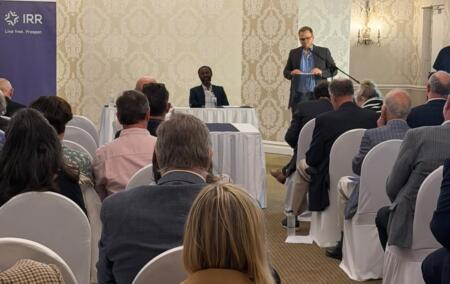
The main opinion piece today is Professor William Gumede’s 47th Alfred and Winifred Hoernlé Memorial Lecture – the IRR’s flagship public lecture – on the topic, “The Future We Share: A New Approach to Transformation”.
The following combines the reflections of master of ceremonies at last evening’s event, IRR Head of Strategic Communications Hermann Pretorius, and the vote of thanks by former IRR staffer and liberal stalwart Paul Pereira.
Pretorius began by noting that the Hoernlé Memorial Lecture series, launched in 1945, “has become one of the longest-standing traditions of public discussion in South Africa”, and also drawing attendees’ attention to a booklet on their seats by David Christianson “recording the history of the Institute of Race Relations’ bursary programme”.
(Professor Gumede prefaced his lecture by saying he himself had been a beneficiary of IRR bursary funding that had made all the difference to his life’s trajectory.)
Pretorius said: “It is the story of an undertaking that, over many decades, opened educational opportunities to thousands of South Africans, often in circumstances of considerable difficulty. Among the beneficiaries of the IRR’s historic commitment to opening doors of opportunities through funding was one Nelson Rolihlahla Mandela.
“As I understand it, he might still owe us a few pounds. But I suppose there is some benefit to be able to say Nelson Mandela is in your debt.”
Turning to an earlier period of history, Pretorius went on:
Ladies and gentlemen, the first Hoernlé Memorial Lecture was delivered in 1945 by Jan Hofmeyr, who had served as Deputy Prime Minister, Minister of Finance, Minister of Education, and for long periods of the Second World War stood in for the then-prime minister General Smuts when Smuts was in Britain and North Africa.
Hofmeyr was also the nephew of the historic Onze Jan, leader of the first Afrikaner political party in the country – the party was Bond, Afrikaner Bond. Yet, the younger Hofmeyr, a proud Afrikaner himself, came to occupy a remarkable place in the history of liberalism in South Africa.
The title of his inaugural lecture in the series we continue here this evening was “Christian Principles and Race Problems”. And it would be no exaggeration to say that that first lecture on a topic of such importance by a speaker of such standing, set the standard for subsequent addresses.
This lecture series commemorates Alfred and Winifred Hoernlé, two figures who devoted much of their lives to examining and understanding the relations between South Africa’s different communities and the principles upon which a free and just society might be built.
Over the ensuing eight decades, this platform has been occupied by people as varied as Archbishop Denis Hurley, Alan Paton, and Mangosuthu Buthelezi.
Our speaker this evening, more about him in a moment, is appropriately now to become the newest member of a club of extraordinary people who’s contributions to thought, policy, and politics in South Africa have defined the route through history that has brought us to where we are today as a country – and a country, at that, with an almost miraculously sustained liberal tradition.
And a key part of this tradition is that we can gather here this evening and hear ideas those in power might not approve of.
That is no small liberty.
And those liberals who’ve gone before us, some of whom spoke hopeful and uncomfortable truths from this platform that is the Hoernlé Memorial Lecture, have made it possible to address the pressing questions.
Many of the questions they addressed remain familiar to us. Others belong to political circumstances that have long since disappeared.
There is, however, an earlier occasion in the Institute’s history that I think deserves recalling tonight.
On 21 January 1942, three years before the first Hoernlé Lecture, Prime Minister Jan Smuts addressed a conference of the Institute of Race Relations in Cape Town.
South Africa was at war. The political and social order of the country rested upon a system of racial separation that had been established and defended over many decades.
And yet, before that IRR audience, Smuts made an extraordinary admission.
“Isolation has gone,” he said, “and I am afraid that segregation has fallen upon evil days too.”
Now, Smuts had certainly not become an advocate of racial equality. While he did instigated the Fagan Commission into the Pass Laws, his government continued to enforce discriminatory laws, and six years later the National Party would come to power and embark upon an even more extensive programme of racial separation.
But consider the significance of those words.
A sitting prime minister, speaking about a policy upon which so much of South African public life had been built, was acknowledging that the circumstances of the country had changed and that the old arrangements were becoming increasingly difficult to sustain.
That was eighty-four years ago.
I mention it tonight because South Africa may once again be approaching a period in which some of the settled assumptions of our politics are open to reconsideration.
In 2024, the African National Congress lost its parliamentary majority for the first time. Just two weeks ago, in the municipal elections of 4 November, it received less than a third of the national vote. Across the country, parties are now negotiating arrangements for governing municipalities in which none can command a majority alone.
We are living through political changes that would have seemed improbable only a few years ago.
What these changes will produce is still uncertain. Political change does not, by itself, guarantee better government or wiser policy. But it does create opportunities to reconsider arrangements that once appeared permanent.
And perhaps that brings us to a question particularly appropriate for tonight.
For more than three decades, transformation has occupied a central place in South Africa’s public life. It has informed legislation, government policy, economic arrangements, and much of our political debate.
Its objectives, its methods, its achievements, and its shortcomings remain subjects of vigorous disagreement.
But might we now be approaching a point at which transformation, at least as we have come to know and practise it, has fallen in evil days.
And if so, what might take its place?
I can think of few people better placed to help us examine these questions than Professor William Gumede.
Professor Gumede is an associate professor at the Wits School of Governance, the founder and executive chairperson of the Democracy Works Foundation, and a widely published author and political commentator.
His work has taken him from journalism and political analysis to the practical business of democratic negotiation. He chaired the negotiations that brought together opposition parties in the Multi-Party Charter ahead of the 2024 general election.
His books include Thabo Mbeki and the Battle for the Soul of the ANC and Restless Nation: Making Sense of Troubled Times.
He has also played a prominent role in the recent debate about transformation policies, particularly black economic empowerment. Professor Gumede has argued that, since 1994, more than R1 trillion has moved through BEE transactions involving fewer than 100 politically connected beneficiaries, including individuals, companies, trusts, and other entities, with very little of that wealth trickling down to ordinary South Africans. It is a claim that has provoked considerable public debate and raised difficult questions about the effectiveness of policies intended to achieve broad-based economic empowerment.
He brings to tonight’s subject an understanding of South Africa’s political history, its institutions, and the difficult business of making change possible.
In his vote of thanks, Paul Pereira said:
I should like to point to some things that struck in an overall insightful, original, and useful analysis. I was particularly taken by Professor Gumede’s discussion of:
We have choices in how we approach transformation. This should be inclusive, a non-racial extension of reach without losing focus on the least well-off in opportunity and thus assets, both physical and otherwise.
This insight speaks directly to Institute learning of almost 100 years now.
Professor Gumede canvassed much more than that, of course.
Importantly, the consequences of BEE included the misallocation of scarce capital with unintended opportunity costs.
Then:
- Wrongly equating the habit of conflating current BEE policy with transformation; and
- The political trick, not only here, of portraying BEE policy and its cousins as a part of black identity itself.
In the shifting undercurrents of South Africa’s current political discourse, tonight’s talk is original, and relevant.
I commend Professor Gumede for sharing his carefully deep thinking; and the Institute for giving us this opportunity to absorb it, reflect, and discuss.
We have a lot to mull on.
[Image: Professor Gumede and Hermann Pretorius. John Endres]