

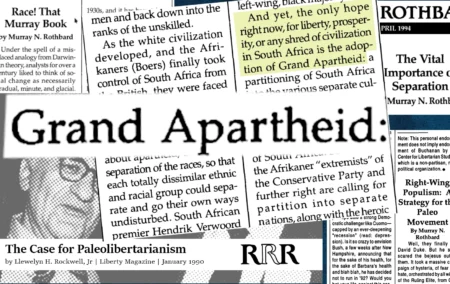
With paleo-libertarianism – I show in this second of a four-part essay – Murray Rothbard and Lew Rockwell created a branch that imbibed racism right from the source.
In part one of this series, I set out the charge that left-wing critics such as Quinn Slobodian, Benjamin Fogel and Jack Graham lay against libertarianism: that racism runs through it from root to branch.
In this four-part series, I argue that it runs through only one branch: the paleo-libertarianism of Murray Rothbard, Lew Rockwell, Ron Paul and Hans-Hermann Hoppe.
Before I defend the rest of libertarianism, the evidence for the prosecution deserves to be weighed. And against paleo-libertarianism, the left-wing accusation holds up disturbingly well. The most damning evidence comes from the words of the paleo protagonists themselves.
Rothbard’s mellow middle age
Murray Rothbard (1926–1995) was an economist of the Austrian School, and a central figure of the 20th century libertarian movement. He was a leading light of anarcho-capitalism, which considers all state power to be illegitimate.
Rothbard was not always consistent with regard to race. Melinda Cooper, an Australian sociologist and political theorist who makes a similar argument to that of Slobodian, talks of his “volatile political trajectory”.
In the September–December 1980 issue of his Libertarian Forum newsletter, which came out when Rothbard was 54, he tore into the Libertarian Party’s presidential candidate, Ed Clark. Clark wanted more Mexican immigration, but not free immigration while the welfare state existed.
Rothbard called this “probably the greatest (or perhaps the second greatest) single scandal” of the campaign, because it “betrayed the libertarian principle of free and open immigration”. Undocumented Mexicans, he wrote, “have proved themselves to be among the most productive, hard-working members of society. Clark kicks them in the teeth, and unjustly”.
In 1985, he opposed sanctions against South Africa, arguing that disinvestment would make matters worse for black workers.
Rothbard wrote: “I yield to no one in my abhorrence of the apartheid system.” He argued that “Free-market capitalism is a marvelous antidote for racism”, and that “It is only when the State steps in that the government can socialize the costs of racism and establish an apartheid system.”
(For the record: the Institute of Race Relations was sympathetic to this view. In 1988, its then-president, Stanley Mogoba, published Sanctions and the Alternatives, co-authored with former IRR CEO John Kane-Berman and Ronnie Bethlehem, chief economist at Johannesburg Consolidated Investment Company Limited. The book argued that the decades-long boycott had delivered its message, and that further use of the stick of sanctions would be an empty moral gesture, impose severe hardship on black South Africans, and be less effective than negotiations and the positive reinforcement of foreign investment.)
It seems clear that in the first half of the 1980s, a middle-aged Rothbard was opposed to apartheid, not prejudiced against Hispanics, and in favour of free immigration.
The younger Rothbard
But he also had other positions, both before and after his middle age.
In “Life in the Old Right”, a memoir published in Chronicles in 1994, Rothbard recalled that in 1948 he “embraced the new states’ rights or ‘Dixiecrat’ ticket of Strom Thurmond” (a Jim Crow-era segregationist) and “founded a Students for Thurmond group” at Columbia. Of his favourite congressmen, he wrote: “I remember being disappointed that once in a while they might deviate by favoring a federal anti-lynching bill; did they not know that the federal government is not supposed to have any police powers?”
He wrote that without apology. If he appeared to turn non-racist in his middle age, he didn’t start out that way as a young man.
Rothbard with Rockwell
By his sixties, Rothbard had shifted once again. With Llewellyn “Lew” Rockwell, who co-founded the Ludwig von Mises Institute, he broke with the Libertarian Party (LP), and in 1990 the pair launched the Rothbard-Rockwell Report, to build a coalition with the “paleo-conservatives” of the populist right, as Reason reported in 2008.
Rockwell made “The Case for Paleolibertarianism” in 1990, declaring the LP “probably irreformable” and “irrelevant” because it embraced “counter-cultural beliefs” and “cultural anti-norms” that he personally found “abhorrent” and that put the public off too.
“We will continue to be seen as a sect that ‘resists authority’ and not just statism, that endorses the behaviors it would legalize, and that rejects the standards of Western civilization,” he wrote. “Arguments against the drug war, no matter how intellectually compelling, are undermined when they come from the party of the stoned. When the LP nominates a prostitute [Norma Jean Almodovar] for lieutenant governor of California and she becomes a much-admired LP celebrity, how can regular Americans help but think that libertarianism is hostile to social norms, or that legalization of such acts as prostitution means moral approval? There could be no more politically suicidal or morally fallacious connection, but the LP has forged it.”
Instead, he wanted to restore “the old libertarianism” that, while rejecting state authority, embraced the social authority of family, church and community norms. He wanted it to preserve and defend “Western culture”, and uphold “objective standards of morality, especially as found in the Judeo-Christian tradition, as essential to the free and civilized social order”.
It is a manifesto that is recognisably anti-modern, anti-liberal, religious-conservative, and what we today would call anti-woke and alt-right.
In it, he wrote: “State-enforced segregation, which also violated property rights, was wrong, but so is State-enforced integration. State enforced segregation was not wrong because separateness is wrong, however.”
He continues: “Wishing to associate with members of one’s own race, nationality, religion, class, sex, or even political party is a natural and normal human impulse. … When the State abolishes the right of free association, it creates not social peace but discord.”
Rockwell even offered a model. A woman he knew had lived in “an Italian working-class enclave surrounded by Cleveland’s slums”, where, thanks to private surveillance, anyone who committed a crime was “almost always caught. But the perpetrator was seldom turned over to the police.” The criminal, he wrote, “was punished on the spot, and as a result, there was almost no crime in this neighborhood.”
It was “hardly an ideal system”, Rockwell admitted, but “it was rough justice and eminently libertarian” (my emphasis). He added: “Yet many libertarians would oppose such a system – even though it was a response to State failure – because the criminals were black. Paleolibertarians have no such reservation.”
So he was against racism, but only on the part of the State. He had no qualms at all about replicating its effects using only private means. (And lest we gloss over this point: “many libertarians” would oppose such a system regardless of the race of the criminals.)
“Outreach to the Rednecks”
Rothbard, like Rockwell, was fed up with the unpopularity of the mainstream of libertarianism, and in 1992 wrote “Right-Wing Populism: A Strategy for the Paleo Movement”.
He mourned white supremacist David Duke’s defeat in the race for governor of Louisiana. “If it was OK to be a Commie, or a Weatherman, or whatever in your wild youth, why isn’t it OK to have been a Klansman?” he asked. There was “nothing in Duke’s current program that could not also be embraced by paleo-conservatives or paleo-libertarians”.
Rothbard’s own programme included abolishing “the entire ‘civil rights’ structure, which tramples on the property rights of every American”. Cops “must be unleashed, and allowed to administer instant punishment”. They should “clear the streets of bums and vagrants. Where will they go? Who cares?”
He sneered at the libertarian circle around Cato, for supporting “‘anti-discrimination’ laws that trample on the rights of private property”. He called his plan “a strategy of Outreach to the Rednecks”, and held up Joe McCarthy’s disdain for the power elite and direct populist appeal as its model.
The January 1992 issue of the Rothbard-Rockwell Report endorsed arch-conservative Patrick Buchanan (not to be confused with libertarian economist James Buchanan) as “our leader”. Pat Buchanan was (and still is) a protectionist opposed to outsourcing, and an anti-immigration populist, and is now widely viewed as the godfather of the woke right that birthed the MAGA movement.
The paleo branch of the libertarian schism, in search of broader electoral appeal, had unapologetically chosen an alliance with the far right.
Grand Apartheid
By 1994, Rothbard believed he had a solution to the South African question.
In “The Vital Importance of Separation”, Rothbard wrote: “Beyond a small quantity, national heterogeneity simply does not work”.
Weeks before South Africa’s first democratic election, he prescribed “Grand Apartheid: a partitioning of South Africa into the various separate cultural and ethnic groups: not just cantonization, but separate sovereign nations”.
He wanted to revive the plan of “Hendrik Verwoord [sic]”, which (had he not been “mysteriously assassinated – naturally by a ‘lone nut’”), “would have ended the pattern of racial domination” by finally separating the races – as opposed to the “Petit Apartheid” of the “moderates”, which resulted in non-white races being oppressed by the white government.
It was the domination by the state to which Rothbard objected. In his view, that domination would end once the races were separated, each responsible for their own affairs.
The ANC, he claimed, wanted “a unitary nation so they can loot and plunder the successful white minority”. And he asked, innocently: “Why is it ‘racist’ to want to be left alone?”
But South Africans know what Grand Apartheid meant in practice. There was no clean way to partition the country in 1961. There was no clean way to do it in 1994, either.
However equitably distributed the land might have been, a separation of South Africa’s “nations” would have involved bantustans, pass books and forced removals on an epic scale.
Imagine the partition of India, but instead of separating Hindus and Muslims, separating four or more different races and tribes. In India, up to two million people died, and up to 20 million were displaced.
In pursuit of realising the right to be “left alone”, a great number of people would not have been left alone, and would have had to be dispossessed and evicted by a coercive state to the racially pure “nation” where their skin-colour dictated they belonged.
The Bell Curve
In December 1994, weeks before he died, Rothbard wrote a glowing review of the book that revived the fortunes of scientific racism and “racial hygiene”, The Bell Curve, under the headline “Race! That Murray Book”.
Racial differences in intelligence, he wrote, were “almost self-evident truths” that “everyone, and I mean everyone, knew in their hearts”, until “Communist anthropologist Franz Boas” drove them out of the public square. He called Philippe Rushton, who went on to head the eugenicist Pioneer Fund, “a heroic professor”, and claimed “there were too few blacks residing in Europe for the Nazis to bother about”.
He ended: “racialist science is properly not an act of aggression or a cover for oppression of one group over another, but, on the contrary, an operation in defense of private property against assaults by aggressors.”
He turned his (legitimate) opposition to the redistributionist economics of the left into a narrative of white victims bravely defending their property against pillaging black thieves and welfare leeches.
His defenders say he is quoted out of context. A 2019 blog post argues that race and IQ were in “the mainstream of debate” in 1994, and quotes the passage in which Rothbard clears his side: “Paleos want Big Government off all of our backs, be we smart or dumb, black, brown or white.” It is liberals and neocons, he argued, who deserve “the statist-racist-fascist label”, because they use race science to decide whom to subsidise and control.
That is fair, as far as it goes: equal rights do not depend on equal IQs. Rothbard’s alibi is that paleos want no state to act on race, but that private discrimination on private property is a matter of personal freedom.
Yet eight months earlier, he had demanded “separate sovereign nations” drawn along ethnic and racial lines in South Africa. A sovereign nation is a state. A state whose borders are drawn by race, and which admits or excludes people by race, is the state acting on race, on the largest possible scale.
Rothbard did not have an opportunity to resolve that contradiction before he died in 1995 at the age of 68. He never got to explain exactly how he proposed – without relying upon the coercive power of the state – to separate a mixed population into racially homogeneous, geographically separated “nations”.
Ghostwriters and gatekeepers
The same paleo-libertarian ideas reached a mass audience through newsletters published for years under Ron Paul’s name. And those newsletters were a cesspool of racial bigotry.
When Ron Paul ran for president in 2008, he denied writing the offending items, and declared himself unaware of their contents. Though it seems implausible that he would not have known of the content of newsletters published under his name for so many years, David Boaz, of the Cato Institute, took him at his word.
The Ron Paul Investment Letter listed Lew Rockwell as a contributing editor in 1987 and as its editor in 1988, and Reason found half a dozen movement veterans who named him as Paul’s chief ghostwriter.
Rockwell, for his part, has denied responsibility for the newsletters’ contents, and twice declined to discuss the matter with Reason.
So, nobody will take responsibility for the incendiary items that ran under Paul’s name from roughly 1989 to 1994: the years of the paleo-libertarian strategy.
These newsletters cited Jared Taylor, who went on to found the white supremacist magazine American Renaissance (link withheld because I won’t send them traffic). They worried about America’s “disappearing white majority”. They portrayed South Africa’s transition to democracy as a “destruction of civilization”, and in March 1994 warned of a “South African Holocaust”.
Reason’s verdict was adroit: “Ron Paul may not be a racist, but he became complicit in a strategy of pandering to racists.”
Passing the baton
Hoppe took the baton from Rothbard and ran with it. In a 1996 memo, “From Nation to Household”, he wrote that America “was – and should be – a white-European-Christian-male dominated civilization”.
Towns should post signs: “no beggars, bums, homeless, but also no Moslems, Jews, Catholics, Blacks, Chinese, Mexicans, etc.” By the time this line reached his book, Democracy: The God That Failed (2001), the list read “no homosexuals, drug users, Jews, Moslems, Germans, or Zulus”.
Who exactly he hated changed. The method – replace state-sponsored discrimination with private discrimination – did not. In the same chapter, he dismisses mainstream libertarians like Cato and the Institute for Justice as “left libertarians”, and says “true libertarians must embrace discrimination”.
Uniting the right
Hoppe’s Property and Freedom Society has hosted Jared Taylor, who calls himself a “race realist”, Peter Brimelow, who lost a defamation suit against the New York Times over being called a “white nationalist”, and the late Richard Lynn, who was openly racist. In 2010, Slobodian records, the neo-Nazi Richard Spencer gave its lead-off speech, on “the alternative Right in America”.
Spencer, who claims to have coined the term “alt-right”, later told Reason’s Nick Gillespie that Ron Paul had activated him into politics.
The ill-fated Unite the Right rally in Charlottesville in 2017 attracted alt-rightists, neo-Confederates, neo-fascists, white supremacists, neo-Nazis, and far-right militias. Among the Confederate battle flags and Nazi flags flew Gadsden flags depicting a coiled rattlesnake over the words “Dont Tread on Me [sic]”, a banner widely adopted by right-libertarians. Two prominent attendees, Mike Enoch and Christopher Cantwell, came from libertarian circles. Cantwell borrowed Hoppe’s talk of “physical removal”.
In 2022, the pro-Trump, paleo-libertarian Mises Caucus won 17 of 17 seats at the US Libertarian Party’s convention, and removed “we condemn bigotry as irrational and repugnant” from its platform (although party elders saved a compromise version).
From Mises to Carlyle
The road to MAGA and the new right runs through Curtis Yarvin, an influential political blogger under the nom de plume Mencius Moldbug, who, along with accelerationist philosopher Nick Land, founded the Dark Enlightenment philosophical movement that animates the alt-right.
Its followers call it neoreaction, or NRx. New York magazine described its main strain as “a form of post-libertarian futurism that, realizing that libertarians aren’t likely to win any elections, argues against democracy in favor of authoritarian forms of government”.
It rejects Enlightenment values such as non-racism, cosmopolitanism, human rights, religious tolerance, and constitutional democracy.
Instead, it holds that freedom and democracy are incompatible. In place of the democratic state, it wants authoritarian capitalist city-states that compete for citizens: in the words of the academic Jonathan Ratcliffe, “a network of hyper-capitalist city states ruled by authoritarian CEO monarchs”.
It calls the institutions of liberal society “the Cathedral”, because they enforce political correctness like a state religion. And it endorses scientific racism, under the euphemism “human biodiversity”, or, in Land’s cacophemism, “hyper-racism”. Several journalists and academics describe it as neo-fascist.
In a 2010 post, “From Mises to Carlyle: My Sick Journey to the Dark Side of the Force”, Yarvin wrote: “before I became a royalist or a Carlylean or whatever, I was a libertarian. Specifically, a Misesian.”
Thomas Carlyle was an influential Scottish historian, philosopher, white supremacist and anti-semite of the 19th century.
Hoppe, Yarvin said, was “a very easy means by which a Misesian can go past libertarianism”.
Yarvin’s own answer to crime was a “savage police crackdown”, in which “preventive-detention facilities will spring up like puffballs” and “some innocent heads will be cracked”. That, he wrote, was “the Rothbard of the Rothbard-Rockwell Report, somewhat exaggerated but not absurdly so” – referring to the Rothbard who wanted cops “unleashed”.
Yarvin is “often cited as the ‘house philosopher’ of the New Right”, and JD Vance calls him a friend.
Three decades after his death, Rothbard’s “Outreach to the Rednecks” found its way into the White House after all.
The dark side
I hope I have convinced you of the dark side of libertarianism.
Four decades after the young Rothbard regretted congressional support for an anti-lynching bill, Rockwell was praising the punishment of black suspects, on the spot and without trial, as “eminently libertarian”.
Among some libertarians and their intellectual progeny in the alt-right, racism is an unremarkable, deeply held and even celebrated conviction.
I make no excuses for it; in fact, I condemn it out of hand as a morally repugnant belief. But it involves one branch, which broke away on purpose and painstakingly documented its reasons. It is not the whole tree.
Contrary to the accusation from the left, the racism that Rothbard introduced wasn’t always latent in libertarianism. He imported it from outside the Austrian School. And the classical liberal tradition, on which the paleos walked out, rejected their racism, in some cases long before they voiced it. That is the subject of part three.
[Image: The Rothbard-Rockwell Report was the epicentre of paleo-libertarianism, a distinctly racist offshoot of the mainstream libertarian tradition. Illustration by the author]
The views of the writer are not necessarily the views of the Daily Friend or the IRR.
If you like what you have just read, support the Daily Friend